
This guide is comparing MIE Trak Pro vs EZIIL to shed some light on which one is the best option for a small custom steel fabricator. It is not written for generic manufacturers, high-volume production plants, or companies looking for the broadest possible manufacturing ERP just because it has the longest feature list. It is written for smaller, project-based fabrication shops that need better control over quoting, production scheduling, shop floor tracking, and project execution without taking on more software than they can realistically adopt and manage.
MIE Trak Pro vs EZIIL at a glance
At a high level, MIE Trak Pro and EZIIL solve some of the same operational problems, but they are not trying to be the same kind of product. MIE Trak Pro software is better understood as a broader job shop ERP or manufacturing ERP with deeper quote to cash and back-office coverage. EZIIL is a more focused custom steel fabrication software option built for smaller, project-based shops that want faster adoption, simpler production scheduling, and clearer day-to-day visibility on the floor.
| MIE Trak Pro | EZIIL | |
|---|---|---|
| Best fit | Better fit for shops that want a broader MIE Trak Pro ERP with quoting, purchasing, inventory, reporting, accounting, and deeper operational coverage in one system. | Better fit for small custom steel fabricators that want a simpler operating system for planning, tracking, and delivering jobs without taking on a full ERP rollout and price tag. |
| Type of buyer it suits best | Teams that are looking for a larger metal fabrication software stack and are comfortable with more setup, process definition, and admin ownership. | Teams that need practical control fast and want software that matches how a smaller fab shop actually works day to day. |
| Onboarding and time to value | Typically a heavier lift because the platform covers more functions and usually requires more implementation effort, training, and process mapping. | Typically easier to adopt for smaller teams that want to get live quickly and improve visibility without a long software project. |
| Production scheduling | Strong option for buyers who want more advanced scheduling depth and a more traditional ERP-style MIE Trak Pro schedule approach. | Strong option for buyers who want visual, easier-to-follow scheduling that helps keep departments aligned without extra complexity. |
| Shop floor tracking | Covers shop-floor reporting and kiosk-style workflows well, especially for shops that want detailed operational tracking inside a larger ERP environment. | Strong for simpler, clearer shop floor tracking that helps teams see progress, bottlenecks, and status updates without adding too much admin work. |
| Accounting and back-office depth | Clear advantage if built-in accounting and broader business process coverage matter. This is one of the main reasons a buyer chooses MIE Trak Pro over a lighter tool. | Better for teams that do not need a deep all-in-one accounting-heavy ERP and would rather keep the operational side easier to manage. |
| Ease of use for smaller teams | Powerful, but may feel broader and more admin-heavy than some small shops really need. This is a common theme behind many MIE Trak Pro reviews. | Easier fit for leaner teams that do not have a dedicated ERP owner and need software people will actually use consistently. |
| Pricing and buying commitment | Pricing not disclosed publicly. MIE Trak Pro pricing tends to sit in the category of a more involved ERP purchase, where buyers should expect broader implementation considerations, not just a simple monthly tool decision. | Subscription-based modular pricing model starting from €120/month, add modules if and when needed. Better fit for buyers who want lower upfront risk, a more straightforward path to adoption, and less chance of overbuying. |
| What tends to tip the scales | Choose MIE if you want one broader system with deeper ERP coverage and tighter integration across quoting, accounting, purchasing, and operations. | Choose EZIIL if you want faster clarity, easier rollout, and a system built around the needs of a small, project-based steel fabrication shop. |
TL;DR: MIE Trak Pro is often the stronger choice when the buyer wants a broader ERP backbone. EZIIL is often the better choice when the buyer wants less software overhead and a faster path to better planning, visibility, and execution.
What is MIE Trak Pro?
MIE Trak Pro is a manufacturing ERP platform designed for custom manufacturers that need to manage work from initial quote through production and final delivery. In practice, that means it sits in the category of broader job shop ERP and manufacturing ERP systems rather than lightweight point solutions. It is an all-in-one operational backbone for companies that want to connect estimating, order management, purchasing, inventory, scheduling, reporting, accounting, and shop floor tracking inside one platform.
A useful way to think about MIE Trak Pro software is that it is built around a quote to cash model. The system is meant to help manufacturers move from RFQ and estimating, into work orders and production scheduling, then through purchasing, inventory control, labor tracking, shipment, invoicing, and financial follow-through. That broader scope is a big part of MIE’s appeal. For buyers who want one system to cover both operational and back-office workflows, the MIE Trak Pro ERP angle is one of its strongest selling points.
MIE Trak Pro is not built only for steel fabricators, but it is clearly aimed at the kinds of businesses that operate in similar environments: custom manufacturers, job shops, sheet metal companies, precision engineering firms, and other make-to-order operations that deal with variable jobs, routing complexity, and frequent scheduling changes. Its positioning makes sense for shops that need more than a simple planning board and want deeper control over quoting, inventory, purchasing, labor visibility, and delivery performance. Features and ecosystem considerations like CAD to BOM, QuickBooks integration, SolidWorks integration, and broader MIE Trak Pro integrations also matter here, because they reinforce its role as a larger operational system rather than just a scheduling tool.
That said, understanding what MIE Trak Pro is also means understanding what kind of buyer it is best suited for. It is generally a better fit for companies that are looking for a broader metal fabrication software or ERP environment and are prepared for the added structure that comes with that. If a buyer wants deeper business-process coverage and is willing to take on more setup, training, and system ownership, MIE can be a strong option. If the buyer is a small, project-driven steel fabrication shop looking for fast adoption and less operational overhead, that is where the fit question becomes more important, and where alternatives like EZIIL may feel more aligned.
MIE Trak Pro’s features and capabilities
One of the main reasons MIE Trak Pro stays in the conversation for custom manufacturers is the breadth of what it covers. This is not narrow point software. It is a broader MIE Trak Pro ERP platform built to connect estimating, order handling, production scheduling, purchasing, inventory, reporting, accounting, and shop floor tracking inside one system. That wider quote to cash scope is a big part of its appeal for buyers who want more than just a planning board or job tracker.
Quoting
MIE positions the system to help manufacturers create quotes faster, improve estimating consistency across the team, and base quotes on real costing data rather than rough guesswork. For buyers evaluating metal fabrication software or a more complete job shop ERP, this quoting layer is part of what makes MIE feel like a full operational system rather than just a scheduling tool.
Work orders
MIE Trak Pro also ties quoting directly into downstream execution through sales orders and work orders. Its workflow is built so manufacturers can move from estimate to order without re-entering the same information repeatedly, then manage production-related details in a connected environment. MIE’s own positioning emphasizes that work orders give shops real-time visibility into production information, which supports better coordination once a quoted job actually hits the floor.
Scheduling
The platform highlights multiple scheduling approaches, including forward finite, backward infinite, and calendar-based drag-and-drop scheduling, with the goal of helping manufacturers plan jobs, machines, and labor more accurately. In other words, MIE Trak Pro schedule capability is designed for shops that need more than a simple due-date list. It is meant to support real capacity planning and delivery decisions inside a broader manufacturing ERP environment.
Purchasing and inventory
The system promotes MRP-driven purchasing, reorder points, vendor tracking, and the ability to link purchase orders to specific work orders or projects. On the inventory side, MIE highlights tracking for details such as locations, lot serialization, remnants, WIP, consignment, and other stock-related information.
Kiosk and shop-floor reporting
MIE’s kiosk module lets employees clock in, track real-time job progress, view schedules and documents, issue material to jobs, and even create purchase-order requests, all without relying on paper timesheets. That makes it relevant for buyers who care about stronger shop floor tracking and cleaner reporting from production back into the system.
Accounting
MIE Trak Pro software can manage G/L accounts, journal entries, reports, and cash-flow projections alongside operational workflows. That is important because it reinforces the product’s identity as a broader ERP, not just a production tool.
Integrations
MIE emphasizes a broad ecosystem that includes options such as QuickBooks integration, SolidWorks integration, SigmaNEST, Paperless Parts, and other connections that help link estimating, CAD/CAM, accounting, and production workflows.
Taken together, these capabilities explain why MIE is a serious option in the market. It covers far more than one problem area. The tradeoff, of course, is that this breadth can also make it feel like a bigger system to buy, implement, and manage, which is exactly why fit matters so much for a small custom steel fabricator.
MIE Trak Pro pricing
MIE Trak Pro pricing is not especially transparent in the way many modern SaaS buyers expect. On MIE’s own site, the product is presented as custom pricing tailored to your specific needs, with no public monthly or annual pricing table you can use to estimate cost on the spot. MIE says pricing includes access to all MIE Trak Pro modules, ongoing technical support, deployment options, and regular platform updates, but it does not publish standard package tiers or straightforward per-seat pricing on its main pricing page.
For a small custom steel fabricator, that matters because software cost is rarely just the subscription number. With a broader MIE Trak Pro ERP or manufacturing ERP purchase, the total cost of ownership usually includes implementation effort, onboarding time, internal process setup, and user training. G2 reports an average implementation time of about 4 months for MIE Trak Pro, which is a useful signal that this is not typically a plug-and-play rollout. MIE also offers formal training separately, including online training billed at an hourly rate, which reinforces the idea that buyers should expect training and rollout costs to be part of the decision, not an afterthought.
This does not automatically make MIE overpriced. It just means buyers should evaluate MIE Trak Pro pricing in the context of what the product actually is: a broader job shop ERP built to cover more of the quote to cash workflow, including quoting, orders, production scheduling, purchasing, inventory, accounting, and shop floor tracking. If a shop genuinely wants that broader operational depth, the extra cost and implementation commitment may be justified. But if the buyer is a smaller, project-based steel fabricator mainly looking for faster adoption, visual planning, and less operational overhead, the heavier pricing and rollout model can become part of the reason a more focused alternative, like EZIIL, feels like a better fit.
Who is MIE Trak Pro best for?
In practical terms, MIE Trak Pro software is best suited to businesses that are comfortable buying a larger job shop ERP or manufacturing ERP, not just a lighter layer of custom steel fabrication software. If a company wants deeper ERP coverage, more connected back-office workflows, and broader process control across the business, MIE is easier to justify. This is especially true for shops where needs extend beyond scheduling and visibility into areas like costing, purchasing, financial oversight, and workflow connectivity with tools such as QuickBooks integration, SolidWorks integration, or CAD to BOM processes.
MIE Trak Pro is also better suited to shops that want more system depth, even if that comes with more setup and structure. Some buyers actively want that. They are not looking for the fastest possible rollout or the simplest interface. They want a platform that can support more of the business in one place, even if the tradeoff is a steeper learning curve and a more involved implementation. In that context, the broader MIE Trak Pro ERP footprint becomes a strength rather than a drawback.
Another important fit factor is internal ownership. MIE tends to be a better choice for shops that have someone who can own setup, rollout, and ongoing system discipline. That does not always mean a full-time ERP administrator, but it usually does mean there is a person or team who can take responsibility for configuration, process alignment, user training, and making sure the system is used properly across departments. With a broader ERP-style platform, success often depends not just on the software itself, but on whether the business has the capacity to implement and maintain it well.
So, who is MIE Trak Pro best for? In short, it is best for shops that want more ERP depth, have more complex operational needs, and are prepared to manage a broader system. For the right buyer, that can be a very good fit. For a smaller steel fabrication shop that mainly wants quicker adoption, simpler day-to-day control, and less software overhead, that same breadth may feel like more system than necessary.
MIE Trak Pro pros and cons
MIE Trak Pro’s biggest strength is breadth. MIE Trak Pro software covers far more than one narrow operational problem. It is designed as a broader job shop ERP or manufacturing ERP, which means buyers get quoting, work orders, production scheduling, purchasing, inventory, shop floor tracking, reporting, and accounting inside one platform. For shops that want deeper quote to cash coverage and do not want to stitch together several separate tools, that breadth is one of the strongest arguments in MIE’s favor.
Another major plus is support. Across many MIE Trak Pro reviews, customer support is one of the themes that comes up consistently as a positive. That matters because software in this category is not always easy to implement or optimize without help.
Flexibility is another reason MIE remains a serious option. The platform is broad enough to serve different kinds of custom manufacturing environments, and its feature set gives buyers more room to shape processes around their business than they would typically get from a narrower planning tool.
MIE Trak Pro integrations also strengthen the case for the product. This matters most for companies that want their ERP to sit closer to the center of the business and connect multiple functions rather than act as a stand-alone planning layer.
One more advantage is that MIE brings accounting and operational visibility into the same environment.
At the same time, the weaknesses are just as important to understand, especially for a small custom steel fabricator.
One of the more common concerns is that MIE can feel clunky in places. That does not mean it is weak software. It means the user experience can sometimes feel heavier or less intuitive than buyers may expect from a more modern SaaS tool. For some companies, that is an acceptable tradeoff for the feature depth. For smaller teams, it can become friction.
The training and setup burden is another real consideration. Because MIE is a broader ERP-style system, it usually asks more from the customer during implementation and rollout. Buyers should expect more process setup, more training, and more internal ownership than they would with a narrower custom steel fabrication software product. That is manageable for shops with the time and resources to support it. It is harder for leaner teams that need results quickly without a long software project.
This leads to one of the biggest fit issues: MIE may simply be too much system for some smaller custom fabrication businesses. If a shop mainly needs better visibility, easier scheduling, and clearer project coordination, the full MIE Trak Pro ERP footprint can feel broader and more admin-heavy than necessary. In that situation, the product’s strength, its depth, can also become its weakness.
Pricing clarity is another drawback. MIE Trak Pro pricing is not cleanly transparent, which makes it harder for smaller buyers to estimate cost early in the research process. When you combine quote-based pricing with likely implementation and training effort, the buying decision can feel less straightforward than it would with a more focused product.
So the overall takeaway is balanced. MIE Trak Pro is strong when a manufacturer wants breadth, flexibility, support, integration depth, and one system that connects accounting with operations. But for smaller custom steel fabricators, the same things that make MIE powerful can also make it feel heavier, slower to adopt, and harder to justify if the real need is faster clarity and less operational overhead.
MIE Trak Pro reviews: What real users say
Looking at MIE Trak Pro reviews across major software review platforms, the overall picture is fairly consistent. The product is generally well rated, with 4.6/5 on Software Advice and 4.3/5 on G2, and one of the strongest recurring positives is support. Review summaries and individual reviews regularly point to customization, tailored workflows, and the ability to make the system fit different manufacturing environments.
At the same time, the downside themes are also clear. Some users describe MIE as a very expansive platform with more features than they currently need, and others point to a more complex interface, limited out-of-the-box reporting flexibility in some areas, and a longer learning curve for teams that are not especially technical. One individual review even describes the UI as full of features and says users may need more time to get comfortable with the flow. That does not mean MIE is bad software. It means the product’s breadth can also create friction, especially for smaller shops that do not want a heavy system or a lot of admin overhead.
Buyers seem to like MIE most when they want a deeper, flexible ERP and are prepared to invest the time to learn it. But for a small custom steel fabricator, the same qualities that make MIE powerful can also make it feel broader than necessary, a bit heavier in day-to-day use, and more demanding during setup and adoption.
What is EZIIL?
EZIIL is a steel fabrication software built specifically for small custom steel fabricators that need a better way to plan, schedule, track, and manage jobs without jumping straight into a full-scale ERP project. EZIIL is a lightweight production management, scheduling, and execution platform with a strong focus on real-time visibility, project control, and practical day-to-day usability.
In practical terms, EZIIL is designed for shops that have outgrown spreadsheets, whiteboards, paper handoffs, and disconnected tools, but do not necessarily want the overhead of a broader manufacturing ERP right away. The product is an all-in-one operational layer for project-based steel fabrication, helping teams centralize project information, improve production scheduling, and keep everyone aligned with real-time status updates and simpler shop floor tracking.
Unlike MIE Trak Pro, which is built more like a broader job shop ERP with deeper quote to cash and back-office coverage, EZIIL is aimed at the smaller custom fabrication shop that wants faster adoption and less software complexity. EZIIL offers an affordable, pay-as-you-go system for steel fabricators taking their first step into digital production management, with the option to add more advanced ERP-style modules later as the business grows.
So the simplest way to understand EZIIL is this: it is a more focused custom steel fabrication software option for small, project-based shops that need clearer scheduling, better coordination, and live operational visibility, without taking on the full weight of a traditional ERP from day one.
EZIIL’s features and capabilities
EZIIL’s feature set is built around the way small custom steel fabricators actually run work. Instead of trying to be a broad manufacturing ERP from day one, EZIIL focuses on the operational layer that smaller fabrication teams tend to struggle with most: planning jobs clearly, scheduling work visually, tracking progress in real time, and keeping every project phase visible from start to finish. That is what makes it a more focused custom steel fabrication software option in this comparison.
One of EZIIL’s strongest points is project-based planning. Small fabrication shops usually do not operate like repetitive mass-production environments. They are managing custom jobs, shifting priorities, deadlines, dependencies between departments, and constant changes as projects move through the shop. EZIIL is designed around that reality, giving teams a central place to structure work by project rather than forcing them into a heavier ERP workflow that may be broader than they need.
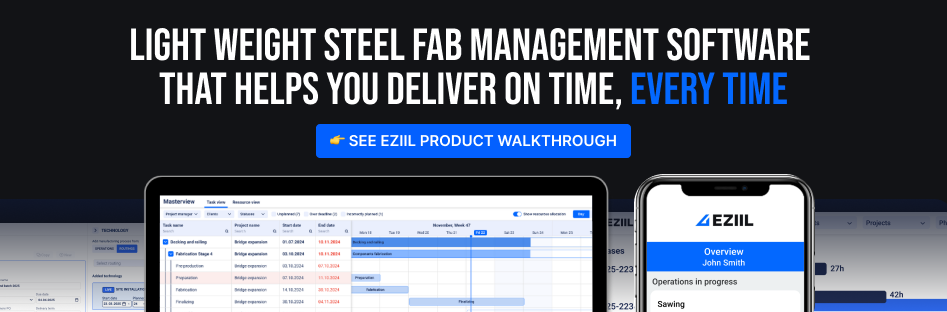
That connects directly to EZIIL’s visual scheduling capabilities. For small shops, better production scheduling is often less about advanced ERP logic on paper and more about being able to see what is happening, what is coming next, and where bottlenecks are building. EZIIL is built to make schedules easier to understand and act on, which is a big advantage for teams that need practical clarity rather than a more admin-heavy system.
Another important capability is real-time tracking. EZIIL helps teams keep job progress updated as work moves through the shop, which improves coordination between departments and reduces the usual gaps caused by spreadsheets, paper notes, and disconnected updates. For a small steel fabricator, that kind of live shop floor tracking is valuable because it makes day-to-day control easier without adding unnecessary complexity.
EZIIL also stands out because of its simpler rollout. That is a capability in its own right. Many smaller shops do not have the time, internal resources, or appetite for a long ERP implementation. EZIIL is significantly faster and easier to adopt than any heavy ERP system, which matters for buyers who want to get operational value quickly instead of spending months on setup, training, and process overhaul.
Finally, EZIIL gives teams better project-phase visibility. Instead of treating production as one black box, it helps users see how jobs are progressing across the stages that matter in a steel fabrication environment. That makes it easier to spot delays, keep teams aligned, and understand whether projects are moving as planned. In practice, this is one of the main reasons EZIIL can feel like a better fit for smaller fabrication companies than a broader system like MIE Trak Pro. It is not trying to win on sheer ERP breadth. It is trying to give small custom steel fabricators a clearer, faster, and more usable way to run work every day.
EZIIL pricing
EZIIL’s pricing model is much easier to understand than a typical quote-led ERP purchase. EZIIL Starter is an affordable, pay-as-you-go option for steel fabricators taking their first step into digital production management, with plans starting at €120/month and the ability to cancel anytime. EZIIL has clear pricing based on usage tiers: 1 to 15 users for €120/month, 16 to 50 users for €180/month, and 51 to 150 users for €290/month.
That matters because it creates a lower-risk entry point for smaller fabrication teams. Instead of forcing a buyer into a large upfront ERP commitment, EZIIL lets shops start with the operational basics they need most, like planning, scheduling, real-time production visibility, and live task tracking, then grow from there.
The other important part of EZIIL pricing is the modular path. EZIIL Starter is the base layer, but the company also offers ERP add-on modules that can be added over time as the business grows. Its pricing page describes this as a pick-and-mix approach, where shops can add advanced capabilities such as BOM, procurement, warehouse, traceability, inventory, subcontractor management, machine planning, and invoicing/accounting integrations without overhauling their workflow all at once. Add-on module pricing is quote-based, but the model itself is clearly built around gradual expansion rather than a forced all-in ERP purchase from day one.
For a small custom steel fabricator, that makes EZIIL easier to justify financially. You can start with a lightweight operational layer, get value from better production scheduling and shop floor tracking, and only add more depth when the business actually needs it. In this comparison, that is one of EZIIL’s clearest advantages over a broader system like MIE Trak Pro: the pricing structure creates less upfront risk, while still leaving room to expand into a more complete operating setup later.
EZIIL pros and cons
One of EZIIL’s biggest benefits for a small custom steel fabrication shop is that it’s specifically build around their daily/weekly/monthly workflow. For a small custom steel fabricator, EZIIL is often easier to adopt, easier to understand, and easier to get value from quickly than a broader job shop ERP or manufacturing ERP. That is a major reason it stands out against MIE Trak Pro for smaller, project-based shops. EZIIL is built to help teams improve production scheduling, day-to-day coordination, and shop floor tracking without forcing them into a heavier ERP rollout before they are ready.
One of the clearest pros is faster adoption. Smaller fabrication teams usually do not have months to spend on implementation, training, and internal process redesign. They need a system that can start bringing order to work quickly. EZIIL is positioned around that lower-friction path, which makes it attractive for businesses that want operational visibility now rather than a longer ERP project.
Another strength is easier scheduling clarity. In many smaller steel fabrication shops, the real problem is not the lack of software features on paper. It is the lack of clear visibility into what is happening, what is delayed, and what needs attention next. EZIIL is strong when the goal is to make schedules easier to follow and easier to act on. That clarity can matter more to a lean team than the broader feature depth of a larger system.
EZIIL is also simply easier for smaller teams. A lean custom fabrication shop often does not have a dedicated ERP owner or an internal systems specialist. The product’s more focused scope makes it a better fit for teams that need people across the business to use the software consistently without a steep learning curve. This is one of the biggest practical differences when buyers compare a focused custom steel fabrication software platform against broader MIE Trak Pro software.
The lower upfront risk is another important advantage. Because EZIIL starts with a simpler subscription model and a more modular growth path, buyers can improve planning, visibility, and operational control without committing to the full cost and complexity of a larger quote to cash system from day one. For many small shops, that makes the purchase easier to justify both financially and operationally.
At the same time, EZIIL has its limits. It is not trying to be a full financial ERP in the same way a broader system like MIE Trak Pro ERP is. Buyers looking for deeper native accounting, more extensive back-office coverage, or a broader all-in-one manufacturing ERP may find EZIIL lighter than what they need.
That leads to the second main limitation: EZIIL is lighter than MIE on broader ERP depth. If a company wants stronger built-in coverage across areas like full accounting, deep purchasing and inventory workflows, or a larger integration ecosystem, a heavier ERP system may still look stronger on paper.
It is also important to understand that EZIIL is a better fit for project-driven shops than for large-scale enterprise operations with more complex multi-layer requirements. Its strength is helping smaller custom steel fabricators run work more clearly and efficiently. For businesses that want a broader enterprise backbone from the start, a system with more ERP depth may feel more aligned.
So the tradeoff is straightforward. EZIIL wins on speed, clarity, ease of use, and lower risk for smaller fabrication teams. Its downside is that it is more focused and less expansive than a broader ERP. For the right buyer, especially a small custom steel fabricator trying to replace spreadsheets and daily chaos with something practical, that focus is exactly the point.
MIE Trak Pro vs EZIIL: which is better for small custom steel fabricators?
For small custom steel fabricators, the better option is usually EZIIL. That is the most honest verdict when the decision is filtered through the real needs of a smaller, project-based shop. If the main goal is to improve production scheduling, get clearer day-to-day visibility, strengthen shop floor tracking, and move away from spreadsheets and disconnected updates without taking on the weight of a full ERP project, EZIIL is typically the better fit.
That does not mean MIE Trak Pro is the weaker product. It means it is a broader one. MIE Trak Pro software is the stronger choice when a buyer wants a more complete job shop ERP or manufacturing ERP with deeper quote to cash coverage, more built-in accounting and back-office functionality, and a wider integration layer around workflows.
But breadth is not always the same thing as fit. For many smaller steel fabrication teams, the bigger question is not “Which system does more?” but “Which system will we actually implement, use consistently, and get value from without a long and heavy rollout?” That is where EZIIL tends to come out ahead. It is more focused, lower risk, and more closely aligned with the way smaller custom fabrication shops operate.
Choose MIE Trak Pro if you want a broader ERP-style platform that covers more of the business in one system, including quoting, work orders, purchasing, inventory, accounting, reporting, and operations. It makes the most sense for shops that are comfortable with a larger software project, want more ERP depth, and have someone internally who can own setup, training, and ongoing system discipline.
Choose EZIIL if you are a small custom steel fabricator that wants faster adoption, simpler scheduling clarity, better live visibility across projects, and less software overhead. It is the better option if your priority is not buying the broadest possible ERP, but getting your shop under control with a system that is easier to roll out, easier for smaller teams to use, and easier to justify financially.
| If you’re looking for… | Choose… |
|---|---|
| Fastest time to first live job | EZIIL |
| Lowest upfront risk/easier cash flow | EZIIL |
| Easiest visual scheduling for small teams | EZIIL |
| Broader quote-to-cash ERP breadth | MIE Trak Pro |
| Accounting inside the same system | MIE Trak Pro |
| Better fit for shops without a dedicated ERP admin | EZIIL |
| Better fit for shops that want one bigger operational backbone | MIE Trak Pro |
So the final answer is simple. If you want a broader MIE Trak Pro ERP with deeper system coverage, MIE may be the better choice. If you want a more practical custom steel fabrication software solution for a small, project-driven shop, EZIIL is usually the better option.
Ready to see if EZIIL is a better fit than MIE Trak Pro?
If you are comparing MIE Trak Pro against EZIIL and trying to decide which option makes more sense for a small custom steel fabricator, the best next step is to see how EZIIL works in practice.
Take a quick product walkthrough to see how EZIIL helps small fabrication teams improve production scheduling, simplify shop floor tracking, and get clearer visibility across every project phase without taking on the weight of a broader manufacturing ERP.