
This guide lays out what a sub $500 budget really buys, why per user pricing quietly pushes shops over that line, and compares the top six affordable production scheduling tools for a small fabricator. It is meant to help you make a clear decision, not to talk you into anything.
You can definitely run real production scheduling for under $500 a month, even as a custom or project based steel shop. The catch is that the price on the website and the amount you actually pay each month are often two different numbers.
What can a small Steel shop get for $500 a month
There are four price bands in this market, and they behave very differently as your shop grows:
- Free tools and spreadsheets. No software cost, but the work of keeping them current lands on a person, usually a planner or the owner.
- Per user software ($40 to $100 per user each month). Cheap for two or three logins, expensive once the shop floor needs access.
- Flat rate software ($99 to $350 a month). One price for the whole team, predictable as you grow.
- Full ERP. Capable, but usually well over $500 a month once you add the modules and implementation a fabricator needs.
Under $500 a month, you should still expect the basics that make scheduling worth doing: a visual capacity view so you can see what the shop can actually take on, drag and drop scheduling you can adjust by hand, shop floor or mobile reporting so progress updates itself, and plan versus actual job costing so you know which jobs made money. Cheap should not mean a glorified calendar.
why per user pricing pushes past $500 fast
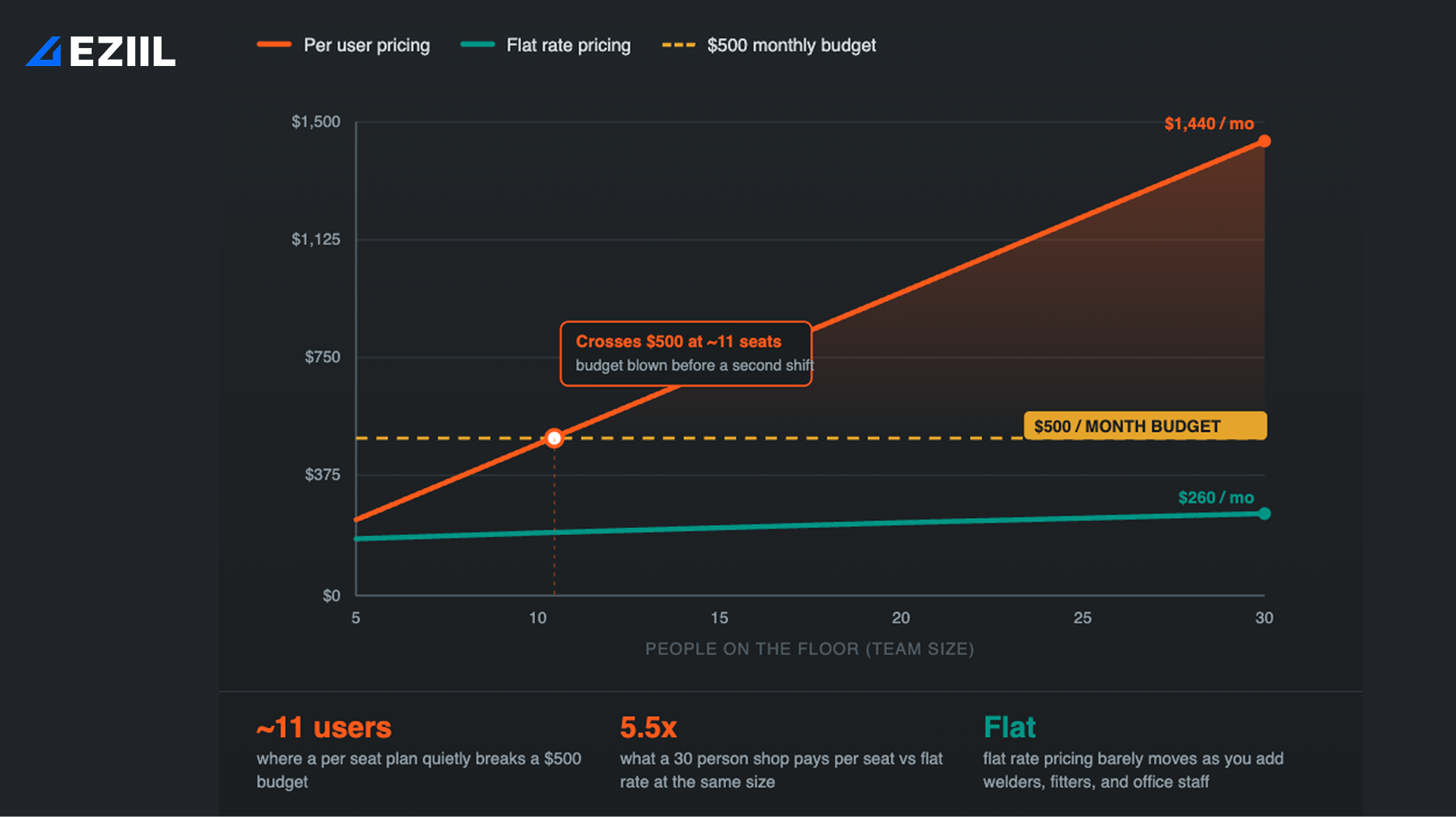
Per user pricing looks affordable when you price it for the office. It stops looking affordable the moment your welders, machine operators, and foreman need to log in too. That is the part shops tend to discover after they have committed.
This is a common theme in online software reviews. On Capterra and G2, small manufacturers rate MRPeasy highly on capability but repeatedly flag the per user model, with one reviewer noting that paying $50 or more per worker just to clock in and out is hard to justify when the floor does not touch most of the features.
Here is the same shop priced three ways as it grows. Take a fabricator that starts with five office users and ends up giving thirty people access once the shop floor is on the system.
| Tool and model | 5 users | 15 users | 30 users |
|---|---|---|---|
| MRPeasy (Starter, $49 per user) | $245 | $735 | $1,470 |
| JobBOSS² (about $100 per user) | $500 | $1,500 | $3,000 |
| EZIIL (flat rate, whole team) | $140 | $140 | $210 |
On a per user plan, a shop stays under $500 a month only while a handful of people use it. MRPeasy on its entry Starter plan stays under the line to roughly ten users, then climbs past it. JobBOSS² reaches $500 a month at around five users. Flat rate pricing behaves the opposite way: the cost barely moves as the team grows, because you pay for the shop, not the seat. EZIIL, for example, is one flat price for the whole team at each size band, which is why a thirty person shop still sits near $210 a month.
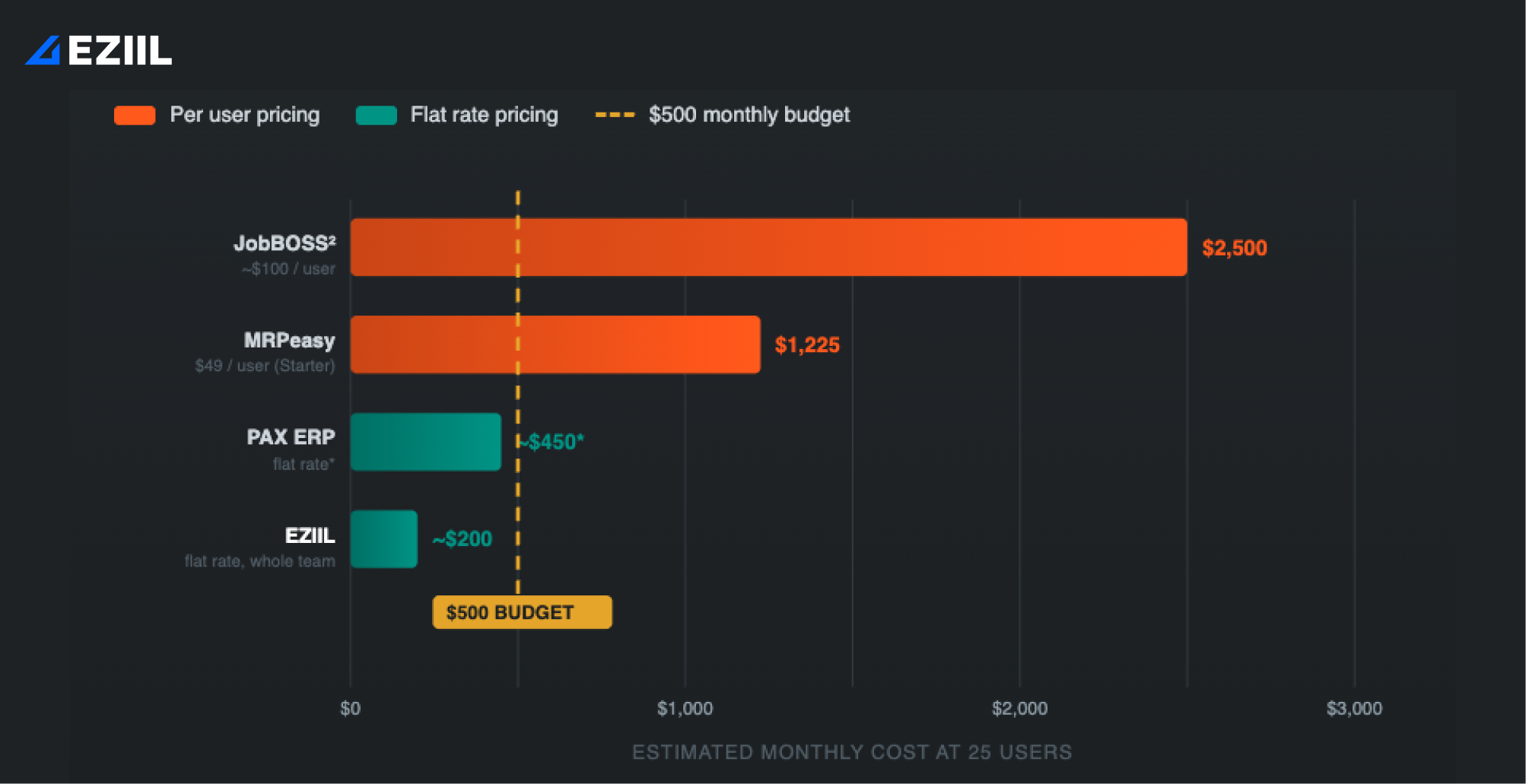
Figures above use published list prices as of June 2026 (see each tool below). Always confirm current pricing, since plans change. EZIIL pricing is set out in full on the EZIIL pricing page.
Affordable Production scheduling software (under $500 a month): the shortlist for 2026
No single production scheduling tool wins for every shop. The right pick depends on how many people need access, whether you make to order or make to stock, and how specific your work is to steel fabrication. Here is how six widely used options compare.
| Tool | Pricing model | Typical monthly cost | Cost for a 25 person shop | Scheduling strength | Steel fab fit |
|---|---|---|---|---|---|
| MRPeasy | Per user | $49 to $149 per user | Over $500 | Strong | General manufacturing |
| JobBOSS² | Per user (quoted) | About $100 per user | Well over $500 | Strong, built for job shops | Good for machine and job shops |
| Katana | Flat base plus add ons | From $299, add ons climb | Often over $500 with add ons | Good, visual | Light manufacturing, ecommerce |
| Odoo | Low license, paid setup | Low license, setup cost varies | Under $500 license, setup adds up | Good once configured | Generic, needs configuration |
| ERPAG | Flat, low cost | From about $99 | Under $500 | Basic to moderate | Generic small manufacturing |
| PAX ERP | Flat rate | About $350 (to 5 users) | Around $350 | Moderate | General manufacturing |
| EZIIL | Flat rate by team size | $140 to $338 | About $210 plus one off setup | Strong, capacity led | Built for metal fabrication |
A few honest notes on the table:
- MRPeasy is capable and easy to start, and the right choice for plenty of small manufacturers. The per user model is the thing to watch as the floor comes online.
- Katana has a clean interface and a flat base price, but the manufacturing features many shops need are paid add ons, which is what pushes the real total above $500.
- Odoo and ERPAG are the lowest cost on paper. The trade is configuration effort (Odoo) or a more basic feel and lighter scheduling (ERPAG).
- JobBOSS² is genuinely strong for machine and job shops, with a planning board and a whiteboard style rescheduler. Pricing is quote based and per user, so it adds up for larger teams.
If you want a wider roundup with more tools and deeper feature notes, see our full guide to the best production scheduling and planning software for metal fabricators.
Is free or cheap production scheduling software good enough?
A spreadsheet or a free tier can carry a small shop further than people admit, and there is no shame in starting there. The question is not whether free works today. It is what free costs you once the work outgrows it.
Free and spreadsheet based scheduling tends to break at the same points: when two jobs quietly claim the same steel, when a due date moves and nothing downstream updates, and when the only person who understands the schedule is out for the week. Fabricators describe this regularly saying that the recurring theme is that whiteboards and spreadsheets look fine until the shop floor hits them, and then you spend your day rewriting rows and chasing updates instead of running the shop.
The cost of that shows up as missed dates. Industry analyses of on time delivery point out that custom and job shops have the hardest time hitting dates because every order is different, and that material and planning gaps drive a large share of late jobs. A late job can mean a penalty, expedited freight you pay for, or a customer who quietly stops calling.
So free is rarely free. It usually trades a software bill for a planner spending a couple of hours a day rebuilding the schedule, plus the harder to see cost of dates you cannot fully trust. Paid tools earn their keep when that trade stops making sense, which for most growing shops is somewhere between fifteen and thirty people.
What to look for in an affordable production scheduling tool for a steel shop
General manufacturing tools assume you make the same part many times. A custom or project based steel shop does not work that way, so a few criteria matter more for you than for a typical small manufacturer:
- It speaks fabrication. The fields and steps should match how you actually work, including preparation, fitting, welding, and finishing, rather than generic factory stages.
- A real capacity view. You should be able to see whether you can take a rush job before you promise it, not find out afterward. Capacity led scheduling is the difference between a confident yes and a hopeful one.
- Mobile shop floor reporting. If the crew can start and stop a job from a phone, your schedule updates itself and your costing reflects reality.
- Plan versus actual job costing. Knowing which jobs made money, while you can still act on it, is worth more than any single feature.
- Role based access. Your foreman should see the schedule without seeing customer pricing. This comes up constantly and many cheap tools cannot do it.
- Room to grow without re platforming. A budget tool should let you add bill of materials, procurement, and traceability like EN 1090 later, on your own timeline, rather than forcing a rip and replace.
These criteria come straight from how fabricators describe their work, and they are the reason a generic cheap tool can technically fit the budget and still fail the shop. For the capacity side specifically, our explainer on finite capacity scheduling for metal fabrication goes deeper.
How EZIIL solves production scheduling for custom steel shops
EZIIL is built for project based metal fabricators, and it is flat rate. The whole team is covered for one monthly price set by shop size, $140 a month for up to 15 users, $210 for 16 to 50, and $338 for 51 to 150, with the same features at every tier. There is a one off onboarding fee of $350 that covers setup, training, and regular check ins, and we state it plainly rather than hiding it. You can see the full breakdown on the pricing page and the feature list on the features page.
Practically, that means a 25 person fabricator runs visual capacity planning, drag and drop scheduling, mobile shop floor time tracking, and plan versus actual job costing for about $210 a month, and the bill does not jump when the floor logs in. You start with scheduling, then add modules like bill of materials, procurement, inventory, or EN 1090 compliance one at a time, when you are ready, instead of paying for them up front.
However, if you run high volume, repeatable mass production, a traditional MRP is a better match. And if you want a fully automated scheduler that decides everything for you, EZIIL is not that. It keeps manual control where a planner wants it and automates the parts that genuinely benefit from it. For a custom steel shop, that balance is usually the point.
To sum it up…
You do not need to overspend to get your shop floor under control. Under $500 a month is plenty for real scheduling, as long as you watch how pricing scales and pick a tool that fits how a steel shop actually works. Start with scheduling, keep it flat rate, and add the rest when you are ready.
If you want to see how this looks for a shop your size, you can review EZIIL’s flat rate pricing or sign up for a product walkthrough.
FAQ
How much does production scheduling software cost for a small shop?
Most small shops land between about $100 and $500 a month. Per user tools start around $40 to $100 per user, so the total depends entirely on how many people log in. Flat rate tools run roughly $99 to $350 a month for the whole team. Full ERP usually sits above $500 a month once you include the modules and setup a fabricator needs.
Can I get real production scheduling for under $500 a month?
Yes. Several tools deliver genuine capacity planning, drag and drop scheduling, and job costing under $500 a month. The way to stay under the line as you grow is to favor flat rate pricing, because per user plans climb past $500 once the shop floor needs access.
Is there free production scheduling software for a fab shop, and is it enough?
There are free tiers and spreadsheet templates, and they can work for a very small shop. They tend to break when jobs compete for the same material, when due dates change, or when the schedule lives in one person’s head. At that point the planner’s time and missed dates usually cost more than a modest software subscription.
What is the cheapest production scheduling software for a steel fabrication shop?
ERPAG and Odoo are among the lowest cost on paper, though Odoo needs configuration and ERPAG is lighter on scheduling. For a steel shop specifically, the cheapest tool that still fits how you work, including capacity planning and fabrication steps, matters more than the lowest sticker price. A flat rate tool built for fabrication often costs less in total than a cheaper per user tool once the floor is included.
Does EZIIL charge per user?
No. EZIIL is flat rate. One monthly price set by team size covers everyone, from the office to the shop floor, with no per seat fee. That is why a larger team does not push the cost over $500 a month.
What is the best production scheduling software under $300 a month?
Under $300 a month, flat rate tools are the safe choice because per user plans rarely fit more than a few people at that budget. EZIIL’s entry tier is $140 a month for up to 15 users, and ERPAG starts near $99. Match the tool to your shop type and the features you actually need, not just the price.
How is this different from a full ERP?
A full ERP tries to run everything from accounting to inventory and usually costs well over $500 a month, with a longer setup. A focused scheduling tool gets your shop floor organized first, for less, and lets you add modules over time. Our guide to ERP implementation for fab shops covers when stepping up to more modules makes sense.