
In this article, we’re comparing Fulcrum vs EZIIL to see which one is the best software for custom steel fabricators.
You have probably decided to get rid of the Excel spreadsheets. Good call. Both tools exist for exactly that moment, and both are far better than the whiteboard and the ten Excel files nobody trusts. But they are built for different shops, priced in completely different ways, and one of them will fit yours much better than the other.
Before we dive into the detailed comparison, here is the short answer:
Fulcrum is a broad, cloud-native manufacturing platform (quoting, autoscheduling, inventory, production) built for US job shops doing machining, sheet metal, and assembly, with revenue-based pricing that starts around $800 per month and a launch process of up to 12 weeks.
EZIIL is purpose-built production management for small custom steel fabricators, with flat team-size pricing (€120/$140 to €290/$338 per month plus a one-off €300 onboarding fee), built-in EN 1090-2 traceability, and a modular start that has shops live in under a week. If you are a 15 to 150 person custom steel shop in Europe, the UK, or anywhere EN 1090 matters, EZIIL is the more precise and far more affordable fit. If you are a larger job shop that lives on quoting velocity and mixed machining work, Fulcrum deserves a serious look.
Last updated: July 2026.
Fulcrum vs EZIIL at a glance: comparison table
| What matters to a small custom steel fab shop | EZIIL | Fulcrum | Why it matters |
|---|---|---|---|
| Monthly cost | EZIILFlat by team size: €120 / $140 per month (1 to 15 users), €180 / $210 (16 to 50), €290 / $338 (51 to 150). No per-user fees. | FulcrumRevenue-based pricing bands, billed annually. Starts around $800 / €740 per month (SelectHub estimate, euro figure approximate); rises with your revenue and integrations. Unlimited users. | Why it mattersA 30-person steel shop pays €180 / $210 per month on EZIIL. On Fulcrum the same shop pays roughly 4 to 5x more, and the bill grows as revenue grows. |
| Upfront cost | EZIILOne-off €300 / $350 onboarding fee (setup, training, check-ins). | FulcrumOne-time fixed launch fee (amount not published; quoted per shop). | Why it mattersCash flow is the small shop’s oxygen. Know the full year-one number before you sign. |
| Time to go live | EZIILUnder a week, starting with one module. | FulcrumUp to 12 weeks with Fulcrum’s in-house launch team (sometimes faster). | Why it mattersEvery week of implementation is a week your team runs two systems and patience burns. |
| Steel fabrication depth | EZIILPurpose-built for project-based steel work: structural BOM handling, drawings tied to jobs, subcontractor management, EN 1090-2 traceability built in. | FulcrumBuilt for job shops broadly: machining, sheet metal, assembly. Strong nesting and routing, no EN 1090 module. | Why it mattersGeneric job shop logic bends awkwardly around one-off structural steel projects. Fit is the difference between adoption and abandonment. |
| EN 1090-2 compliance | EZIILBuilt in (the only tool in this comparison with it). | FulcrumNot offered. US compliance focus instead (CMMC 2.0 ready, ITAR hosting on Azure GovCloud). | Why it mattersIf your contracts require EN 1090 execution class traceability, this row alone decides it. |
| Scheduling | EZIILDrag-and-drop capacity planning by department, OTD indicators flag jobs falling behind. | FulcrumAutomated throughput-based “live” scheduling that reorders jobs from shop floor activity. Reviewers praise it, with caveats on unattended/lights-out runs. | Why it mattersAutoscheduling is genuinely impressive. The question is whether you want the system to reshuffle the plan or your production manager to stay in control. |
| Quoting and estimating | EZIILNot built in. Use your own pricing tool; plan vs actual data sharpens future quotes. | FulcrumStrong quoting and pricing intelligence, quote-to-cash flow. | Why it mattersFulcrum’s clearest win. If quoting speed is your bottleneck, weigh this heavily. |
| Shop floor use | EZIILMobile app (iOS and Android): start/stop timer, today’s tasks, drawings on the phone. | FulcrumTablet-based interfaces at workstations, operators log work and view drawings. | Why it mattersBoth do this well. Ask which one your least tech-happy welder will actually use. |
| Adoption model | EZIILStart with one module, add BOM, procurement, EN 1090 and more only when ready. | FulcrumFull platform adoption: quoting through shipping from day one. | Why it mattersAll-at-once works with a project champion and clean data. Modular works when you need wins fast. |
| Onboarding help | EZIILPersonal onboarding by people from the fabrication industry, included in the €300 / $350 fee. | FulcrumIn-house launch team, fixed fee, no third-party implementors. | Why it mattersBoth beat the “here’s a login, good luck” SaaS norm. |
| Best fit | EZIILCustom steel fabricators, 15 to 150 people, EU/UK or export work, EN 1090 requirements, tight budgets. | FulcrumJob shops (machining, sheet metal, mixed work), quoting-heavy, with a serious software budget, DoD/ITAR work. | Why it mattersThe right tool matches your shop’s DNA, not the demo that looked slickest. |
Fulcrum pricing verified July 2026; revenue-based figures are third-party estimates (SelectHub), confirm current pricing with the vendor. EZIIL pricing: eziil.com/pricing.
What is Fulcrum?
Fulcrum is a cloud-native manufacturing software platform from, that acts like a modern replacement for ERP, MRP, MES, and QMS in one system. It’s mainly used by small and mid-sized job shops, roughly 10 to 200 people, doing machining, sheet metal fabrication, and assembly work.
Fulcrum’s headline feature is its automated scheduling engine. Instead of a static plan, the system continuously reorders jobs based on real shop floor activity, machine availability, lead times, and inventory. Its quoting module is equally central: pricing intelligence, quote-to-cash flow, and integrations with tools like Paperless Parts.
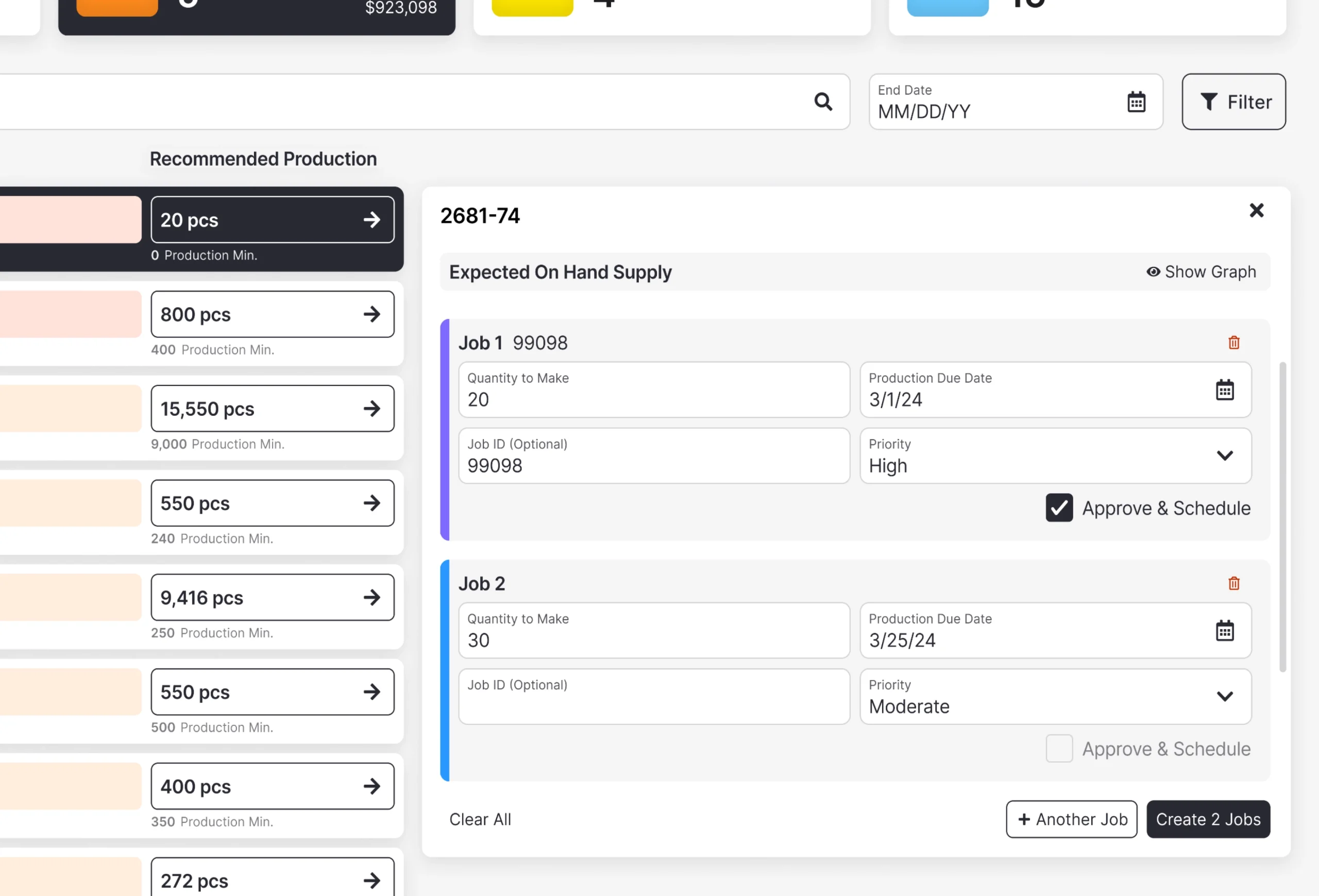
Fulcrum’s pricing is revenue-based. You enter last year’s revenue on their pricing page and get placed in a band, billed annually, with unlimited users and a one-time fixed launch fee. Published third-party estimates put the starting point around $800 per month, and the price steps up as your revenue crosses into new bands or you add integrations.
Two tiers exist: a Base tier (job tracking, quoting and sales orders, job costing, purchase orders, shipping and receiving) and a higher tier that adds Autoschedule, Capable to Promise, purchase planning, demand planning, grouped work, and custom reports.
Implementation is handled by Fulcrum’s in-house launch team for a fixed fee, with a stated timeline of 12 weeks, sometimes faster.
What Fulcrum does well
Independent online reviews praise Fulcrum for the following capabilities:
- The interface is modern: Users describe it as intuitive and clean, a contrast to legacy job shop systems.
- Autoscheduling works for most jobs: The dynamic scheduler that reorders work based on lead times, inventory, and machine availability is the most praised feature.
- The company ships fast: Forum users note Fulcrum is “very aggressively updating/improving,” with weekly product updates and reported issues fixed within months.
- Unlimited users, no seat fees: Like EZIIL, Fulcrum refuses per-seat pricing, so the whole shop floor can be in the system.
- Support is strong: A support team that includes engineers with an average response time of under 2-hours, plus a dedicated account manager after launch.
- US compliance credentials: CMMC 2.0 ready, ITAR customers hosted on Azure GovCloud. For American shops doing defense work, this matters a lot.
Where Fulcrum falls short for a small custom steel fabricator
At the same time, many online reviews and forum threads surface consistent limitations:
- Price scales with your success: Revenue-based pricing sounds aligned until you realize growing your turnover raises your software bill even if your team and usage stay the same. At a starting point around $800 per month billed annually, Year 1 likely lands upward of $10,000 before the launch fee. For a 20-person steel shop that is a serious line item.
- It is not steel-specific: Fulcrum’s DNA is machining and sheet metal job shops (parts, routings, nesting, repeat-quote work). One-off structural steel projects, assembly-heavy BOMs, drawing revisions from external detailers, site deliveries, and subcontracted galvanizing or painting are not what the workflows were shaped around.
- No EN 1090 support: Fulcrum’s compliance investment is going toward CMMC and ITAR, which makes sense for its US market. If you fabricate structural steel for the European market, execution class traceability is your problem to solve elsewhere.
- Scheduler edge cases: Reviewers note the autoscheduler handles unattended and lights-out machine runs poorly, and cannot always distinguish a 16-hour weekend job from a 48-hour one. Automation-heavy shops feel this most.
- Reporting depth: Some users find built-in reporting limited, lacking the filtering and customization needed for deeper production analysis, and QMS functionality is an acknowledged gap.
- All-at-once adoption: Fulcrum replaces quoting, scheduling, inventory, and production in one move. Success, as reviewers stress, “depends heavily on the effort put in by the customer”: clean data and thorough training. A 12-week launch is honest and well-supported, but for a small custom steel fabrication it is still quite a long time.
- Cloud only: Fulcrum does not have an offline mode and needs a steady internet connection.
Who is Fulcrum the best solution for
A US machine shop or mixed job shop, quoting daily, running CNC machines alongside fabrication, possibly doing DoD work, with a project champion who will drive a 12-week implementation. For that shop, Fulcrum is arguably the best modern option on the market.
What is EZIIL?
EZIIL is cloud production management software built specifically for small custom steel and metal fabricators, the 15 to 150 person shops doing project-based, one-off work: structural steel, staircases, architectural metalwork, industrial equipment. It was founded by people from the fabrication industry and is used by shops across Europe, USA, Australia, Canada and the UK.
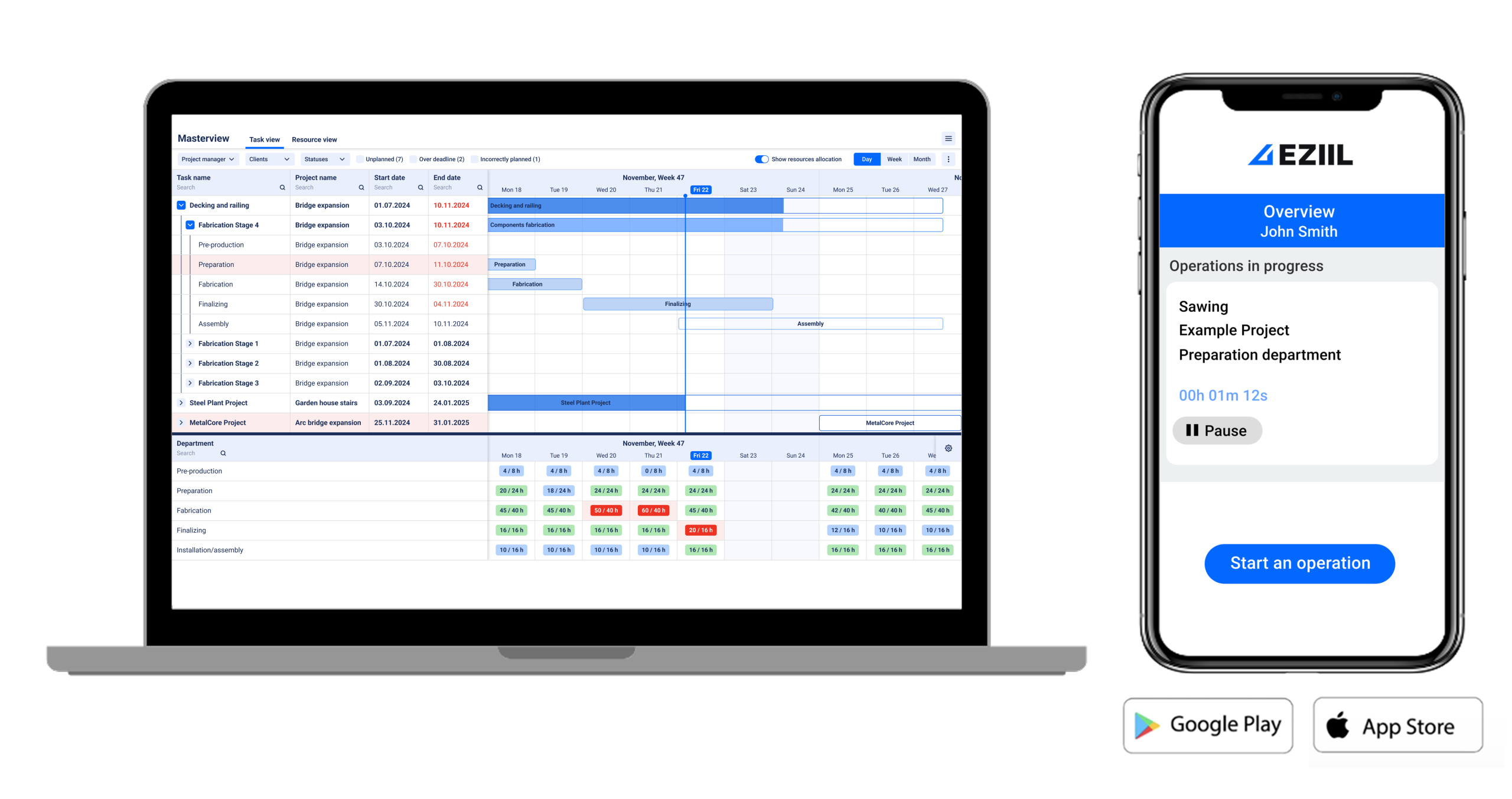
EZIIL’s core idea is different from Fulcrum’s.
Instead of replacing everything at once, you start with EZIIL Starter, the complete base product: drag-and-drop capacity planning by department, a live dashboard that updates as hours are reported, plan vs actual hours and costs per project, OTD indicators that flag anything falling behind, drawings and documents tied to each job, and a mobile shop floor app where workers start and stop a timer and see today’s tasks.
Then you add modules only when you are ready: Bill of Materials (BOM), procurement, inventory, EN 1090-2 compliance, subcontractor management, machine planning, shipments, and more.
EZIIL’s pricing is flat by team size, and every tier gets the same full Starter feature set:
- €120/$140 per month for 1 to 15 users
- €180/$210 per month for 16 to 50 users
- €290/$338 per month for 51 to 150 users
- One-off €300/$350 onboarding fee (setup, training, and regular check-ins)
No per-user fees, no revenue-based escalation. A 50-person shop pays €180/$210 per month whether it turns over €2M or €20M.
Implementation is where EZIIL is most opinionated: go live in under a week, starting with one module, with personal onboarding from people who understand fabrication. APS Group‘s planner Syed H. describes it plainly: “It only took us a few weeks to roll out EZIIL internally, as the learning curve was minimal.”
What EZIIL does well
- Steel fabrication depth: Structural BOM handling, drawing and document management tied to the job, subcontractor management, and built-in EN 1090-2 traceability. It is not a generic job shop tool, it was built around project-based steel fabrication from day one.
- Real cost math a small shop can plan around: Year 1 for a 30-person shop: €180 x 12 + €300 onboarding = €2,460 (in USD: $210 x 12 + $350 = $2,870). Everything included. Compare that with a five-figure year one on Fulcrum.
- Fast, low-risk start: One module, live in under a week, add the rest when ready. Kane Metall built a production drawing management platform and job order system within a week.
- Shop floor adoption that actually happens: EZIIL’s mobile app for shop floor is intentionally designed to be simple and easy to learn regardless of anyones technological knowledge and capabilities. B&W Metall reached 100% shop floor adoption, every worker reporting in EZIIL regardless of age or role, through a step-by-step rollout. The mobile app asks workers for two things: start/stop a timer and check today’s tasks.
- Profit visibility in real time: EZIIL compares planned budget against actual hours and costs as the job runs, so you know which jobs are losing money while you can still act on it, not weeks after invoicing. APS Group runs 20+ concurrent projects this way and reports “tighter control of active jobs, better-informed estimating and concrete profit/loss insights per job.”
- Proven, attributed outcomes: VMT raised engineers’ work efficiency by 40% and increased turnover by 30% without hiring, after adopting EZIIL BOM. Enefit Solutions deleted 12 separate Excel sheets: “The whole team can now work in one system,” says Rait K., Chairman of the Board. Nordic Shelter‘s engineering lead reports a 24x return: “1 hour invested in Eziil BOM saves 8 hours in procurement and 16 hours in production.”
Where EZIIL falls short
- No built-in quoting engine: EZIIL sharpens your future quotes with plan vs actual data, but it does not generate quotes the way Fulcrum’s pricing intelligence does.
- Not a full ERP: EZIIL is meant to be a simple, fast and lightweight software that focuses on production management and integrates with accounting softwares (such as Directo) rather than replacing them. Shops wanting accounting, CRM, and production in one system will find EZIIL deliberately narrower.
- Not built for machining-first or repeat-batch shops: EZIIL is, first and foremost, built for project-based steel fabrication workflows. If half your floor is CNC machining repeat parts, Fulcrum’s routing and nesting orientation fits better.
- No US defense compliance: EZIIL does not support CMMC or ITAR. American shops with DoD contracts should consider Fulcrum.
- Cloud only: Like Fulcrum, EZIIL needs an internet connection. Neither tool has an offline mode.
Fulcrum vs EZIIL: the verdict for small custom steel fabricators
Choose Fulcrum if you are a job shop with meaningful machining or repeat-parts work, quoting is a daily bottleneck, you have $10,000+ per year of software budget and a champion to drive a 12-week implementation, or you need CMMC/ITAR compliance for US defence work. It is a polished, fast-improving platform and the most credible modern option for that profile.
Choose EZIIL if you are a custom steel fabricator with 15 to 150 people doing one-off, project-based work, you need EN 1090-2 traceability, your budget is real-world, and you want the team live this month, not this quarter. You get purpose-built steel workflows, flat predictable pricing (€120/$140 to €290/$338 per month plus €300/$350 once), and onboarding by people who have stood on a shop floor.
| Your situation | EZIIL | Fulcrum |
|---|---|---|
| Custom steel fabricator doing one-off, project-based work | ||
| EN 1090-2 traceability required on your contracts | ||
| Need to be live this month, not this quarter | ||
| Flat, predictable software cost on a small-shop budget | ||
| Start with one module and expand at your own pace | ||
| Whole team in the system, no per-user fees | ||
| Personal onboarding included, no third-party implementors | ||
| Built-in quoting and pricing intelligence | ||
| Machining or repeat-parts work alongside fabrication | ||
| Scheduling that reorders jobs automatically from shop floor activity | ||
| DoD, ITAR, or CMMC compliance work |
The pattern across every category is the same: Fulcrum is broader, EZIIL is deeper on steel and dramatically lighter to adopt and afford. For a small custom steel fabricator, breadth you will not use is just weight. Depth in the work you do every day is what shows up in on-time delivery and margin.
The cheapest way to find out is to look inside both. Fulcrum offers a demo through its sales team. EZIIL offers a free product tour, sign up and see the platform in a demo version, or book a demo and bring your biggest live project for us to discuss.
five questions to help you decide
1. What does year one actually cost?
EZIIL for a 30-person shop: €180/$210 x 12 + €300/$350 onboarding = €2,460/$2,870 in year one, and €2,160/$2470 every year after.
Fulcrum for a 30-person shop: starting around $800 per month billed annually (per SelectHub’s estimate) plus a one-time launch fee that Fulcrum quotes per shop, so realistically $10,000+ in year one, and the subscription steps up as your revenue crosses band thresholds. You will need a sales call to learn your actual number. Fulcrum, however, does cover a lot more ground (quoting, deeper inventory).
2. How fast will the team actually use it?
Software that is not adopted is the most expensive software of all. EZIIL’s answer is to start gradually with one module and be live in under a week, so the team sees a win before scepticism sets in. Fulcrum’s answer is a structured 12-week launch with a dedicated in-house team, which works well when you have a champion and clean data, and stalls when you do not. The question is, which failure mode your shop is more prone to.
3. Does the software speak “steel fabrication”?
Most production software is built for shops that make the same part over and over: define it, route it, run a batch, repeat. Custom steel fabrication is the opposite, every job is a one-off project with revision-heavy drawings, a changing BOM, subcontracted steps like galvanizing, and deliveries phased to a construction site. Force that work through repeat-production logic and the software will not refuse, it will just make you fight it with fake part numbers, re-entered BOMs, and side spreadsheets, until the team quietly goes back to Excel.
That is the real cost of the wrong fit: not missing features, but workarounds that kill adoption.
Software built for steel fabrication makes your unique cases the default path: drawings live on the job, structural BOMs behave like structural BOMs, the galvanizer sits inside the schedule, and traceability is designed in, not bolted on.
Run this test in both demos: load a real project, a staircase or a skid frame, with a revision-heavy drawing set, a subcontracted galvanizing step, and a phased site delivery, and watch which system bends.
4. How does onboarding work?
Both vendors do onboarding in-house, which already puts them ahead of most of this market. The difference is texture: Fulcrum’s launch team runs a polished 12-week program built for platform migration. EZIIL’s onboarding is done by people from the fabrication industry, costs €300/$350 once, and is scoped to get one module live in days, then grow.
5. What happens when you grow?
On EZIIL, growth means moving tiers when your headcount crosses 15 or 50 users, and the price is published. On Fulcrum, growth means new revenue bands, and the price is a conversation. Also flip the question: if you shrink or have a rough year, a flat monthly subscription is easier to carry than an annual contract.
FAQ
Is Fulcrum good for steel fabrication?
Fulcrum is a strong platform for job shops doing machining, sheet metal, and assembly, and it markets to custom fabricators. It is not steel-specific: there is no EN 1090 module, and its workflows were shaped around parts and routings rather than one-off structural steel projects with external detailing, subcontracted finishing, and phased site deliveries. Small custom steel shops usually get a tighter fit from fabrication-specific software.
How much does Fulcrum cost compared to EZIIL?
Fulcrum uses revenue-based pricing, billed annually, starting around $800 per month (roughly €740) per third-party estimates (SelectHub), plus a one-time launch fee quoted per shop; the price rises as your revenue grows. EZIIL charges a flat monthly rate by team size: €120 / $140 (1 to 15 users), €180 / $210 (16 to 50), or €290 / $338 (51 to 150), plus a one-off €300 / $350 onboarding fee. For a 30-person shop, year one is roughly €2,460 / $2,870 on EZIIL versus an estimated $10,000+ on Fulcrum.
How long does implementation take, Fulcrum vs EZIIL?
Fulcrum’s in-house launch team targets go-live in as little as 12 weeks. EZIIL shops go live in under a week, starting with one module and adding others when ready. APS Group reports rolling out EZIIL internally in a few weeks with a minimal learning curve.
Does EZIIL or Fulcrum support EN 1090 traceability?
EZIIL has EN 1090-2 traceability built in as a module. Fulcrum does not offer EN 1090 support; its compliance investments target the US market (CMMC 2.0 readiness and ITAR hosting). For European structural steel work, this is often the deciding factor.
Does EZIIL have automated scheduling like Fulcrum?
Fulcrum’s autoscheduler continuously reorders jobs from shop floor activity, and it is the platform’s most praised feature (with reviewer caveats around unattended machine runs). EZIIL takes a different approach: drag-and-drop capacity planning by department that keeps the production manager in control, with OTD indicators that automatically flag tasks and departments falling behind as hours are reported.
Can I try EZIIL or Fulcrum before buying?
Fulcrum offers demos booked through its sales team. EZIIL offers a free product tour where you sign up and see inside the platform in a demo version, plus booked demos. EZIIL does not offer a self-serve free trial because steel fabrication setups are unique and the onboarding team helps with initial setup and data migration.
How we compared Fulcrum and EZIIL: methodology
This comparison was researched and written by Team EZIIL in July 2026.
What we looked at: We compared the two products on the criteria small custom steel fabricators tell us decide their vendor shortlists: total year-one and ongoing cost, time to go live, steel fabrication depth, EN 1090-2 traceability, scheduling approach, quoting, shop floor usability, adoption model, and onboarding support. These criteria come from our customer questions and demo call conversations with fabrication shops of 15 to 150 people.
How we researched Fulcrum. All Fulcrum claims are drawn from public sources: Fulcrum’s own website and pricing page (fulcrumpro.com, retrieved July 2026), verified user reviews on G2 and Capterra, the SelectHub analyst profile (the source of the $800 per month starting estimate, since Fulcrum does not publish exact figures), and practitioner discussion on the Practical Machinist forum. We did not rely on internal assumptions about Fulcrum, and where its pricing is estimated rather than published, we say so.
How we described EZIIL. EZIIL pricing, features, and implementation timelines come from our published pricing and documentation. Every customer outcome is attributed to a named customer (Enefit Solutions, VMT, B&W Metall, Kane Metall, Nordic Shelter, APS Group, FLI Structures) and quoted as originally given.
Updates. Pricing and features change. We review this comparison when either vendor makes a material change and re-verify pricing at least quarterly. If you spot something outdated, email support@eziil.com and we will correct it.