
B&W Metall is a structural steel fabricator headquartered in Estonia, building steel constructions for industrial and commercial projects around the world. Since 2007, the team has grown to 76+ employees turning out roughly 100 tons of steel per week, with 10-15 active orders running in parallel at any given moment.
Their work is project-based, every job is its own unique build, even when the part types repeat. The scope runs the full process: cutting, drilling, welding, hot-dip galvanizing or painting, dispatch. Their steel ends up in factories and distribution centres operated by some of the world’s most demanding industrial buyers, from automotive and e-commerce to pharma. EN 1090-2, ISO 3834-2, ISO 9001 and ISO 14001 are the compliance backbone behind every shipment, with CE marking on every load.
In this case study, we’re looking at how B&W Metall replaced Excel (and all the paper that came with it) with EZIIL, what their day looks like today, and what it took to get there.
B&W Metall at a glance:
- Industry: Custom structural steel fabrication
- Location: Estonia
- Company size: 80 employees
- Active projects: 10-15 concurrent orders at any given time
- Output: 100 tons per week
- Average project duration: 2 weeks for smaller orders; up to 3 months for large structural projects
- Certifications: up to EXC3, ISO 3834-2, ISO 9001, ISO 14001, CE marking on every shipment
- Before EZIIL: Separate Excel files per project and spreadsheets for packing, dispatch sheets, printed paper work orders, printed drawings, paper forklift commands
- Using EZIIL since: 2021
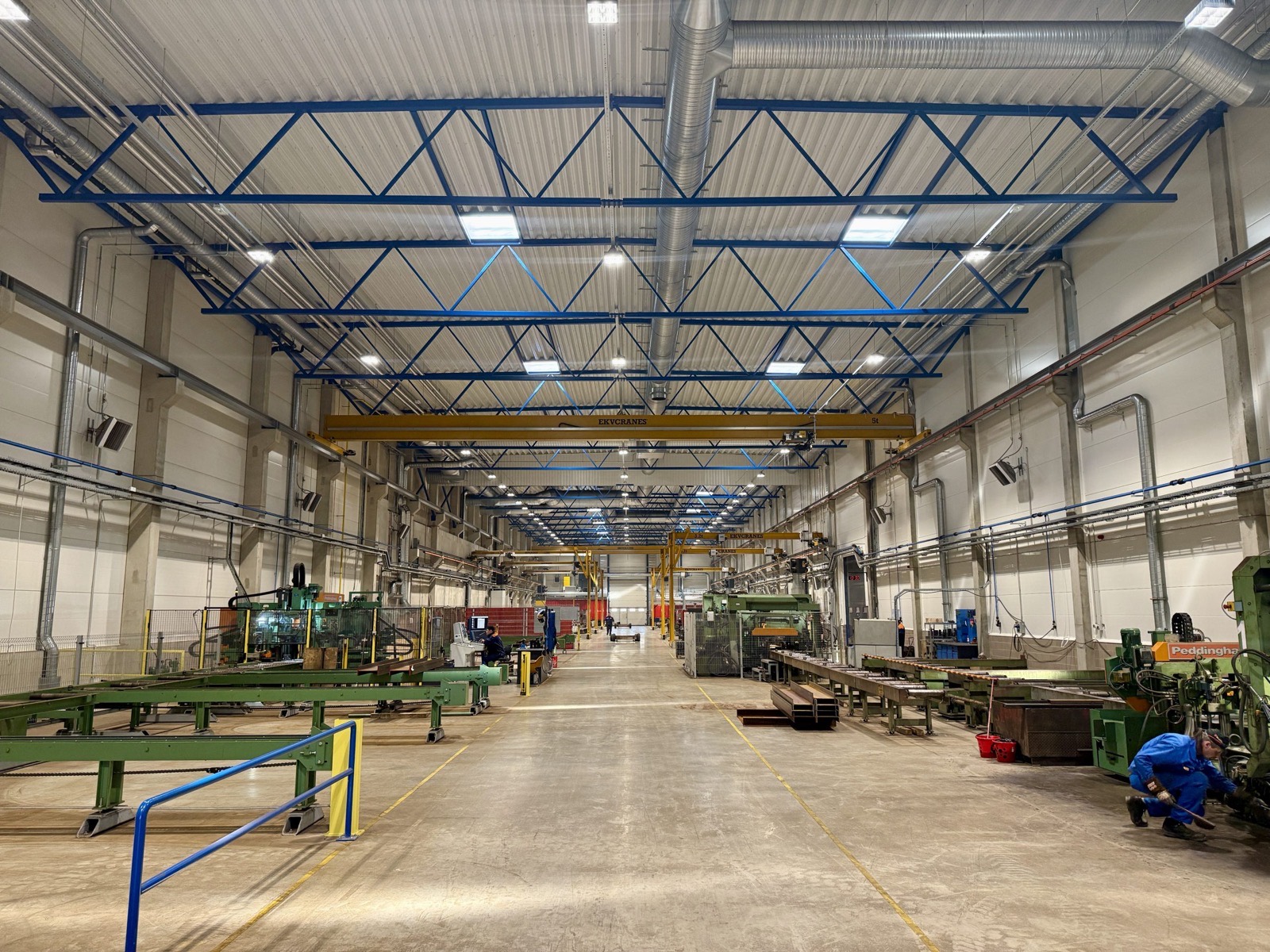
Before EZIIL: paper work chaos and tens of parallel Excels
Before EZIIL, B&W Metall ran their entire production on a hybrid of Excel and printed paper. Every project (ten or more in flight) got its own Excel file, with extra spreadsheets layered on top for packing and dispatch. Tracking what was produced, what was in progress, what had been packed, all happened in those spreadsheets. Layered on top: separate packing Excels, dispatch sheets, and a constant flow of printed work orders, drawings and forklift commands moving across the shop floor.
“Everything happened in Excel. The only thing I could monitor from my desk was finished, packed parts, those were ticked off in Excel. If I wanted anything more, the only way was to walk into production and either look at the physical work order or ask the operators.” – Elari, project manager and planner at B&W Metall
From a planner’s desk, the only visibility was binary: packed, or not packed. Anything in flight, being cut, being welded, queued for galvanizing, was effectively invisible. The only way to know was to walk the shop floor and ask the operator. Urgent reprioritisation was verbal: a planner walked over to the right machine and said it out loud, often without knowing how much work was actually left to push aside.
The problem was not only slow admin. It was uncertainty. When status is spread across paper, memory and separate spreadsheets, the planner carries more of the system in their own head.
“A large project could be a thousand drawings. We’d archive them in folders for years. If we needed any information afterwards, we’d open the archive, find the project’s folders and start flipping page by page to find the one detail we needed.” – Elari, project manager and planner at B&W Metall
That kind of process can function at lower volumes but as B&W’s project volume increased, the administrative load and the room for confusion grew with it.
Why BW Metall chose EZIIL
As order volume kept growing, the cracks in the Excel-and-paper stack stopped being an annoyance and started being a ceiling. The packing-slip paperwork process (copy-pasting from a blanket template into every label) alone was eating five hours of work per project and documentation was getting harder to find. The team needed a comprehensive steel fabrication management software that could carry a project end-to-end: BOM, planning, reporting, packing, dispatch, traceability. They evaluated several ERPs.
The deciding factor wasn’t a feature checklist alone. It was the flexibility. EZIIL was willing to come along and tweak the system to what B&W Metall actually needed, the way they needed it. For a fabricator with very specific workflows around BOMs, subcontracted galvanizing, traceability and a real shop floor, that flexibility made all the difference.
“The main thing was being able to run a project from start to finish through one program. EZIIL gave us the confidence we could do that.” – Elari, project manager and planner at B&W Metall
The other thing that mattered most to B&W Metall was knowing that they could keep producing. EZIIL gave them confidence the system would carry an end-to-end project. For the first three projects, the team ran EZIIL alongside Excel in parallel. After three clean closes, they trusted it enough to drop the backup.
How B&W Metall manages metal fabrication today: one system, fifteen active projects, no paper
Today, every project, from intake to dispatch, lives in EZIIL. The shop floor reports through it and the office plans through it.
“EZIIL simplifies the whole process. It gives you the overview. It pulls everything into one place, projects, profiles, everything. Once the order volume grows, I can’t see how you’d manage without it.” – Elari, project manager and planner at B&W Metall
Here’s what B&W Metall’s workflow looks like with EZIIL, across the office and the shop floor:
- Project intake and BOM creation.
- The team receives the project and builds the BOM directly in EZIIL. The planners review every BOM before it goes into production.
- Digital instructions instead of paper handoffs.
- Generated from the BOM (XLS export) and pushed digitally to forklift operators over the network. No paper commands.
- Operations planning.
- Each operation is time-blocked per machine in EZIIL’s planning module.
- Preparation and machining with live reporting.
- Material moves through preparation and machining and the drilling line auto-reports completed parts into EZIIL.
- Screen-based welding workflow.
- Welders pull up the part on screen at their station, enter the part code, start the operation, and see the live drawing version. No printed drawings on the welding bench.
- Shop floor management and self-reporting at every station.
Workers report completion through the EZIIL browser/mobile app.
“Instead of walking the floor to ask if something’s done, I open the machine view and I can already estimate whether a rush is actually a rush.” – Elari, project manager and planner at B&W Metall
- Packing across all live projects in one place.
- Packing is handled in EZIIL, with filters across all active projects, so staff can sort what they need without searching for the right Excel file.
- Dispatch and yard visibility.
Goods moving to coating, subcontracting and final dispatch remain visible in EZIIL, sortable by weight, length and project.
“I have less to worry about now. I can sit at my desk and judge the situation. That’s a big deal.” – Elari, project manager and planner at BW Metall
- Traceability when it matters.
Historical lookups, including who made a specific part, can now be pulled from reported operations rather than paper archives.
“All projects are right there in the system. I can quickly filter and sort to find what I need. I’m not hunting for some Excel file anywhere.” – Elari, project manager and planner at B&W Metall

B&W’s results with EZIIL: Five hours of packing-slip paperwork in twenty minutes, and paper-based systems eliminated
The biggest wins for B&W Metall is speed and clarity. But the broader result is control. Paper work orders are gone from the shop floor, forklift commands are digital, physical drawing archives are no longer needed for large projects, and production reporting has become a daily habit across the team.
Instead of chasing updates across separate files and paper folders, B&W Metall now works from a shared operating flow that makes progress easier to see and easier to trust. Here are the results:
1. Packing-slip and dispatch paperwork time cut by 90%
Generating packing slips and dispatch documentation used to be a five-hour job per project, is now done in roughly twenty minutes. In EZIIL, the team simply moves the selected parts into a pack and prints the label.
“Packing used to be a five-hour job. Today I can probably get the same five hours of work done in twenty minutes.” – Elari, project manager and planner at B&W Metall
2. Thousands of paper work orders and archives eliminated
B&W Metall has largely eliminated paper-based systems. Work orders, forklift commands, prep drawings are all digital today. This means no more lost work orders, no compliance gaps, and more accurate and consistent traceability.
“Today our reporting is accurate enough that we don’t need physical archives. If we ever need to look back and see who made a part, we see it in the reported operations. There are thousands and thousands of papers that today are unprinted.” – Elari, project manager and planner at B&W Metall
3. Traceability in seconds
Instead of digging through physical archives and flipping through hundreds of pages, all project information is now available in EZIIL in a few clicks.
“If we want to look back and see who made a part, we see it in the reported operations. We don’t have to dig through a stack of a thousand drawings.” – Elari, project manager and planner at BW Metall
4. 100% shop-floor adoption
Although universal adoption of EZIIL was the hardest milestone for B&W Metall, the team got there with a step-by-step rollout: first one monitor at one machine and then expanding. Today, every worker reports in EZIIL, regardless of age or role.
5. Cross-project visibility for packing and dispatch
Building packing lists across 10-15 active projects used to mean digging for the right Excel file. Today, the entire active project list sits in EZIIL, sortable and filterable by weight, length, or project. Dispatch coordination with the galvanizer and painter runs out of the same view.
6. Forklift commands now digital and network-distributed
Forklift commands used to be paper, hand-delivered. Today they’re generated from the BOM and pushed over the network to the operator. Less paper, fewer mistakes, faster handoffs.
7. Reduced cognitive load for the planning team
All of the remembering, organising and surfacing that previously lived across paper and personal follow-up, is now done by EZIIL. Removing the mental load of having to remember where every project is.
“I have less to worry about now. The kind of constant low-level worry about whether things are getting done is reduced.” – Elari, project manager and planner at B&W Metall