
From Word documents and mega-spreadsheets to real-time visibility across every department, how a 70-employee UK steel fabricator eliminated data silos, removed material bottlenecks, and built an efficiency flywheel that compounds month after month.
About FLI Structures
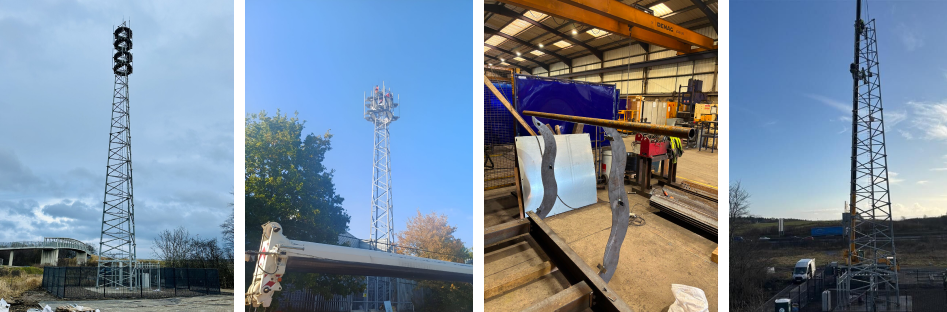
FLI Structures (Francis & Lewis International Ltd) is one of the UK’s leading designers, fabricators, and installers of steel structures and screw pile foundations. Based in Gloucester, south-west England, FLI Structures has been engineering steel solutions for over 70 years. From the telecoms towers that carry half the UK’s mobile network to the 3,000 nuclear-grade door frames they’re fabricating for Hinkley Point C, the country’s newest power station.
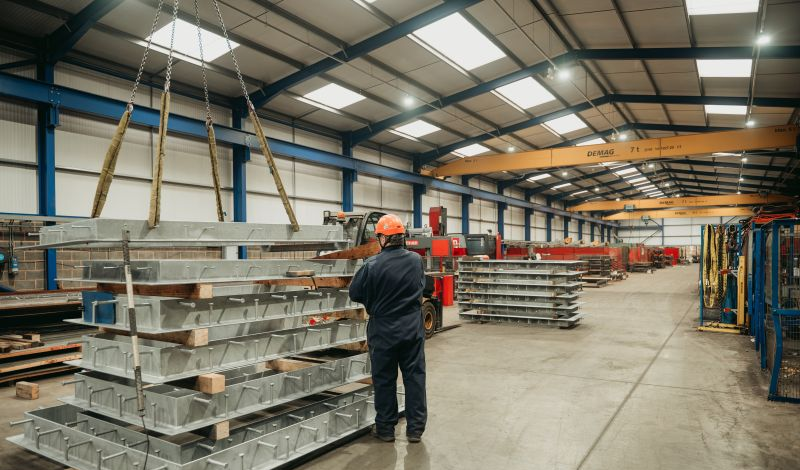
With approximately 70 employees, two workshops totalling 6,000 sqm, and in-house engineering, drawing office, and project management teams all under one roof, FLI is a vertically integrated operation handling everything from initial design through to on-site installation. They serve some of the UK’s most demanding sectors (telecoms, nuclear, rail, highways, and defence) where quality, traceability, and hitting deadlines aren’t optional.
FLI Structures is certified to BS EN 1090 Execution Class 4 (the highest classification for structural steelwork), holds Fit 4 Nuclear (F4N) status, and maintains a reported defect rate of just 0.1%. They’re the only UK company that offers both steel superstructure and screw-piled foundation solutions as a combined, turnkey system.
In April 2023, FLI Structures began implementing EZIIL software to manage their custom steel production. Three years later, the software has become what Joe Stroud, Projects Team Manager at FLI Structures, calls “such an integral part of the business, you almost forget what it was like before.”
FLI Structures at a glance
- Industry: Custom steel fabrication (structures, towers, foundations)
- Location: Gloucester, UK
- Company size: 70 employees across engineering, drawing office, project management, purchasing, workshop, and dispatch
- Active projects: 100 concurrent jobs at any given time, managed by a team of 9 in the projects department
- Average project duration: 2-3 months per project
- Average contract value: £30,000 (ranges from £5k-£1.5m)
- Markets served: Telecoms (50% of revenue), nuclear, rail, highways, general construction, defence and aviation
- Certifications: BS EN 1090 Execution Class 4, Fit 4 Nuclear (F4N), CE Marking, 0.1% defect rate
- Before EZIIL: Excel spreadsheets, Word documents, custom Power BI dashboards, file explorer for drawings
Before EZIIL: 100 Active Projects, One Massive Spreadsheet, and a Lot of “Let me call you back”
Before implementing EZIIL, FLI’s production management was a patchwork of manual processes that had evolved over decades. Each department had its own way of tracking work, and none of them talked to each other automatically.
Work orders: from Word documents to Power BI
The drawing office would export data from FLI’s design software into Excel, process it through a series of spreadsheets, and then feed it into a custom Power BI interface to produce work orders. Before Power BI, work orders were manually typed Word documents.
“It was really, really labour intensive and prone to errors because it was so manual. It was a nightmare.” — Joe Stroud, Projects Team Manager, FLI Structures
Every time an engineering change came through, the drawing office had to manually update the data, creating a high risk of transcription errors at each step. If something changed at the design stage, there was no automatic way for that change to flow through to production or purchasing.
“Before EZIIL, the Drawing Office spent significant time manually creating and maintaining Word-based works orders and packing lists by re‑typing information already contained in models, drawings, and spreadsheets, introducing avoidable risk around version control, transcription errors, and late changes. Issued documents were static, revisions were difficult to track, and the Drawing Office became a bottleneck for updates and re‑issues.” — Jodi Leech, Draftsperson, FLI Structures
Project tracking: a mega-spreadsheet with a running story
To keep track of approximately 100 concurrent projects, the Projects Team Manager maintained what he describes as a “massive Excel tracker” containing every live project, the responsible project manager, key dates, and a running comment log. Each entry was timestamped with initials and a note, creating a chronological story of each project’s journey. Nine project managers, each handling 15-20 jobs, fed into this central spreadsheet.
The problem wasn’t that the system didn’t work, it was that it relied entirely on people manually updating their own records and then telling everyone else about changes. If a date shifted, the project manager knew, but the drawing office, the workshop, and purchasing might not find out until it was too late.
“Quite often, someone would miss a date, but you wouldn’t find out. That’s when you have a problem. If you know in advance, you can move everything else to suit, but if you don’t find out until the day that it’s due, then you have a problem.” — Joe Stroud, Projects Team Manager, FLI Structures
→ Related: How EZIIL solves scheduling and planning for fabricators
Purchasing: manual re-entry, job-by-job ordering, and premium pricing
FLI’s buyer would take the BOM data from the drawing office (whether from Word documents, Excel sheets, or Power BI outputs) and manually re-enter it into a separate purchasing spreadsheet. Orders were placed on a job-by-job basis, which meant placing five, six, sometimes ten separate orders with the same steel supplier in a single day.
“Before EZIIL most projects ran as “just in time”, the bottleneck of data passing from one department to another caused this issue which was very problematic.” — Lynn Smith, Purchasing Manager, FLI Structures
“That might mean you’re placing five orders with the same supplier in a day, whereas now we can see that it doesn’t matter about the job, we just need this material, and it means we place less orders.” — Joe Stroud, Projects Team Manager, FLI Structures
Beyond the admin overhead of raising multiple purchase orders (each generating a separate invoice for the accounts team to process), the fragmented approach had a more expensive consequence: when something was needed urgently, there was no time to shop around.
“If something was last minute, you don’t have time to go around getting multiple quotes, you have to just take the first one. That’s all gone away now.” — Joe Stroud, Projects Team Manager, FLI Structures
Finding information: file explorer archaeology
When a customer called with a question about a specific part or project, finding the answer meant navigating through files, opening separate drawing folders, searching through lists of drawings, and cross-referencing with separate BOM documents. It was slow, fragmented, and couldn’t happen in real time.
Workshop scheduling was similarly siloed. Without cross-project visibility, two or three jobs would sometimes get committed for the same dates, forcing overtime, weekend work, or night shifts to get everything over the line.
The cumulative cost
None of these problems existed in isolation. Manual data entry created errors. Errors created delays. Delays created urgency. Urgency meant premium material pricing and overtime. And throughout it all, every department was working from its own version of the truth, with no easy way to see the full picture.
Why FLI Chose EZIIL
After initial discussions with EZIIL, the FLI team saw the value and potential quickly.
What made the decision easier was how closely EZIIL’s data requirements aligned with what FLI Structures was already producing. The drawing office had been exporting structured BOM data to feed their Power BI dashboards, and it turned out that this data was almost identical to what EZIIL needed. The migration required little more than renaming a few fields.
“If FLI have a suggestion to improve upon how EZIIL works for us as a company, their software developers are quick and responsive, suggested changes are made extremely quickly.” — Lynn Smith, Purchasing Manager, FLI Structures
Equally important was EZIIL’s modular approach. FLI didn’t have to commit to a full-scale ERP implementation overnight. They could start with work orders and BOM management, prove the value, and then layer on purchasing, inventory, and operations planning as the team got comfortable. This step-by-step approach meant FLI could compartmentalise the rollout, reducing risk and minimising disruption to active production.
For the drawing office specifically, the transition was almost seamless. Instead of dropping exported files into a job folder on a shared drive, they dropped them into EZIIL. The process barely changed, but the impact on everyone downstream was transformative.
→ Related: See EZIIL’s modular features and pricing
How FLI Manages Custom Steel Production With EZIIL
Three years into their EZIIL implementation, the software touches virtually every department in FLI’s production workflow. Here’s how each team uses it.
BOM View: the backbone for all teams
The BOM (Bill of Materials) view is the most-used module across FLI. The drawing office uses it as their primary workspace. Engineering references it. Project managers live in it. Workshop teams pull their work from it. It’s the single hub where every part, every drawing, and every material requirement connects.
Data flows directly from FLI’s design models into EZIIL, with drawings linked to their corresponding BOM items. When a project manager needs to check a part, they can see the BOM, the linked drawing, the material status, and the production stage, all in one place.
“Now, our works orders and packing lists are generated from a single, centralised BOM and project dataset, producing consistent, revision‑controlled outputs that are directly linked to the job, drawings, and delivery stages. This reduces manual effort, improves accuracy, strengthens traceability, and allows the Drawing Office to focus on validating and controlling information quality rather than manually typing Word documents, ultimately improving shop floor confidence, delivery reliability, and overall efficiency.
EZIIL also allows the Drawing Office to issue standard products efficiently, which has significantly reduced admin time and allows them to focus on detailing non-standard projects.” — Jodi Leech, Draftsperson, FLI Structures
Purchasing and inventory: from five orders a day to one
FLI’s buyer works primarily in EZIIL’s purchasing and stock modules. Because the BOM data flows directly from the drawing office into the purchasing module, there’s no manual re-entry. The buyer can see material requirements across all active projects simultaneously, consolidate orders to the same supplier, and maintain real-time visibility of what’s in stock.
The stock management capability has been particularly impactful. FLI Structures now carries strategic stock material, with clear visibility of what’s available, what’s allocated, and what needs ordering. Materials are often already on-site before they’re needed, completely removing the old bottleneck of waiting for deliveries.
“Our buyer is going on long leave this year. What we have now means that when the project managers have to pick up and purchase for their own jobs, it’s much, much easier. There’s no calculating to do. There’s no calling around multiple suppliers.” — Joe Stroud, Projects Team Manager, FLI Structures
Workshop: operations planning on the shop floor
The workshop team primarily uses the BOM view alongside EZIIL’s operations planner, which FLI is progressively rolling out to replace their legacy scheduling system. Workshop operators can see what’s allocated to them, access the drawings linked to each part, and track progress through the production stages.
“To me, EZIIL means: Standard jobs simplified. Complex detailing prioritised.” — Jodi Leech, Draftsperson, FLI Structures
→ Related: How EZIIL solves shop floor management for steel fabrication
Project management: real-time answers instead of callbacks
For the Projects Team Manager and his team of nine, EZIIL has replaced the massive Excel tracker and the constant manual communication chain. Every project’s status, dates, materials, and drawings are visible in one system. The cross-project search function has become one of the most heavily used features, whether it’s finding a part that can be borrowed from a less urgent job, checking what material is allocated where, or answering a customer question on the spot.
“If I get a phone call from a customer and they’ve got a problem on any site, I can find it straight away. I can find the drawing straight away. I can have that information immediately, whereas in the past, I would have had to say, “let me look into it, I’ll call you back.” — Joe Stroud, Projects Team Manager, FLI Structures
The single source of truth
Perhaps the most significant shift for FLI is cultural as much as operational. Every team, from engineering to dispatch, now works from the same data. When a date changes, it changes once. When a drawing is updated, it’s updated everywhere. When a part is allocated, every downstream team can see it.
“Everyone is now on the same page. Before, the project manager has a date. If that date changes, only they know about it, and then they have to tell everyone. Whereas now you just change the date and everyone sees the changes immediately. It’s the unifying of information. I think it’s a huge game changer, really.” — Joe Stroud, Projects Team Manager, FLI Structures
The Biggest Wins With EZIIL
1. The material bottleneck is gone
Today, all FLI’s BOM data flows directly into purchasing, orders are consolidated across projects, and stock levels are visible in real time. FLI no longer pays rush pricing for last-minute material orders, because materials are ordered proactively, often before they’re needed.
“Because the data our buyer has is exactly what comes from the drawing office, directly from the model, it has completely removed that material bottleneck we were struggling with before.” — Joe Stroud, Projects Team Manager, FLI Structures
2. Fewer mistakes, less rework, more confidence
By eliminating manual data re-entry between the drawing office, purchasing, and workshop, FLI has dramatically reduced the risk of transcription errors that used to cause rework, delays, and wasted material. The data that reaches the workshop floor is the same data that came directly from the design model.
“Because the data is the last thing they do, they export it directly from the model, you don’t really have that extra work when things change. You just change it in the model and export it again. It has de-risked the process a lot.” — Joe Stroud, Projects Team Manager, FLI Structures
3. Better OTD performance with less stress
FLI’s workshop team has always been committed to hitting their dates, sometimes resorting to weekend working or night shifts to make it happen. With EZIIL providing better planning visibility and preventing the double-booking of workshop capacity, the need for those emergency measures has significantly reduced. Problems surface before the deadline, not on the day of, giving the team time to adjust.
“EZIIL is “a game changer”! It is a hub of information that is extremely easy to navigate, giving a full picture of all live jobs including archived information as a point of reference. Every business is unique and uses different processes, but EZIIL can adapt to this.” — Lynn Smith, Purchasing Manager, FLI Structures
4. Massive reduction in admin overhead
The consolidation of purchase orders alone has had a cascading effect on admin workload. Fewer POs means fewer invoices for the accounts team to process. Less manual data entry means less time spent on non-productive work across every department. The Senior Project Manager noted that FLI’s historical figures show a significant reduction in PO volume, with corresponding savings in processing time for both the buyer and the accounts team.
“The admin work has reduced dramatically, I now have the flexibility to focus on procurement at the best price, and on time delivery to ensure the project remains on track.” — Lynn Smith, Purchasing Manager, FLI Structures
5. Business resilience: the process doesn’t break when people are away
One of the less obvious but practically significant benefits is what happens when key people are unavailable. FLI’s buyer is going on extended leave, and for the first time, the project managers can comfortably pick up purchasing responsibilities because the data is already structured, the process is intuitive, and there’s no need for the tribal knowledge that the old spreadsheet-based system required.
6. The efficiency flywheel
Perhaps the most telling outcome is one that’s hard to quantify directly: by making core operations more efficient, EZIIL freed up the time and headspace for FLI’s team to identify and implement further improvements. Efficiency gains in one area created capacity to improve another, which in turn created more capacity. Three years in, this compounding effect continues.
“By EZIIL making things more efficient, it’s freed up time to make other changes, to build on that, to create more efficiency.” — Joe Stroud, Projects Team Manager, FLI Structures
→ Related: Read how UPFab replaced spreadsheets with EZIIL
→ Related: See how VMT boosted engineer productivity by 40% with EZIIL BOM