
In this guide, we are going to look at Genius ERP and EZIIL to help decide which one is a better option for a small project-based steel fabricator. We will compare the things that matter: pricing approach, implementation weight, ease of use, production scheduling, CAD to BOM flow, job costing, traceability, integrations, shop floor reporting, and overall fit for a small custom steel fabrication business. For a broader shortlist, see our roundup of the best metal fabrication software in 2026.
Because that is really what this comes down to.
Genius ERP is the broader, deeper option. EZIIL is the tighter, lighter one. One leans more toward a full custom manufacturing ERP. The other is more focused on helping small steel fabricators get control of planning, execution, and visibility without taking on a heavy ERP project before they are ready.
So the question is not simply which one has more features.
It is which one makes more sense for the kind of steel fabrication business you actually run.
Genius ERP vs EZIIL: quick comparison table
| Genius ERP | EZIIL | |
|---|---|---|
| Best fit | Shops that need a broader ERP software for manufacturing with engineering, purchasing, production, CRM, accounting, and job costing under one roof. | Small custom steel fabricators that need scheduling, execution, visibility, and one simple system for active jobs. |
| Overall approach | Broader and deeper full ERP-style system | Tighter and lighter operations-first system |
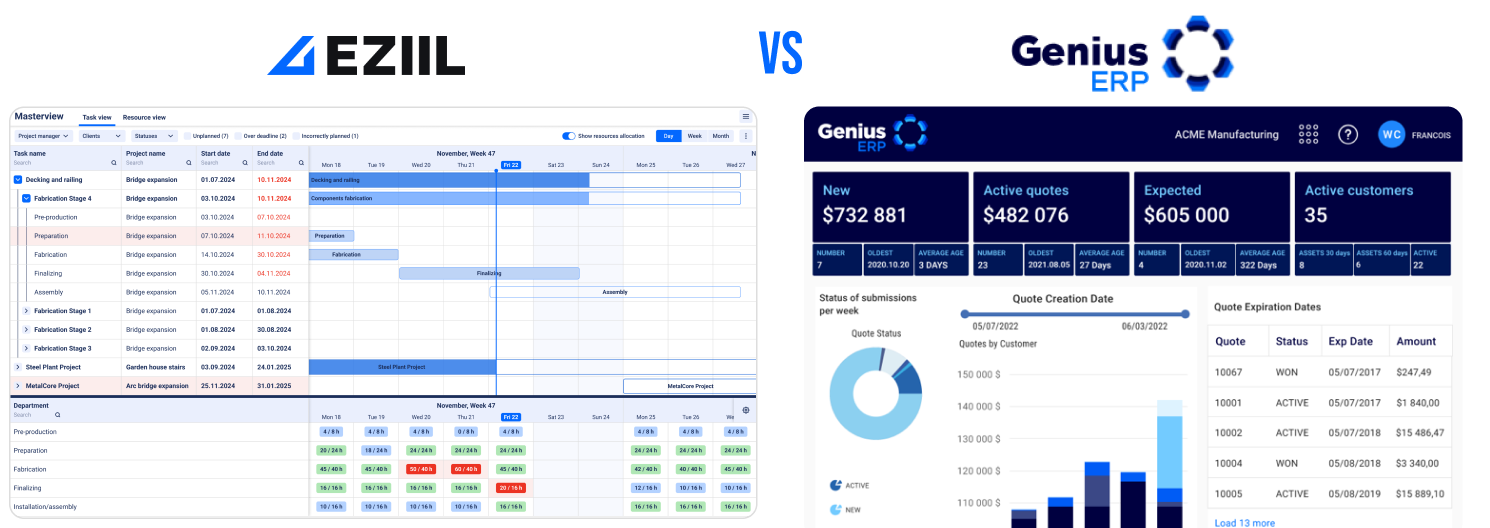
| Production scheduling and capacity visibility | Strong on smart scheduling and production management, especially for high-variable manufacturing. | Strong on live scheduling for small steel shops, department-level visibility, deadline alerts, and keeping everyone aligned on active work. |
| Shop floor control | Includes shop floor functionality as part of a larger ERP stack. Good for companies that want broader operational control in one platform. | Includes mobile task visibility, reporting, real-time updates, and advanced shop floor control in add-on modules when needed. |
| Cloud vs on-prem | More flexible on hosting. Genius states it can be hosted on-premise or in the cloud, depending on business preference. | Cloud-based. You do not need to worry about servers, backups, or tech management, as long as you have internet connection. |
| Accounting and job costing | Clear advantage if integrated accounting and deeper job costing are central to your evaluation. | Better if you do not want to replace everything at once and are comfortable integrating finance/accounting separately while fixing operations first. |
| Pricing clarity and risk | Genius ERP final pricing is determined during the sales process. | Pricing starts from €120/month, modular expansion, and lower capital risk. |
| Time to first live job | Expect a more traditional ERP timeline. Implementation can take anywhere from 1 to 3 or more months, depending on project scope and training capacity. | Faster path to value. The first step can be implemented in less than a week, and most companies usually start seeing results in less than a month. You can add modules (BOM, procurement and inventory, machine scheduling, dispatching, etc) and complexity as your needs grow. |
| Learning curve | Higher. Because it covers more ground across engineering, purchasing, production, finance, and CRM. Independent online reviews also mention that transition can be lengthy and complex. | Lower. EZIIL’s scope is narrower, module-based, and designed to be implemented alongside daily work, which usually makes it easier for a small steel shop to adopt without a full ERP-style rollout. |
| Best choice for small custom steel fab | Best when the shop is truly engineering-heavy, wants deeper ERP control, and is ready for a more involved implementation. | Best when the shop mainly needs scheduling clarity, live production visibility, easier adoption, and a practical way to replace spreadsheet chaos without jumping straight into a heavy ERP project. |
EZIIL Starter for small custom steel fabricators
EZIIL Starter is a lightweight, fabrication-specific operating layer for small custom steel shops. It is not trying to be the broadest manufacturing ERP software on the market. It is trying to help a project-based steel fabricator manage jobs, schedule work, coordinate departments, track progress, and see margin in real time without dragging the whole company into a heavy ERP rollout from day one. It’s a centralized steel fabrication software for project planning, scheduling, job shop management, and execution, built specifically for small custom steel fabricators moving away from Excel, Google Sheets, Microsoft Project, Power BI, and pen-and-paper workflows.
While most ERP software for manufacturing is built to cover every department, every workflow, and every edge case across multiple manufacturing types. EZIIL Starter is narrower by design. It is meant to become the first practical digital system a small steel shop can actually adopt and use daily, rather than another big software purchase that sits half-implemented in the background.
What jobs it solves well
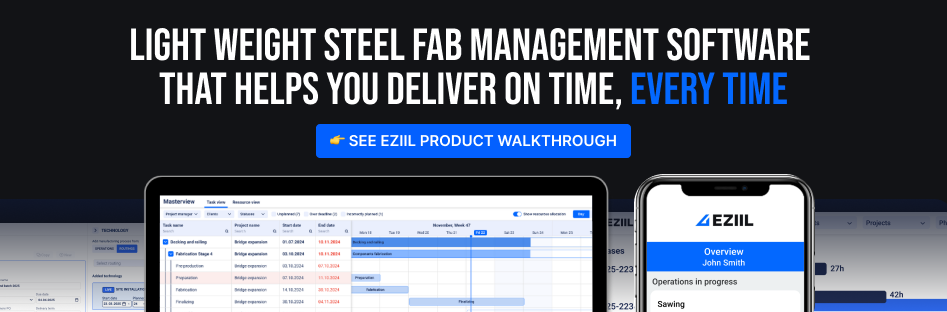
For a small custom steel fabricator, EZIIL Starter is strongest when the real problem is not “we need the deepest ERP possible,” but “we need to get control of the work.” That usually means better production scheduling, clearer department-level visibility, easier task assignment, better document control, and live progress tracking across active jobs. EZIIL’s workflow is built around four stages: Prepare, Plan, Report, and Analyze, solving the most critical issues on the shop floor and in the office.
In practice, that means EZIIL Starter is a strong fit for shops that need to centralize project data, drawings, tasks, due dates, and routing; schedule fabrication phases with capacity in mind; give workers a live task queue and mobile reporting; and compare planned versus actual time and cost while the job is still running. That combination is especially relevant for small steel shops that are juggling multiple custom projects at once and need tighter shop floor control without buying a full custom manufacturing ERP before they are ready.
Pricing
EZIIL Starter starts at €120/month for 1 to 15 users, €180/month for 16 to 50 users, and €290/month for 51 to 150 users. You can expand and add more ERP-level modules as you grow and ease into it.
Implementation and onboarding
EZIIL Starter has scalable implementation, quick adoption, and a phased rollout rather than a big-bang ERP deployment. Starter is a lightweight steel fabrication software that a team can ease into step by step, with setup, training, and go-live happening quickly enough that the business does not need to stop operating just to get the software in place.
That is a real advantage for small fabrication businesses, where software does not usually fail because the feature list is too short. It fails because the rollout is too heavy, too abstract, or too disruptive for the foreman, PM, and shop team to stick with. EZIIL’s phased model is clearly designed to reduce that risk. It lets a shop start with the planning and execution basics, then add more depth later if and when that makes sense.
Where it is strongest
EZIIL Starter is strongest where small custom steel fabricators usually feel the pain first: production scheduling, visibility, execution, and accountability. It provides your team with real-time dashboards, on-time delivery alerts, capacity-aware planning, task assignment, mobile reporting, and live profit visibility. In simple terms, it helps answer the questions a small steel shop asks every day: What is late? What is blocked? What is each department working on? Are we still on track? Are we still making money on this job?
It is also strong as a practical bridge between office planning and the shop floor. EZIIL ties job data, drawings, routing, reporting, and progress together in one system, so teams are not bouncing between separate spreadsheets, disconnected documents, and verbal updates. For the right buyer, that is the real value proposition: not more software, but less chaos.
Where it is lighter than a full ERP
EZIIL Starter is lighter than a full ERP by design. Out of the box, its center of gravity is planning, execution, reporting, and operational visibility, not the full financial, CRM, and engineering depth you would expect from a broader engineer-to-order ERP or custom manufacturing ERP. EZIIL does offer deeper ERP-style capability through add-on modules such as BOM and engineering data, procurement, inventory, subcontractor management, invoicing and accounting integrations, analytics, EN 1090 traceability, and expanded shop floor control, but those sit beyond the basic Starter scope.
So if a buyer’s top priority is a deeper accounting core, a heavier CAD to BOM workflow, or a wider all-in-one manufacturing ERP system from day one, EZIIL Starter will naturally feel lighter than a product built around that. But for a small custom steel fabricator, that lighter footprint is often part of the value. It means the shop can fix the most painful operational problems first, then decide how much ERP depth it actually wants to add later.
Genius ERP
Genius ERP is a full manufacturing ERP system built for custom manufacturers that need more than scheduling and shop-floor visibility alone. The software focuses on engineering, production, inventory, purchasing, CRM, accounting, analytics, and field service, which is why it reads more like a broad custom manufacturing ERP than a lightweight operations tool. It is aiming to be the core business system for manufacturers that want engineering, operations, and financial control tied together.
Who is Genius ERP really built for
Genius ERP is for manufacturers that are dealing with higher engineering complexity and want a stronger connection between design, estimating, production, purchasing, and costing. The product is especially geared toward engineer-to-order ERP and mixed custom manufacturing environments where the business needs deeper structure around BOMs, routing, cost control, and production planning.
That means Genius ERP will usually make the most sense for a company that is further along in its systems maturity than the average small steel shop still running on spreadsheets and informal handoffs. If the team already knows it wants a broader ERP software for manufacturing, and not just a faster way to schedule and track jobs, Genius belongs on the shortlist.
Strongest capabilities
The strongest part of Genius ERP’s story is depth. Its CAD to BOM capability is one of the clearest examples. Genius’ CAD2BOM feature is an excellent way to turn designs into BOMs and RFQs faster while reducing data entry and production errors. For buyers where engineering handoff is a core pain point, that is a serious strength.
Genius ERP also features strong capabilities around estimating and quoting, job costing, production scheduling, material planning, and nesting integration. On top of that, Genius has integrations with SOLIDWORKS, Autodesk Inventor, AutoCAD, QuickBooks, HubSpot, ProNest, SigmaNEST, Bystronic, and Trumpf.
Pricing
The practical reality of Genius ERP pricing is that it is more quote-led and less transparent than EZIIL. Genius does have a pricing page and an ERP cost guide, but its public pricing is framed more around understanding total ERP cost than around a simple monthly number a buyer can immediately benchmark. Capterra currently lists Genius ERP with a starting price of $3,000 per user per year, which gives buyers some directional context, but it still does not feel like a simple self-serve pricing model.
That does not mean the product is overpriced. It means the buying motion is more typical of a serious ERP. The final cost will likely depend on user count, deployment model, scope, implementation needs, and how much of the system the business plans to use.
Implementation and onboarding
Genius ERP’s implementation can take one to three or more months, depending on the complexity of the business and project scope. That is not unusual for a broader ERP, but it is still a real consideration for a small steel fabricator that wants fast relief from scheduling and visibility problems.
Public review sentiment points in the same direction. On G2, Genius ERP holds a 4.3/5 rating from 32 reviews, and users often praise the system’s functionality, customization, and support. At the same time, G2’s review summary explicitly notes that transition from previous systems can be lengthy and complex, and some reviewers mention laggier interface feel in places. Capterra reviews are also broadly positive, with 4.2/5 overall, but they include comments that reinforce both sides of the picture: reduced spreadsheet reliance and strong BOM/inventory value on one hand, but occasional complaints about dated feel or wanting more direct support on the other.
So the implementation reality is fairly straightforward. Genius ERP may absolutely be worth the effort for the right company, but it should be approached like a real ERP project, not like a light operational tool you can casually switch on next week.
Best-fit use cases
Genius ERP is the best fit when the company is genuinely engineering-heavy, needs stronger end-to-end structure, and wants one system that reaches deeper into quoting, BOMs, routing, purchasing, inventory, costing, and accounting. It is especially compelling when CAD to BOM, engineering-to-production flow, and integrated job costing are high on the buying checklist, or when the business needs a more serious manufacturing ERP software foundation rather than just better job visibility.
For a small custom steel fabricator, that usually means Genius ERP makes the most sense when the shop is trying to build a more complete ERP environment around custom manufacturing complexity. If that is the real goal, Genius ERP is a credible option. If the immediate problem is mainly scheduling clarity, shop-floor reporting, and getting out of spreadsheet chaos without taking on a heavier ERP rollout, its breadth may end up feeling like more system than the shop actually needs right now.
Genius ERP vs EZIIL comparison by buying criteria
Pricing
If pricing transparency matters early, EZIIL is easier to evaluate. EZIIL publicly lists Starter pricing at €120/month for 1 to 15 users, €180/month for 16 to 50 users, and €290/month for 51 to 150 users, which makes it much easier for a small steel shop to understand the entry cost before talking to sales. Genius ERP takes the more traditional ERP route. Its own site says pricing depends on company size, users, and deployment type, while Capterra lists Genius ERP at a starting price of $3,000 per user per year.
Scheduling
Both products are strong in scheduling, but they do it from different angles. Genius ERP frames scheduling inside a larger ERP context, pairing smart scheduling with production management, material planning, capacity, inventory, and real-time shop floor data. It is built for high-variable manufacturing and clearly speaks to more complex operational environments.
EZIIL’s scheduling story is more immediately relevant to a small custom steel fabricator trying to get control of daily work. EZIIL excels in real-time scheduling, at-a-glance progress tracking, deadline visibility, and practical shop-floor coordination for teams moving away from Excel, paper, and disconnected tools. That makes EZIIL easier to picture in a smaller steel shop where the real problem is not “we lack ERP sophistication,” but “we do not have a schedule people can actually trust.”
Shop floor control
EZIIL is especially strong here. When it comes to real-time scheduling, simplified task assignments, mobile or live reporting, at-a-glance progress tracking, and a centralized system designed for metal fabricators replacing spreadsheets and paper-based coordination, EZIIL is a strong choice. A deeper shop floor control is part of the EZIIL expansion path as a shop matures.
Genius ERP absolutely covers the shop floor too, but again as part of a bigger ERP structure. The platform covers shop floor, smart scheduling, production management, and real-time manufacturing data. That works well for manufacturers who want shop floor control tightly tied to engineering, purchasing, costing, and accounting. For a small steel fabricator, though, that broader scope can be either a strength or extra weight depending on what problem they are actually trying to solve first.
Accounting & job costing
This is one of Genius ERP’s advantages, as accounting and job costing are in the front and center of their design, alongside engineering, production, and scheduling. If a buyer wants tighter financial control inside the same manufacturing ERP system, Genius ERP is the stronger answer in this comparison.
EZIIL is lighter here by design. The software focuses more on project profitability, live operational visibility, and connected ERP add-ons than being the main accounting-first backbone from day one. That is not necessarily a weakness for the right buyer. For a small steel shop, it can actually be a cleaner path: fix planning, tracking, and execution first, then add more ERP depth later if needed.
Fit for small custom steel fabricators
This is where the decision usually becomes clearer. Genius ERP is a better fit when the company is genuinely engineering-heavy, wants stronger CAD-to-production flow, needs broader accounting and ERP structure, and is prepared for a more involved rollout. It is a better answer to “we need a serious ERP for custom manufacturing.”
EZIIL is a better fit when the company is a small custom steel fabricator that mainly needs better planning, clearer scheduling, stronger shop-floor coordination, and faster visibility without buying more system than the team can realistically absorb. It is a better answer to “we need control of our work now, and we do not want a heavy ERP project just to get it.”
Final verdict
For small custom steel fabricators, the better choice is EZIIL.
Not because Genius ERP is weak. It is not. Genius ERP is a serious manufacturing ERP system with real depth in engineering, CAD to BOM, purchasing, production, accounting, and job costing. If you are looking for a broader custom manufacturing ERP or engineer-to-order ERP that can connect engineering, shop floor, scheduling, finance, and management in one deeper system, Genius ERP is the stronger fit.
But that is not the same as being the best fit for a small project-based steel fabrication shop.
If your business is mainly trying to get control of active jobs, improve production scheduling, reduce spreadsheet chaos, tighten handoffs between office and shop floor, and give your team one system they will actually use, EZIIL is the better option. EZIIL is much more focused on make-to-order steel fabrication, phased rollout, capacity-aware planning, mobile shop-floor reporting, and modular growth without forcing a full ERP overhaul on day one. It also makes the buying decision easier by emphasizing monthly subscription, scalable implementation, and quick adoption.
So the short answer is this:
Choose Genius ERP if you are a heavier ETO or custom manufacturing business that needs deeper engineering-to-production flow, stronger ERP breadth, and more integrated financial and operational control
Choose EZIIL if you are a small custom steel fabricator and what you need most is a practical, lower-risk system for planning, execution, visibility, and throughput improvement. EZIIL is the better answer for that buyer.