
If you run a custom steel fabrication shop, you may be searching for a Katana MRP alternative that handles one-off projects, drawings, and job costing rather than SKUs and stock levels.
Katana was built inventory-first, for manufacturers making standard products. Custom steel fabrication, where every job has its own drawings, its own deadline, and its own budget to protect, asks for a different kind of tool.
This comparison looks EZIIL as a Katana MRP alternative and compares them side by side, so you can judge whether Katana fits your shop or whether a steel fabrication-specific alternative fits better. For a more in-depth comparison see full metal fabrication software buyer’s guide.
TL;DR: Katana is cloud inventory and manufacturing software built around products and stock: SKUs, recipes, reorder points, and e-commerce orders. It is excellent for manufacturers who make standard products and sell them through Shopify, Amazon, or wholesale. But it has no concept of a project.
EZIIL is purpose-built production management for custom steel fabricators doing one-off, project-based work, with drag-and-drop project scheduling, plan vs actual job costing per project, drawings tied to jobs, and built-in EN 1090-2 traceability, at a flat team-size price €120/$140 to €290/$140 to $338 per month plus a one-off €300/$350 onboarding fee). On cost, the gap is wide: Katana’s Core plan starts at €2550/$299 per month before add-ons, and manufacturing routings alone are a €170/$199 per month add-on. If you fabricate custom steel, EZIIL is the tighter and far cheaper fit. If you make standard products for stock and sell them online, Katana is the better tool and we will tell you so.
Last updated: July 2026.
Katana MRP Alternative, EZIIL: comparison table
| What matters to a small custom steel fab shop | EZIIL | Katana | Why it matters |
|---|---|---|---|
| Built for | EZIILOne-off, project-based custom steel fabrication (make-to-order projects). | KatanaProduct businesses making standard items: make-to-stock and product-based make-to-order, sold via e-commerce and wholesale. | Why it mattersThis single row explains every other row. A staircase with revision C drawings is not a SKU. |
| Monthly cost | EZIILFlat by team size: €120 / $140 per month (1 to 15 users), €180 / $210 (16 to 50), €290 / $338 (51 to 150). Every feature in every tier. | KatanaFree plan (30 SKU limit). Core plan from $299/mo (about €255). Manufacturing routings and insights: +$199/mo (about €170). Batch/serial traceability: +$249/mo (about €215). Warehouse app: +$149/mo (about €130). | Why it mattersA fabricator on Katana realistically needs Core plus Manufacturing, roughly $498/mo (about €425) before anything else. On EZIIL a 30 person shop pays €180 / $210 per month, all features included. |
| Upfront cost | EZIILOne-off €300 / $350 onboarding fee: setup, training, and regular check-ins done for you. | KatanaSelf-serve start, no mandatory onboarding fee. Implementation is on you. | Why it mattersKatana wins on frictionless signup. EZIIL wins on someone from the fabrication industry setting it up with you. |
| Project scheduling | EZIILDrag-and-drop capacity planning by department, built for metal fabrication timelines, with OTD indicators that flag jobs falling behind. | KatanaProduction scheduling by manufacturing order priority and material availability. No project-level timeline across departments. | Why it mattersCustom fab lives and dies by “which jobs are behind and by how much”. You need the answer per project, not per SKU. |
| Job costing | EZIILPlanned vs reality reports per project: estimated vs actual hours, costs, and timelines, plus a real-time profit dashboard with color-coded margins. | KatanaProduct cost calculation from BOMs and operations, planned vs actual time per operation. No project-level profit view for one-off jobs. | Why it mattersOn custom work you find out whether a job made money after you invoice, unless your software tracks it as you go. |
| Drawings and documents | EZIILDrag and drop blueprints, drawings, and documents into each project. Everything tied to the job. | KatanaNot built for drawing management. Items carry product data, not revision-heavy drawing sets. | Why it mattersIf your shop runs on PDFs from a detailer, the software must hold them where the work happens. |
| EN 1090-2 traceability | EZIILBuilt-in module: material certificates linked to work records, assemblies, and jobs (who did what, and when). | KatanaBatch and serial number traceability available as a $249/mo (about €215) add-on. Not EN 1090 execution class traceability. | Why it mattersFor structural steel in the EU and UK, this row alone can decide the vendor. |
| Shop floor app | EZIILMobile app (iOS and Android): operators start/stop a timer, log hours and task status per job task from their phones. | KatanaShop Floor App (web-based, tablet friendly): operators start, pause, and finish tasks on manufacturing orders with automatic time tracking. | Why it mattersBoth do this credibly. The difference is what the time lands on: a customer project in EZIIL, a manufacturing order in Katana. |
| Inventory and purchasing | EZIILInventory and procurement modules tied to projects: see what each project needs, what is in stock, what is on order. | KatanaExcellent multi-channel inventory: real-time stock, reorder points, barcode scanning, e-commerce sync. Katana’s strongest suit. | Why it mattersIf stock accuracy across sales channels is your main pain, Katana is genuinely hard to beat. |
| Integrations | EZIILDirecto, ProNest, and others. Accounting integrations via the invoicing module. | KatanaDeep native integrations: Shopify, WooCommerce, Amazon, Xero, QuickBooks, plus API. | Why it mattersShops selling standard products online should weigh Katana’s ecosystem heavily. |
| Time to go live | EZIILUnder a week, starting with one module, with personal onboarding included. | KatanaSelf-serve: days to weeks depending on your data and patience. Support is chat and email based. | Why it mattersFast either way. The difference is whether you climb alone or with a guide who knows fabrication. |
| Pricing predictability | EZIILFlat monthly price by team size. Published. Changes only when your headcount crosses a tier. | KatanaRecent user reviews report repeated pricing model changes (per user, then order-based, then GMV-based, then add-ons with usage fees) and steep increases. | Why it mattersYour software bill should not be a moving target. Read Katana’s recent reviews on this before you commit. |
| Best fit | EZIILCustom steel and metal fabricators, 15 to 150 people, project-based work, EU/UK or export jobs, EN 1090 requirements. | KatanaSmall product manufacturers selling standard goods through e-commerce and wholesale: food, cosmetics, furniture, electronics, apparel. | Why it mattersThe right tool matches how your shop actually makes money. |
Katana pricing verified on katanamrp.com in July 2026. Katana bills in USD, euro figures are approximate conversions. Confirm current pricing with the vendor. EZIIL pricing: eziil.com/pricing.
What is Katana?
Katana is cloud inventory and manufacturing software that serves thousands of small and mid-sized product businesses worldwide. Its center of gravity is inventory: real-time stock visibility across sales channels, purchasing, and production planning for products defined as SKUs with bill-of-materials recipes.
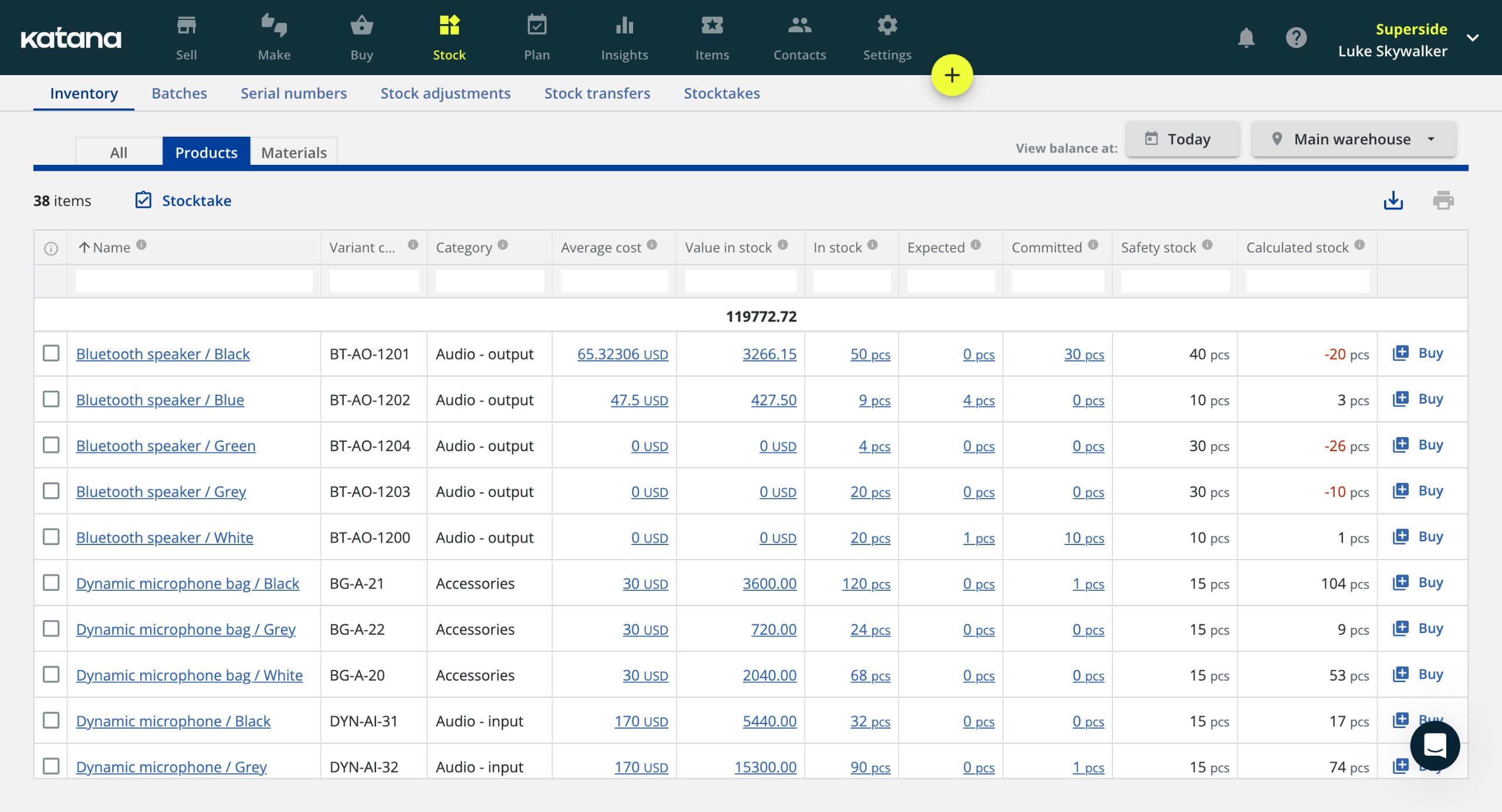
Katana’s headline strengths are its clean, modern interface, which independent online reviewers consistently describe as the easiest way into MRP for a first-time buyer, and its integration ecosystem: native connections to Shopify, WooCommerce, Amazon, Xero, and QuickBooks, plus an open API. For a business that makes standard products and sells them across several channels, Katana pulls orders, stock, and production into one live view.
Katana’s pricing (verified on katanamrp.com, July 2026) starts with a Free plan limited to 30 SKUs. The Core plan starts at €255/$299 per month with unlimited users, unlimited SKUs, and one inventory location.
Key capabilities are add-ons on top of that: Manufacturing management (routings and manufacturing insights) at €170/$199 per month, end-to-end batch and serial traceability at €215/$249 per month, and the Warehouse management app at €130/$149 per month. An Advantage plan with custom pricing sits above Core. Third-party analyses note that manufacturers who need routings and traceability commonly land between roughly €640/$750 and €940/$1,100 per month, and that annual plans carry a 15% “price lock premium” rather than the usual annual discount.
Implementation is self-serve. You sign up, import your data, and build your items and recipes yourself, with chat and email support and a knowledge base. There is no mandatory onboarding fee and no implementation team, which keeps the start frictionless for simple setups and leaves complex ones on your shoulders.
What Katana does well
We analyzed Katana users’ online reviews on G2 and Capterra, plus roundups across other software comparison sites, and here’s what Katana gets the most praise for:
- The interface is a genuine strength. First-time MRP adopters repeatedly say Katana’s visual dashboard shortened their learning curve. If your team has never used production software, this matters.
- E-commerce and accounting integrations are best in class for this price point. Shopify, WooCommerce, Amazon, Xero, and QuickBooks connections are native and well maintained. Orders flow in, stock levels flow out, books stay synced.
- Inventory management is the core competence. Real-time stock across locations and channels, reorder points, barcode scanning, and batch tracking (as an add-on). Reviewers running product businesses trust the numbers.
- The Shop Floor App is credible. Operators see assigned tasks on a tablet or phone, press start, and Katana tracks actual time against planned time per operation automatically.
- Unlimited users on paid plans. Like EZIIL, Katana does not charge per seat, so the whole team can be in the system.
Where Katana falls short for a small custom steel fabricator
However, our analysis on the same online review platforms, plus Katana’s own product structure, surfaced consistent gaps for project-based fabrication:
- There is no project. Katana’s world is items, recipes, and manufacturing orders. A one-off contract with 40 assemblies, a drawing set on revision C, a subcontracted galvanizing step, and a phased site delivery has no natural home. Users of custom work ask for “better functionality for custom made products” in reviews, and it is the most structural limitation of all.
- No project-level job costing. Katana calculates product costs from BOMs and operations and shows planned vs actual time per operation. What it does not do is roll hours, materials, and subcontracting up into a live profit view per customer project. On one-off work, that is the number that keeps you solvent.
- No drawing or document management. Steel fabrication runs on drawings. Katana items carry product data, not revision-heavy PDF sets from an external detailer.
- No EN 1090 traceability. Katana’s traceability add-on (€215/$249 per month) covers batch and serial numbers for products. It is not EN 1090-2 execution class traceability linking material certificates to work records, assemblies, and welders. For structural steel in the EU or UK, that gap is disqualifying.
- No site deliveries or subcontractor workflows. Shipping in Katana means fulfilling sales orders. Phased deliveries to a construction site, and work that leaves your shop for galvanizing or painting and comes back, are outside its model.
- Pricing has become a real complaint theme. Recent reviews describe repeated pricing model changes (per user, then order line based, then GMV based, then modular add-ons with usage fees), steep cumulative increases, and terms changing mid-contract. Capterra and G2 reviewers who sell many small-ticket orders report costs far beyond the value consumed.
- Costs stack up fast for manufacturing use. Core at €255/$299 plus Manufacturing at €170/$199 is €425$498 per month before traceability or warehouse add-ons. Third-party estimates put typical manufacturing configurations at €640/$750 to €940/$1,100 per month. That is roughly 4-7 times EZIIL’s highest tier.
Who Katana is really for
A small manufacturer of standard products, think food and beverage, cosmetics, furniture, electronics, or apparel, selling through Shopify or wholesale, holding stock, and needing inventory accuracy across channels with light production planning. For that business, especially one already living in Shopify and QuickBooks, Katana is one of the best tools on the market, and EZIIL would be the wrong choice.
What is EZIIL?
EZIIL is a cloud production management software that’s the ideal Katana MRP alternative for small custom steel and metal fabricators: the 15 to 150 person shops doing project-based, one-off work such as structural steel, staircases, architectural metalwork, and industrial equipment. It was founded by people from the steel fabrication industry and is used by shops across USA, Canada, Australia, Europe and the UK.
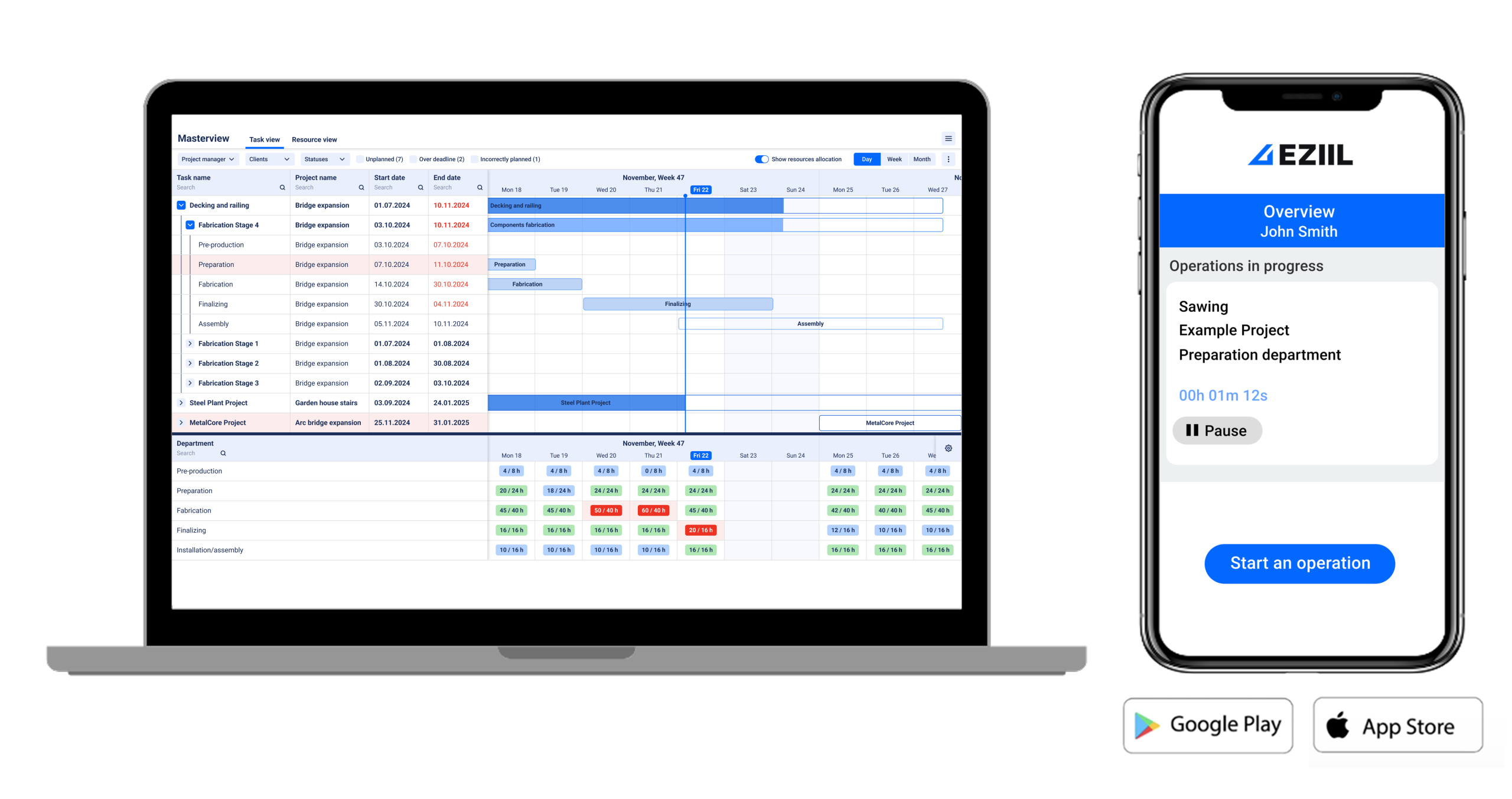
EZIIL’s core idea is the opposite of inventory-first. The unit of work is the project. You start with EZIIL Starter, the complete base product: drag-and-drop capacity planning by department, a live dashboard that updates as hours are reported, planned vs reality hours and costs per project, OTD indicators that flag anything falling behind, drawings and documents tied to each job, and a mobile shop floor app where workers start and stop a timer and see today’s tasks. Then you add advanced ERP modules only when you are ready: Bill of Materials (BOM), procurement, inventory, EN 1090-2 compliance, subcontractor management, machine planning, shipments and deliveries, and more.
EZIIL’s pricing is flat by team size, and every tier gets the same full Starter feature set:
- €120/$140 per month for 1 to 15 users
- €180/$210 per month for 16 to 50 users
- €290/$338 per month for 51 to 150 users
- One-off €300/$350 onboarding fee (setup, training, and regular check-ins)
No per-user fees, no usage-based fees, no add-on required to unlock scheduling or job costing. A 50 person shop pays €180/$210 per month whether it ships two projects a month or twenty.
Implementation is done with you: go live in under a week, starting with one module, with personal onboarding from people who understand fabrication.
APS Group’s planner Syed H. describes it plainly: “It only took us a few weeks to roll out EZIIL internally, as the learning curve was minimal.“
What EZIIL does well
- It speaks project. Scheduling, costing, drawings, procurement, and deliveries all hang off the job, because in a custom shop the job is the business. FLI Structures’ purchasing manager Lynn S. calls it “a hub of information that is extremely easy to navigate, giving a full picture of all live jobs.“
- Profit visibility while you can still act on it. Planned vs reality dashboards per project with color-coded margins. APS Group again: “Now we can see exactly what the workers are doing in the workshop and how many hours they are spending on each process. This has given us tighter control of active jobs, better-informed estimating and concrete profit/loss insights per job.“
- Real cost math a small shop can plan around. Year one for a 30 person shop: €180 x 12 + €300 onboarding = €2,460 (in USD: $210 x 12 + $350 = $2,870). Compare that with roughly $6,000 to $13,000 (about €5,100 to €11,100) a year on a realistic Katana manufacturing configuration.
- Fast, low-risk start. One module, live in under a week, add the rest when ready. Kane Metall built a production drawing management platform and job order system within a week.
- Shop floor adoption that actually happens. B&W Metall reached 100% shop floor adoption, every worker reporting in EZIIL regardless of age or role, through a step-by-step rollout. For the floor, EZIIL is mostly start and stop a timer and see today’s tasks.
- EN 1090-2 traceability built in. Material certificates linked to work records, assemblies, and jobs. When the auditor asks who welded what and from which heat number, the answer is a few clicks.
- Proven, attributed outcomes. VMT raised engineers’ work efficiency by 40% and increased turnover by 30% without hiring after adopting EZIIL BOM. Enefit Solutions deleted 12 separate Excel sheets: “The whole team can now work in one system,” says Rait K., Chairman of the Board. Nordic Shelter’s engineering lead reports a 24x return: “1 hour invested in EZIIL BOM saves 8 hours in procurement and 16 hours in production.”
Where EZIIL falls short
- No e-commerce integrations. No Shopify, WooCommerce, or Amazon connections, because custom steel projects are not sold in a cart. If part of your revenue is standard products sold online, Katana handles that world and EZIIL does not.
- Not an inventory-first system. EZIIL’s inventory and procurement modules exist to serve projects. A business whose main problem is multi-channel stock accuracy will find Katana’s inventory engine deeper.
- No self-serve free trial. EZIIL offers a free product tour (sign up and see inside the platform in a demo version) and booked demos, but not a self-serve trial, because fabrication setups are unique and the onboarding team helps with initial setup and data migration. Katana’s free plan and self-serve start are genuinely lower-friction for kicking tires.
- Not a full ERP. EZIIL integrates with accounting tools (Directo, among others) rather than replacing them, and quoting happens outside the system, sharpened by plan vs actual data.
Katana vs EZIIL: the verdict for small custom steel fabricators
Choose Katana if you make standard products, sell them through Shopify, Amazon, or wholesale, hold stock, and need inventory accuracy across channels with light production planning. Its interface, integrations, and self-serve start are the best in this comparison, and for a product business it is the stronger tool. Just budget for the add-ons you will need and read the last year of reviews on pricing changes.
Choose EZIIL if you are a custom steel or metal fabricator with 15 to 150 people doing one-off, project-based work. You get project scheduling built for fabrication timelines, planned vs reality job costing per project, drawings tied to jobs, a shop floor app your welders will actually use, and EN 1090-2 traceability built in, at €120/$140 to €290/$338 per month flat plus €300/$350 once. Live in under a week, with onboarding by people who have stood on a shop floor.
The pattern across every category is the same: Katana is an inventory-first product tool that is excellent at what it was built for, and custom steel fabrication is not what it was built for. EZIIL is narrower by design, and that narrowness is exactly the fit a project-based shop needs. Breadth you will not use is just weight. Depth in the work you do every day is what shows up in on-time delivery and margin.
Is EZIIL the best Katana MRP alternative: five questions to decide
1. Is your work projects or products?
If you’re producing the same items week after week, replenished to stock or made to order from a catalog, you are a product business and Katana’s model fits you. If every job has its own drawings, deadline, and budget, you are a project business, and EZIIL is the best Katana MRP alternative for you. Forcing projects into a SKU-shaped system is the kind of daily friction that kills adoption.
2. What does year one actually cost?
Year One with EZIIL for a 30-person shop: €180 x 12 months + €300 onboarding = €2,460 in year one ($210 x 12 + $350 = $2,870), and €2,160 / $2,520 every year after.
Katana, same shop needing manufacturing routings: $299 + $199 = $498 per month (about €425), so roughly $5,976 (about €5,120) in year one, and more if you need traceability (+$249/mo, about €215) or the warehouse app (+$149/mo, about €130). Third-party estimates for typical manufacturing configurations run $750 to $1,100 per month, which is $9,000 to $13,200 (about €7,700 to €11,300) a year. Then factor in the review-reported history of pricing model changes and usage fees, and ask each vendor to put your three-year number in writing.
3. Can it answer “which jobs are behind, and did we make money?”
This is the question owners of custom shops actually ask at 7am. In EZIIL, OTD indicators flag jobs and departments falling behind, and the profit dashboard shows planned vs actual per project as hours are reported. In Katana you can see manufacturing order statuses and operation-level times, but nothing rolls up to a customer project, because the project does not exist in the data model.
4. Where do the drawings live?
Load a real job in each demo: a staircase or skid frame with a revision-heavy drawing set, a subcontracted galvanizing step, and a phased site delivery. In EZIIL, drag the drawings into the project and watch them follow the job to the shop floor app, latest revision included. Katana handles this differently: it does not support direct file uploads. The documented workaround is to upload drawings to Dropbox, Google Drive, or OneDrive and paste a shareable link into the “Additional info” text field on the item or order. It works, but it means your drawings live in a separate system, your welder taps out of the shop floor app into a browser to view them, and revision control depends on someone maintaining the cloud folder rather than the job record. For a product business with a stable spec sheet per SKU, a link is fine. For custom steel work where revision C replaced revision B on Tuesday, it is a gap you will feel weekly.
5. What support do you get during setup?
Katana’s self-serve start is real: sign up today, import data, build recipes, chat support when stuck. EZIIL’s answer is a €300/$350 one-off onboarding where people from the fabrication industry set it up with you, train the team, and check in regularly, with the first step live in under a week. Self-serve suits a simple product catalog. A custom fab shop’s data (projects, assemblies, drawings, certificates) rarely imports itself.
FAQ
Is Katana good for metal fabrication?
Katana is strong software for product manufacturers who make standard items and manage stock across sales channels. For custom metal fabrication it has structural gaps: no project-level scheduling or job costing, no drawing management, no subcontractor or site delivery workflows, and no EN 1090 traceability. Reviewers doing custom work ask for better custom product functionality. Fabrication-specific software, like EZIIL, fits a custom steel shop more tightly.
How much does Katana cost compared to EZIIL?
Katana (July 2026) offers a free plan limited to 30 SKUs, then a Core plan from €255/$299 per month. Manufacturing routings are a €170/$199 per month add-on, batch/serial traceability €215/$249 per month, and the warehouse app €130/$149 per month, so manufacturing configurations commonly land between roughly €430/$500 and €940/$1,100 per month. EZIIL charges a flat monthly rate by team size: €120/$140 (1 to 15 users), €180/$210 (16 to 50), or €290/$338 (51 to 150), with every feature in every tier, plus a one-off €300/$350 onboarding fee. Year one for a 30 person shop is roughly €2,460/$2,870 on EZIIL versus roughly €5,100/$6,000 or more on Katana.
Does Katana do job costing for custom projects?
Katana calculates product costs from bills of materials and operations, and its Shop Floor App tracks planned vs actual time per operation. It does not provide project-level job costing that rolls hours, materials, and subcontracting into a live profit view per customer job. EZIIL provides planned vs reality reports and a real-time profit dashboard per project, because one-off jobs are its core data model.
Does Katana or EZIIL support EN 1090 traceability?
EZIIL has EN 1090-2 traceability built in as a module, linking material certificates to work records, assemblies, and jobs. Katana offers batch and serial number traceability as a $249 (about €215) per month add-on, which serves product recalls and expiry tracking rather than EN 1090 execution class requirements. For structural steel work in the EU and UK, this is often the deciding factor.
Does EZIIL integrate with Shopify or QuickBooks like Katana?
No. Katana’s native e-commerce and accounting integrations (Shopify, WooCommerce, Amazon, Xero, QuickBooks) are a core strength and a real reason product businesses choose it. EZIIL integrates with tools relevant to fabrication workflows, including Directo and ProNest, and offers invoicing and accounting integrations as a module. If online sales of standard products are part of your business, weigh Katana’s ecosystem seriously.
Can I try Katana or EZIIL before buying?
Katana offers a free plan (30 SKU limit) and self-serve signup, which is the easiest way to explore it. EZIIL offers a free product tour where you sign up and see inside the platform in a demo version, plus booked demos. EZIIL does not offer a self-serve free trial because steel fabrication setups are unique and the onboarding team helps with initial setup and data migration.
Why do Katana reviews mention pricing changes?
Recent verified reviews on Capterra and G2 describe repeated changes to Katana’s pricing model over the years (per user, then order line based, then GMV based, then modular add-ons with usage fees) and steep cumulative increases, particularly painful for manufacturers with many small-ticket orders. Katana’s current published model is the Core plan from $299 (about €255) per month plus feature add-ons. Whichever vendor you evaluate, ask for your three-year price in writing.
How we compared Katana and EZIIL: methodology
This comparison was researched and written by Team EZIIL in July 2026.
What we looked at. We compared the two products on the criteria small custom steel fabricators tell us decide their vendor shortlists: total year-one and ongoing cost, pricing predictability, project scheduling, job costing, drawing management, EN 1090-2 traceability, shop floor usability, inventory and purchasing, integrations, and onboarding support. These criteria come from our customers and sales conversations with steel fabrication shops of 15 to 150 people.
How we researched Katana. All Katana claims are drawn from public sources: Katana’s own pricing and feature pages (katanamrp.com, confirmed in July 2026), Katana’s support documentation for the Shop Floor App, verified user reviews on G2 and Capterra, and third-party pricing analyses. Katana bills in USD; euro equivalents are approximate conversions at July 2026 rates. We did not rely on internal assumptions about Katana.
How we described EZIIL. EZIIL pricing, features, and implementation timelines come from our published pricing and documentation. Every customer outcome is attributed to a named customer (Enefit Solutions, VMT, B&W Metall, Kane Metall, Nordic Shelter, APS Group, FLI Structures) and quoted as originally given.
Updates. Pricing and features change, and Katana’s pricing in particular has changed several times in recent years. We review this comparison when either vendor makes a material change and re-verify pricing at least quarterly. If you spot something outdated, email support@eziil.com and we will correct it.