
Shop floor control is the software layer that runs the production floor. It schedules operations to machines and people, puts the right drawing in front of each worker, captures what actually gets done as it happens, and shows where every job stands in real time. In custom steel fabrication, it is the part most ERP systems handle worst.
However, most fabrication buyers treat the shop floor as the last step of the job, a piece to bolt on after the drawings, the BOM, the nesting and the purchase orders are sorted. It works the other way around. Those upstream tools produce a plan. The floor is where the hours are spent, the margin is won or lost, and the deadline is either met or missed. That is the important part, and it is exactly where an ERP built for planning and finance tends to go quiet.
In a 2025 survey of manufacturers, half still ran production on spreadsheets or paper alongside their ERP (Qlector, 2025). The plan lives in the system. The truth lives on the floor. The two rarely meet.
This guide covers what shop floor control means for a custom steel or metal fabrication shop, why execution is the real cost center, and the seven functions a fabrication system has to get right that a generic ERP usually misses. It is written for the owners and production managers of shops running 15 to 150 people on one off, project based work.
What shop floor control actually means in fabrication
In a custom steel shop shop floor control is the part that covers scheduling operations to the right machines and people, giving each worker the right job and the right drawing at the right moment, capturing what actually happened as it happens, and feeding that back so anyone can see where every job stands.
It is worth separating three things that fabricators often lump together, because the confusion is exactly why the floor gets under served.
Your CAD and detailing tools (Tekla, SolidWorks, Autodesk Advanced Steel) and your nesting software produce the design and the cut data. That is engineering.
Your ERP or accounting system handles the money and the master records: invoices, purchase orders, the general ledger. That is administration.
Shop floor control is neither. It is production. It answers the questions that decide whether you deliver on time and at a profit: what is running now, what is next, who is on it, how many hours has it taken against what you planned, and is anything about to slip. For a plain definition of where this sits next to planning software, see our explainer on MES vs ERP.
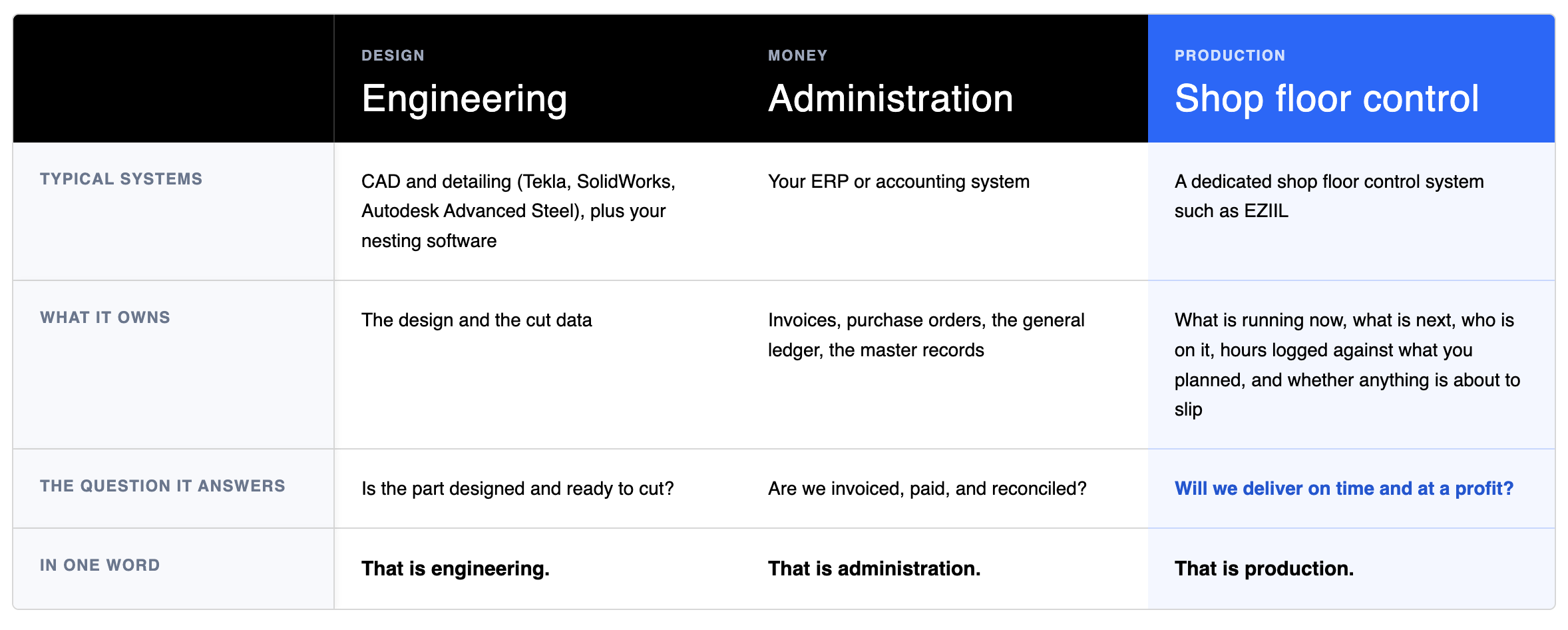
Most ERP platforms were built for the administration layer and for repeatable, high volume production. Bolt a fabrication shop onto one and the finance side works fine, while the shop floor still runs on spreadsheets, printed travellers and a walk across the yard to ask how the job is going.
The Importance of shop floor Control
Execution is where the hours get spent, where quality is won or lost, and where the deadline is met or missed. Here are 3 ways poor shop floor control can hurt a steel fabrication business.
- Wasted production time. The lost share goes to waiting, changeovers and stops that nobody logged. That loss happens on the floor, and the drawings cannot see it. Fabricators know the feeling: machines sit idle for a chunk of the day while the planned hours and the real hours drift apart.
- Rework. The cost of poor quality, the scrap and the do-overs and the fixing, typically runs at 5-30% of sales for manufacturers, and most executives guess low, assuming it is under 5% (Quality Digest). Rework is a shop floor event, it shows up as a welder redoing a part.
- Visibility gap, and it costs money before you ever invoice. When the plan lives in an ERP and the execution lives in spreadsheets and memory, the honest answer to “how far along is this job” is a walk to the shop and a guess. Problems surface late, when they are expensive, instead of early, when they are cheap.
None of this is the fault of your drawings or your BOM. They did their job. The plan is simply the cheap part, and execution is where the hours burn, the margin leaks and the deadline is decided. Treat it as an afterthought and you are left with a good plan and no way to know whether it is coming true.
If you digitize a broken process and you just get a faster broken process. Shop floor control is not about adding screens. It is about running the part of the business where the money is actually made.
The 7 shop floor control functions ERPs are missing
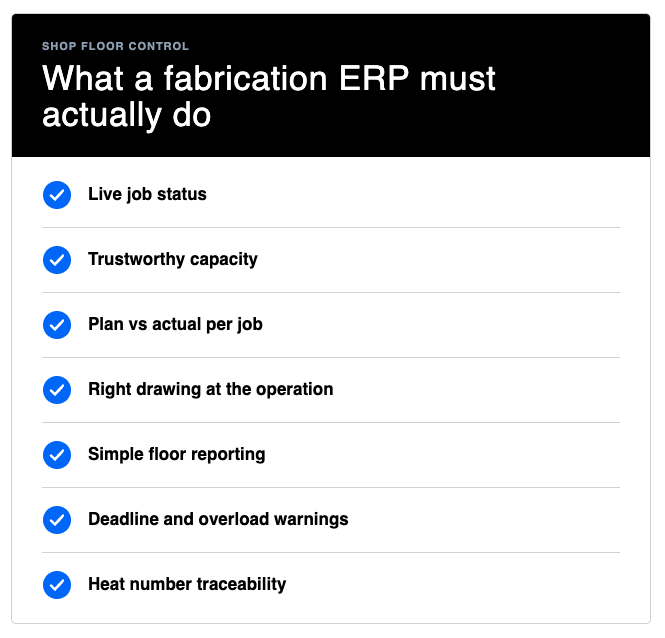
Here is the checklist to hold any steel fabrication system against. Each of these is something the execution layer has to do, and something a general ERP usually does not do well for one off, project based steel work.
1. A live view of where every job stands
Ask a generic ERP where a job is right now and it will show you the last thing someone keyed in, which might be yesterday, or last week. On the floor, that means the only reliable status check is a walk through the shop and a conversation.
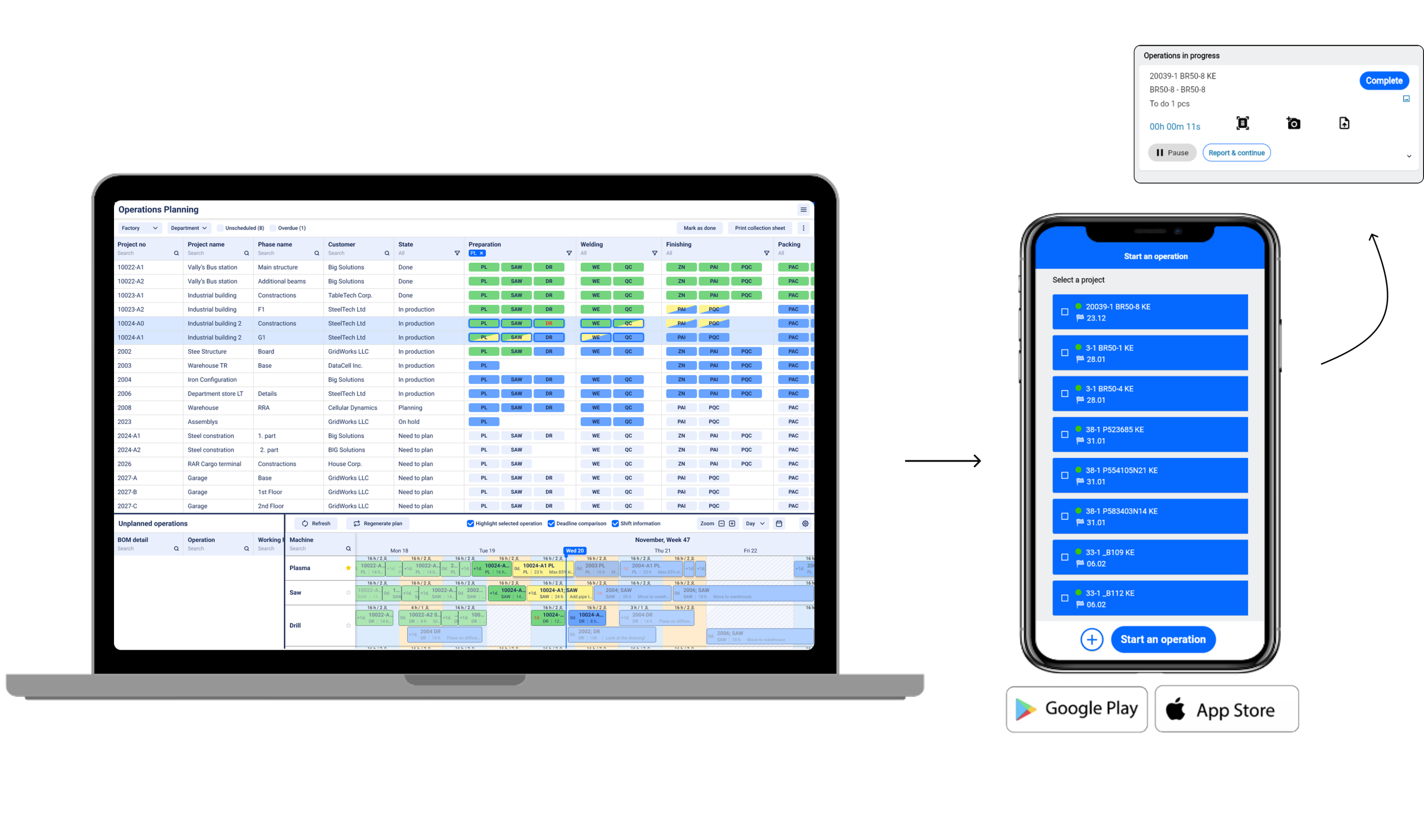
Shop floor control replaces that walk. As work is reported at each operation, a live dashboard updates on its own: what is in progress, what is done, what has not started. If somebody asks how far along the project is, you should not have to go walking in the workshop to find out.
This is the payoff APS Group described after rolling EZIIL out in a few weeks: “Now we can see exactly what the workers are doing in the workshop and how many hours they are spending on each process. This has given us tighter control of active jobs, better-informed estimating and concrete profit/loss insights per job.” (Syed H., Planner, Control Manager and QA-QC, APS Group.)
2. Capacity you can actually trust
The most expensive decision a small steel shop makes is whether to say yes to the next job. Say yes when you are already full and you blow a deadline. Say no when you had room and you leave money on the table. General ERPs built for batch production rarely model finite capacity by department in a way a job shop can trust, so the answer stays a gut call.
Shop floor control gives you real capacity by department and person, including who is available and who is out, so you can see where you are already full and quote a lead time you can hit. In EZIIL this lives in a project level master view that balances estimated hours against capacity and compares them to the deadline, showing how many hours and days are left and whether you are on course to overrun your own timeline. (For the decision itself, see our guide on capacity planning that answers go or no go.
3. Plan versus actual hours and cost, per job
Most shops find out whether a job made money after it ships, when the invoicing is done and it is far too late to act. That is because the estimate lives in one place and the real hours live in another, if they are captured at all. Estimating by feel is normal, and so is the steady gap between the ten hours quoted and the fifteen it took.
Shop floor control closes that loop. As hours are reported against the plan, you see planned budget against actual hours and cost while the job is still open, not months later. That is the difference between managing profit and auditing it. It matters because the leaks are large: recall that rework alone can run to 5-30% of sales (Quality Digest), and you cannot fix what you cannot see until the job is closed.
4. The right drawing and operation in the worker’s hand
A surprising amount of skilled time goes to fetching information. One of EZIIL’s customers, VMT, measured it: “On a week long project, I spent about 25% of my time just printing out work tasks and drawings.” That is a quarter of a skilled worker’s week spent at the printer, and it is invisible to the plan.
Shop floor control ties drawings and operations to the job itself, so the worker opens the current revision at the operation, on a screen at the station or on a phone, without hunting for paper or risking an old version. This is a genuinely mundane function that a general ERP was never built to do, and it is one of the fastest wins on the floor.
5. Reporting simple enough that the floor actually uses it
This is where most digitisation projects die. Build a reporting screen that demands too many taps and the floor quietly goes back to paper. Fabricators are blunt about what works: big buttons, minimal input, usable with gloves and dirty hands, and ideally only asking the worker to flag the exception, not narrate every step.
Shop floor control has to meet the floor where it is. In EZIIL that means a worker logs in, switches to their machine or operation, scans a QR code, sees the filtered list of items to do in planned order, checks the drawing, reports the quantity done, leaves a comment and completes. That is close to the whole interaction. Simplicity is what drives adoption, and adoption is what makes the data real. B&W Metall reached 100% shop floor adoption, every worker reporting regardless of age or role, through a step by step rollout, and eliminated thousands of paper work orders in the process.
6. Deadline and overload warnings before the Project slips
Firefighting is the default state of a shop with no execution layer. Problems become visible only when they are already problems: the job is late, the department is buried, the customer is calling. By then the options are all bad.
Shop floor control turns status into early warning. On time delivery (OTD) indicators flag the tasks and departments that are falling behind while there is still time to move work, add a shift or reset an expectation. The deadline comparison in EZIIL shows the overrun coming before it lands, which is the whole point of watching the floor in real time instead of reading about it in a post mortem.
7. Material and heat number traceability tied to the job
For anyone working to EN 1090 or a similar standard, traceability is not optional, and doing it on paper is slow and fragile. Linking heat numbers and mill certificates to the right parts, tracking offcuts back into stock, and producing an audit trail on demand is a shop floor function, because that is where material is consumed and recorded.
Shop floor control keeps that thread intact from goods in to dispatch. EZIIL builds EN 1090-2 traceability into the product, and it is the only one of our named direct competitors to do so. B&W Metall now pulls traceability in a few clicks where it once meant digging through a physical archive. If EN 1090 is a live requirement for you, keeping heat numbers and mill certs audit ready without the paper archive is worth getting right from the start.
Where drawings, BOM, nesting and your ERP actually fit
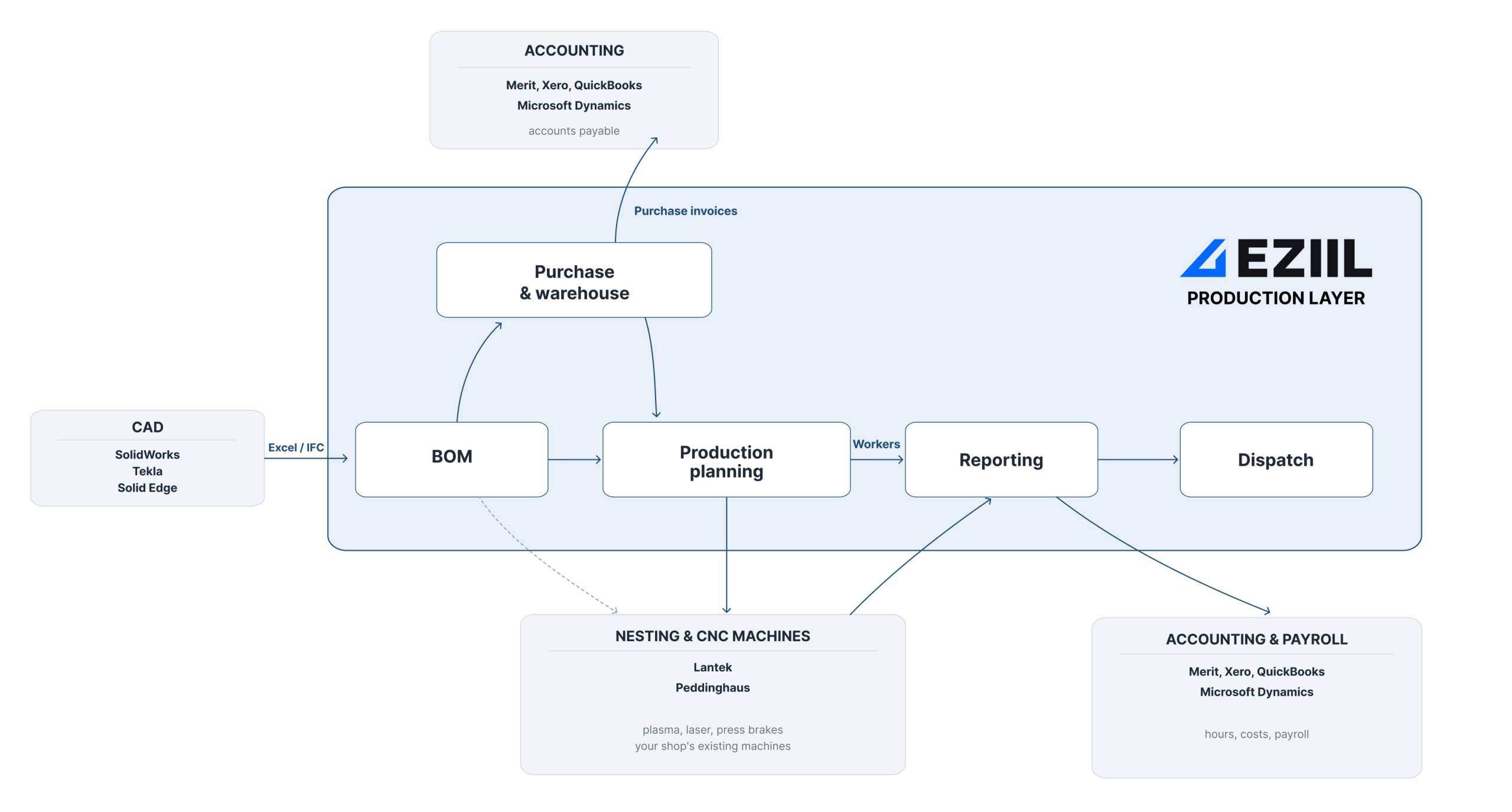
Our aim is not for you to throw out the tools you already run. It means putting execution at the center and letting the others feed it, rather than the other way round.
The clean picture looks like this. Your CAD or detailing model releases the BOM, and it imports into production from Excel or an IFC file so your buyer orders from exactly what the drawing office released, not a re-keyed copy. FLI Structures described what that removes: “Because the data our buyer has is exactly what comes from the drawing office, directly from the model, it has completely removed that material bottleneck we were struggling with before.” Your nesting software still does the nesting, and its cut lists flow into production and procurement. Your ERP or accounting system keeps the invoices and the master purchase orders, connected by API. And shop floor control sits in the middle, turning all of that into a scheduled, tracked, reported reality.
That is why the “rip and replace” fear is misplaced. You are not replacing your ERP. You are adding the execution layer it never had. Plenty of shops discover this the hard way after trying to bolt shop floor control and scheduling onto a general business system and finding it comes out light for custom work. The better move is to run purpose built execution alongside what you have, and map the data so nobody enters it twice.
What it looks like when execution is the core
The shops that put the floor first get results that show up in hours, in adoption and in supply reliability.
At B&W Metall, packing and dispatch paperwork that used to take five hours per project now takes about twenty minutes. “Packing used to be a five hour job. Today I can probably get the same five hours of work done in twenty minutes.” (Elari, Project Manager and Planner, B&W Metall.)
VMT, after adopting EZIIL BOM, raised engineers’ work efficiency by 40%, increased turnover by 30% without hiring, and lifted supply security from 45% to 98%. The value of getting the data right once and letting it flow is real: as Nordic Shelter’s engineer lead put it, “Time invested into EZIIL brings us 24X return: 1 hour invested in EZIIL BOM saves 8 hours in procurement and 16 hours in production.” (Aleksandr, Engineer Lead, Nordic Shelter.)
The pattern is the same across all of them. The upstream plan was never the problem. Making the plan real on the floor, and seeing it happen, is where the return came from.
How to choose execution-first fabrication software
To help you make a good informed decision when choosing a solution for shop floor control, ask the following questions:
- Can it show me, right now, where every job stands without anyone keying in a status?
- Can it tell me whether I have capacity for the next order before I promise a date?
- Can it show planned against actual hours and cost while the job is open?
- Will my drawings reach the worker at the operation, in the current revision?
- Is the floor reporting simple enough that people will actually use it?
- Does it warn me before a deadline slips?
- Can it hold my heat numbers and mill certs for EN 1090?
If a system cannot do those seven, you are buying a better plan and leaving the majority of your workflow on spreadsheets.
The usual objection to fixing this is the memory of a six month ERP rollout that the team never adopted. It is worth noting that more than a quarter of ERP implementations still run over budget. EZIIL is built to avoid that. You go live in under a week starting with one module, and add the rest only when you are ready. Pricing is flat by team size, not per seat, so putting every worker on the floor reporting does not inflate the bill: €120/$14o per month for 1-15 users, €180/$210 for 16-50, and €290/$338 for 51-150, plus a one off €300/$350 onboarding fee that includes setup, training and check-ins with people who understand fabrication.
EZIIL doesn’t offer a self serve free trial, on purpose, because custom fabrication setups are unique enough that our team helps with the initial setup and data migration. What you can do is take a free guided product tour and see the whole thing working from the inside.
Frequently asked questions
Is shop floor control part of an ERP? Sometimes, but usually not in a form a custom steel fabricator can use. Most ERPs focus on finance, purchasing and master records, and were built for repeatable, high volume production. Shop floor control is the execution layer that schedules operations, captures reported hours and shows live job status. In fabrication it often has to be added as a purpose built layer alongside the ERP rather than assumed to be inside it.
What is shop floor control in metal fabrication? It is the system that turns a production plan into tracked reality on the floor: scheduling operations to machines and people, putting the right drawing in front of each worker, capturing what was done as it happens, and feeding that back as live status, plan versus actual hours, and on time delivery warnings. It sits between your design and nesting tools and your accounting system.
Do small steel fabrication shops need shop floor control software? If you run one off or project based work and you cannot answer “where is this job and is it making money” without walking the shop, then yes. The value is not in the size of the shop, it is in the fact that every job is different, so capacity, hours and status cannot be assumed. Even shops of 15 people gain from a live view they can trust.
What should a fabrication ERP include beyond planning? Seven execution functions: a live view of every job’s status, trustworthy capacity by department, plan versus actual hours and cost per job, the right drawing at each operation, floor reporting simple enough to be used, deadline and overload warnings, and material and heat number traceability for EN 1090.
Is EZIIL a shop floor control system or an ERP? Both, from the floor up. EZIIL is production management and light ERP built for custom steel and metal fabricators. It runs the shop floor (scheduling, QR based reporting, live status, plan versus actual) and also handles quoting, customer orders and invoicing. It is not a sales CRM, and it is not a heavy ERP for high volume repeatable production.