
Engineer to order manufacturing is a production model where the product is designed and engineered from scratch after the customer places the order. Nothing comes off a shelf. Each job gets its own drawings, its own bill of materials, and its own route through the shop, so every project is effectively new.
This is why generic manufacturing advice rarely fits a custom shop. Most MRP and ERP guidance assumes you already know the design, the parts, and the steps before work starts. In an engineer to order shop you do not. You are quoting and planning something that does not exist yet, and that changes how you schedule it, cost it, and track it.
How does the engineer to order model work?
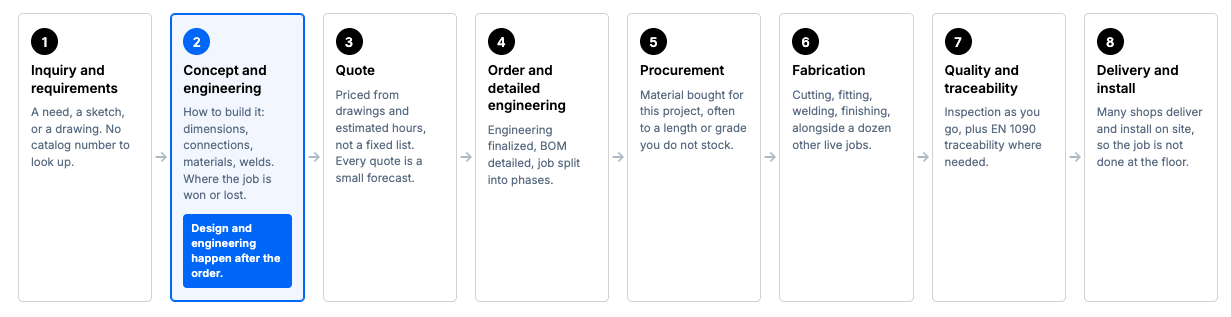
In engineer to order (ETO), the design and engineering happen after the order, not before. That one fact shapes everything else. Here is the usual path from first call to final install.
- Inquiry and requirements. A customer comes to you with a need, a sketch, an architect’s drawing, or a problem on their site. There is no catalog number to look up.
- Concept and engineering. Your team works out how to build it: dimensions, connections, materials, welds. This is the design work, and it is where the job is won or lost.
- Quote. You price the job from those drawings and your estimated hours, not from a fixed list. Every quote is a small forecast.
- Order and detailed engineering. Once the customer says yes, engineering is finalized, the bill of materials is detailed, and the job is split into phases such as structural frame, secondary steel, railings, and finishing.
- Procurement. Material is bought for this specific project, often to a length or grade you do not keep on the rack.
- Fabrication. The job moves across departments (cutting, fitting, welding, finishing) alongside a dozen other live jobs at different stages.
- Quality and traceability. Inspection happens as you go, and structural work may need material traceability to a standard such as EN 1090.
- Delivery and install. Many custom shops deliver and install on site too, so the job is not finished when it leaves the floor.
Design sits at the front and install often sits at the back. That is why an engineer to order job runs longer and carries more unknowns than a repeat product ever will.
ETO vs MTO vs ATO vs MTS: what is the difference?
The four classic manufacturing models come down to one question: how much of the product already exists when the order lands. Engineer to order sits at one end, where the product is designed from nothing. Make to stock sits at the other, where it is already on a shelf. Here is how they line up.
| ETO Engineer to Order | MTO Make to Order | ATO Assemble to Order | MTS Make to Stock | |
|---|---|---|---|---|
| Definition | Product is designed and engineered from scratch for each order | Product is built to order from an existing, known design | Product is assembled to order from pre-made stock components | Product is made to a forecast and sold from stock |
| When design happens | After the order, per job | Before the order (design exists, some options vary) | Before the order (modules pre-engineered, customer picks options) | Long before the order (fixed catalog design) |
| Inventory model | Little or no stock held; material bought per project | Raw material and components stocked; finished goods made on demand | Components and sub-assemblies stocked; final assembly on demand | Finished goods held in stock, made to forecast |
| Lead time | Longest (weeks to months); includes design | Medium; production starts after the order | Short; only assembly happens after the order | Shortest; ships from the shelf |
| Unit volume | One-off or very low, often a quantity of one | Low to medium, repeatable | Medium to high | High, mass production |
| Pricing approach | Quoted per project from drawings and estimated hours | Priced from a known bill of materials and routing | Configured price from selected options | Fixed catalog or list price |
| Typical products | Bespoke, custom-engineered assemblies | Standard products built on demand | Configurable products from standard modules | Standard catalog products |
| Example industries | Custom steel and metal fabrication, industrial machinery, shipbuilding | Specialty equipment, some furniture and components | Computers, cars with option packages, modular furniture | Consumer goods, hardware, off-the-shelf parts |
Scroll sideways to see all four columns.
Where custom fabrication lands: most misc metals, structural, and architectural shops are engineer to order by default. If you design bespoke staircases, structural frames, railings, mezzanines, or one-off industrial assemblies, you run an engineer to order shop, even if you have never called it that. Some repeat items may run make to order, but the bulk of the work is engineered per job. That is why software built for make to stock or assemble to order keeps fighting the way you actually work.
What are examples of engineer to order work?
Engineer to order is easiest to picture through real jobs. In custom fabrication, the common ones are:
- Custom staircases and railings. A feature staircase for a building lobby, engineered to the exact rise, run, and finish the architect drew. No two are the same.
- Architectural and structural steel. Bespoke frames, canopies, and connections detailed for one building on one site.
- One-off structural assemblies. A support frame, a platform, or a mezzanine built around equipment that already sits on the customer’s floor.
- Bespoke industrial fabrications. Machine bases, guarding, conveyors, or tanks built to a spec that has never been built before.
The thread is that the drawing, the bill of materials, and the routing are made for that job and rarely reused as is.
Why is engineer to order hard to manage?
Engineer to order is hard to manage because every job is new, so you cannot lean on a plan that worked last time. The pain shows up in four places most shops will know well.
Multi-project scheduling. You are not running one job. You are running fifteen or twenty at once, each at a different stage, all pulling on the same welders, the same bay, and the same machines. When one slips, the knock-on effect is hard to see until it has already become a missed deadline.
Quoting one-off work. With no repeat price to lean on, every quote is an estimate of hours for something you have not built. Quote too high and you lose the job. Quote too low and you find out you are losing money on it only after it ships.
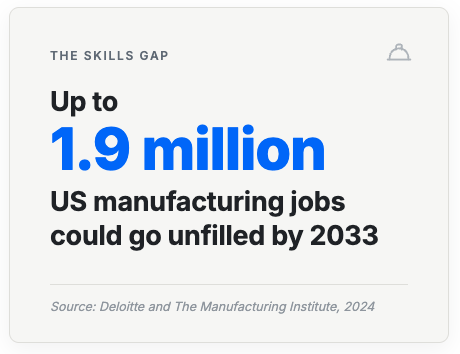
Capacity and skilled-operator bottlenecks. Custom work often hinges on a few people. Maybe only two or three of your team can run the plasma or lay a certified weld. That constraint, not the machine, sets your real capacity, and it is getting tighter. Deloitte and The Manufacturing Institute estimate US manufacturing could need 3.8 million workers by 2033, and that as many as 1.9 million jobs could go unfilled if the skills gap is not closed. When the person who runs the plasma is hard to replace, your schedule lives and dies by who is on shift.
Knowing true job status. When a customer calls to ask how far along their project is, the honest answer in most shops is “let me walk the floor and find out.” Status lives in people’s heads and on paper travelers, not on a screen.
Material timing makes all of it worse. In early 2025, domestic lead times ran roughly 4 to 6 weeks for hot rolled steel coil and 6 to 8 weeks for structural tubing (Craftsmen Industries, March 2025), and one late delivery can stall a project that was otherwise on track. Juggle twenty jobs and a single slipped material date quietly reshuffles the whole schedule.
How do you manage engineer to order production?
You manage engineer to order production by standardizing the process even when the parts change. You will never standardize the product, but you can standardize how a job moves. Four principles do most of the work, and they hold no matter what tool you run.
Standardize phases, not parts. Even pure custom shops repeat a rhythm: design, procurement, fabrication, finishing, delivery, install. Define those phases once and run every job through them. It gives you one shared language for status and a place to track progress, even when the contents differ every time.
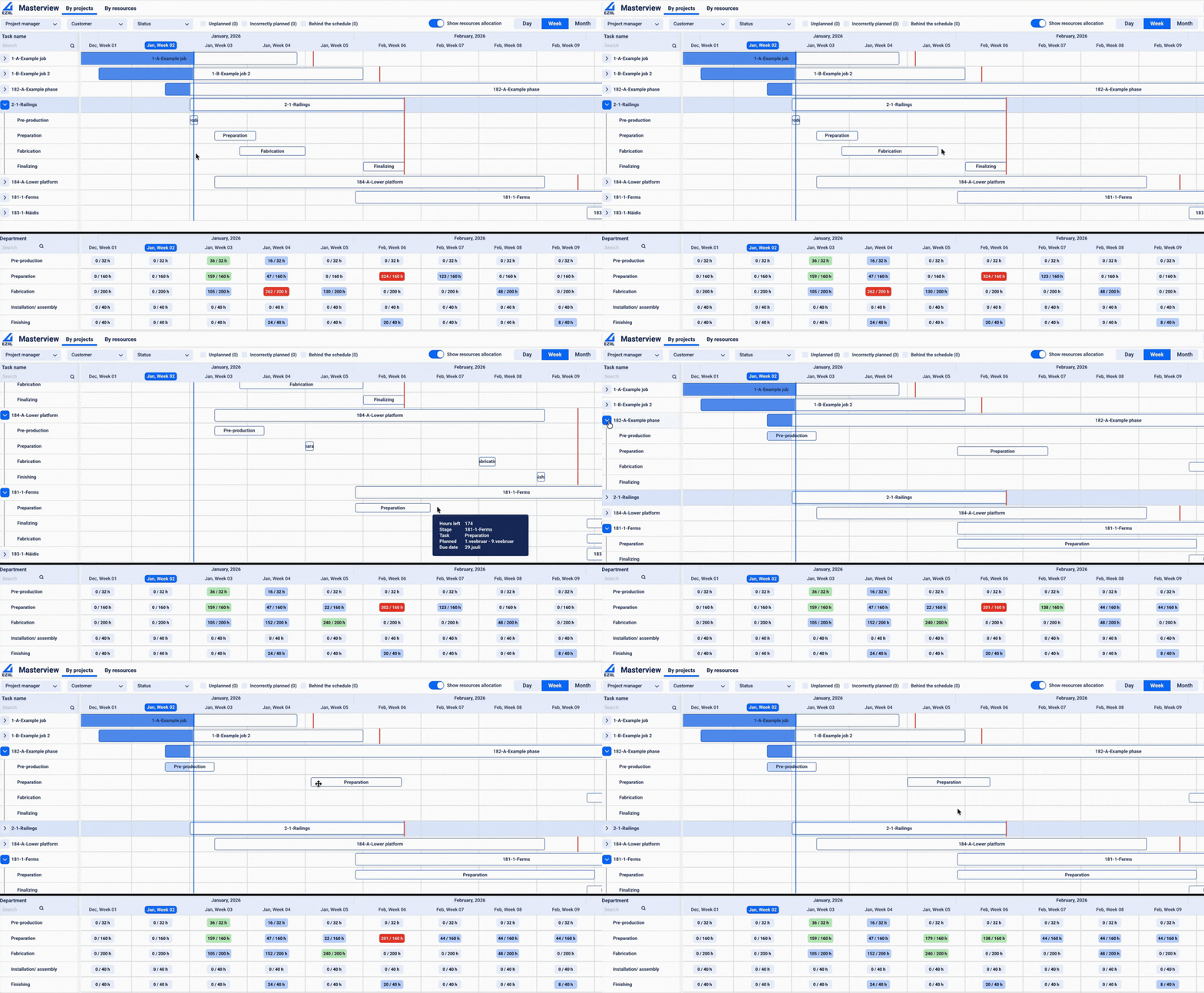
Plan capacity by department, not by job. Do not ask “when will this job finish.” Ask “how many hours of welding, cutting, and fitting are booked next week, and do I have the people to cover them.” Planning against each department’s real capacity is what catches an overload before it turns into a slipped promise.
Track progress against estimated hours. When you quote a job, you estimate hours. Compare the actual reported hours against that estimate as the work happens, phase by phase, not at the end. Drift caught in week three can be fixed. Drift found at invoicing is just a loss you get to explain.
Keep quote and production data connected. The hours you quoted and the hours you build to should live in the same place. When the estimate and the actuals sit apart (a quote in one spreadsheet, the schedule in another, time on paper), you lose the one feedback loop that makes the next quote better.
Plenty of shops run it on disciplined spreadsheets and a good whiteboard. The catch is that the manual version breaks as you grow, and it breaks completely the day the person who holds the schedule in their head is out sick.
Where can software help an engineer to order shop?
Software helps when it matches how project work actually runs, and it gets in the way when it does not. If you look at a tool for an engineer to order shop, look for four things: a project and phase structure rather than a repeat-part catalog, visual scheduling that shows capacity by department, shop-floor progress tracking that updates as work is reported, and a clean handoff from quote to production so you are not retyping the same numbers.
What you avoid matters just as much. Most heavy ERP and MRP systems are built for repeatable or configured-product manufacturing, where you enter the bill of materials up front and the software plans from it. In a custom shop the bill of materials is still being detailed while the first cutting list is on the floor, so those systems are both overkill and a poor fit for a small shop. Purpose-built engineer to order ERP is a real category, and NetSuite puts it on track to reach about $9 billion by 2036. The point is that most of it is aimed at large machinery builders, not a twenty-person fab shop.
That gap is what EZIIL is built for: simple, non-ERP production management for project-based fabricators. You plan jobs across departments on a visual schedule, report progress from the floor, and see where each job stands without walking the shop. It is deliberately not a CPQ, a product configurator, a full estimating suite, or a CRM. If you build highly engineered machinery and need a configurator, a heavier ETO ERP is the best choice. If you run a custom fab shop and want one place to plan and track jobs, that is the whole idea.
Frequently asked questions
What is engineer to order (ETO) manufacturing? Engineer to order manufacturing is a model where the product is designed and engineered from scratch after the customer orders it. Each job has its own drawings, bill of materials, and routing, so every project is effectively new. It is the default model for custom steel and metal fabrication.
What is the difference between engineer to order and make to order? In make to order, the design already exists and you build a known product to a customer’s order. In engineer to order, the design does not exist yet, so engineering happens after the order. Engineer to order carries longer lead times and more unknowns, because you are creating the product, not just producing it.
What are examples of engineer to order products? Common examples in fabrication include custom staircases and railings, architectural and structural steel, one-off support frames and mezzanines, and bespoke industrial equipment such as machine bases or guarding. Each is engineered for a single order and rarely reused as is.
Is engineer to order the same as custom manufacturing? They overlap but are not identical. Custom manufacturing is a loose term for anything made to a customer’s spec. Engineer to order is the specific model where design and engineering happen after the order. Most custom fabrication is engineer to order, but a made-to-spec item built from an existing design is make to order.
What software do engineer to order shops use? Some run heavy ETO ERP systems with CPQ and estimating, which suit large machinery builders. Small project-based fab shops often find those overkill and use a lighter production tool built for project work, or they stay on spreadsheets. The key is project and phase structure, capacity scheduling, and shop-floor tracking, not repeat-part MRP logic.
Why does standard ERP or MRP not fit engineer to order shops? Standard MRP assumes a finished design, a fixed bill of materials, and a known routing before work starts. In an engineer to order shop, all three are still forming while the job is underway. That mismatch is why many fabricators try a repeat-production ERP and end up back on Excel.