
Material traceability means you can link a finished beam, plate or assembly back to the steel it was made from and to that steel’s mill certificate. Most small fab shops need less of it than they fear, but they tend to lose it at the same two moments: when steel arrives and when it gets cut.
Picture the audit. The inspector from your notified body, or the main contractor’s QA engineer, points at one column on the drawing and asks for the mill cert behind it and who welded it. If the answer means someone searching a folder, you are relying on whoever filed the paperwork.
This guide covers how much traceability your work actually asks for under EN 1090 and AISC, where the heat number trail breaks inside a 10 to 50 person shop, and how to keep it, on paper or in software. This guide comes from EZIIL, the production management software we make, and the last section explains what it records and what it leaves to you.
What is material traceability in steel fabrication?
Material traceability is the ability to show which batch or heat of steel went into a job, and which certificate proves that steel’s grade and properties. In steel fabrication it runs in two directions: from a finished member back to its certificate, and from a suspect heat forward to every job it went into.
The backward direction is what an auditor asks for. The forward direction is what you need when a mill tells you a heat was out of spec, and you have to find every job that used it. Traceability in manufacturing generally works the same way, but steel adds one complication: a single plate or bar is usually cut into parts for several jobs.
Two words get mixed up here, and the difference decides how much work you have to do. The American Institute of Steel Construction separates them in its guidance on material identification and traceability:
- Identification means you can show that the specified grade and size went into the structure.
- Traceability means you can link a specific piece of steel in the structure to its specific mill test report, for the life of the structure.
AISC notes that traceability costs significantly more than identification. Plenty of work only needs the first.
One more pair of terms. A heat is a single melt at the steel mill, and the heat number is the ID printed on its certificate. A batch (or lot) is how your yard groups steel that arrived together. On a busy rack the two often get used as if they were the same thing.
What are mill test reports, 3.1 certificates and heat numbers?
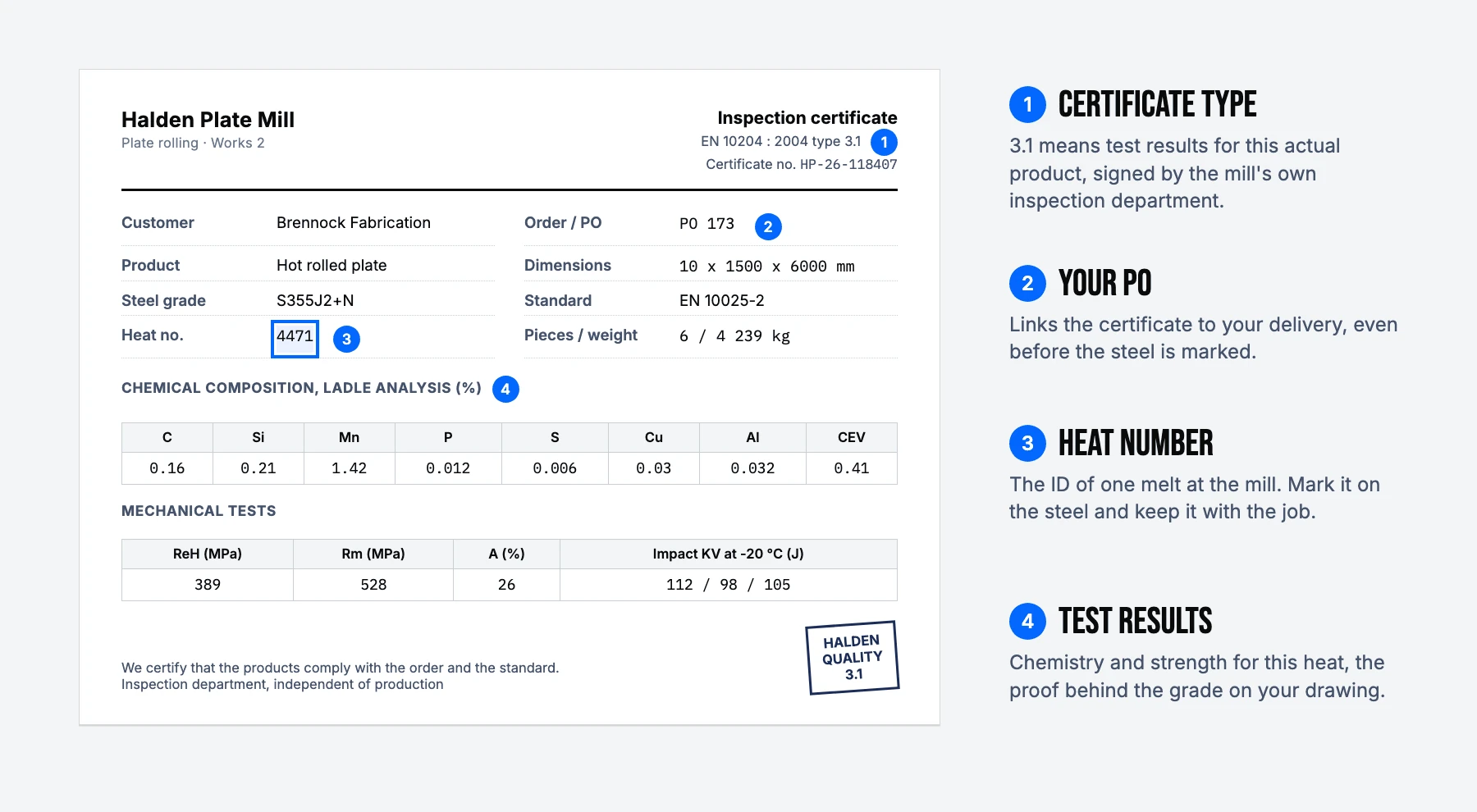
A mill test report (MTR), also called a mill test certificate (MTC) or mill cert, is the document the steel mill issues for a heat. It lists the heat number, grade and standard, chemical composition and mechanical test results. In Europe the type of certificate is set by EN 10204, and 3.1 is the type most structural work uses.
US buyers also see “CMTR”, a certified mill test report, which carries the mill’s signed statement that the results are true. Under EN 10204 there are four types:
| EN 10204 type | What it is | Signed off by |
|---|---|---|
| 2.1 | Declaration of compliance, no test results | The manufacturer |
| 2.2 | Test report with typical (non-specific) test results | The manufacturer |
| 3.1 | Inspection certificate with test results for the actual product | The manufacturer’s inspection department, independent of production |
| 3.2 | Inspection certificate like 3.1, also validated by an outside inspector | The manufacturer plus the purchaser’s or an independent inspector |
Scroll sideways to see all columns.
Which type you need depends on the steel grade and the job. EN 1090-2 lists the required inspection document per steel grade in its Table 1, and the British Constructional Steelwork Association notes in its guidance on EN 10204 certificates that a 3.1 is required for most structural steel products. Check Table 1 for the grades you buy, and check the project specification, which can ask for more.
How much traceability does your work actually need?
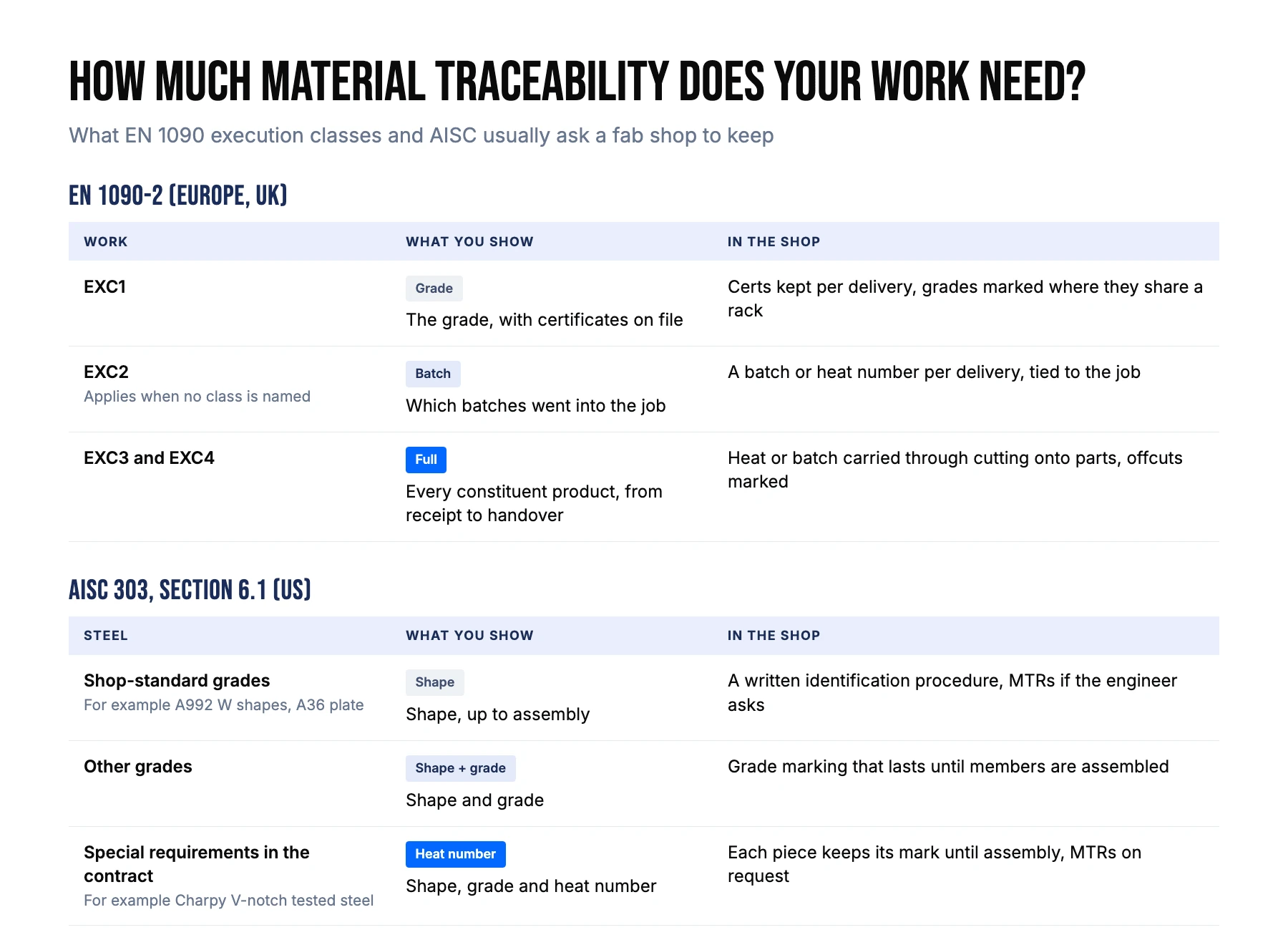
Under EN 1090-2, execution class EXC2 usually asks for partial (batch) traceability, and EXC3 and EXC4 ask for full traceability from receipt to handover. Under AISC, most work needs material identification, and heat numbers come in only when the contract orders steel to special material requirements. The project specification can always ask for more.
Execution class (EXC) is the EN 1090 rating, from EXC1 to EXC4, that sets how strictly a steel structure is made and checked. EXC2 applies when the specification names no class.
| Work | What you usually need to show | In practice |
|---|---|---|
| EXC1 | The grade, with certificates on file | Keep certs per delivery; mark grades where different grades share a rack |
| EXC2 | Partial (batch) traceability: which batches went into the job | A batch or heat number per delivery, tied to the job; grade marking where grades mix |
| EXC3 and EXC4 | Full traceability of constituent products, from receipt to handover | The heat or batch carried through cutting onto parts and assemblies; offcuts marked |
| AISC, shop-standard grade (for example A992 W shapes, A36 plate) | Shape designation, up to assembly | A written identification procedure; representative MTRs if the owner’s engineer asks |
| AISC, other grades | Shape designation and grade | Grade marking that survives until the members are assembled |
| AISC, special material requirements in the contract (for example Charpy V-notch tested steel) | Shape, grade and heat number | Each piece keeps a heat or identification mark until assembly; MTRs on request |
Scroll sideways to see all columns.
AISC’s Code of Standard Practice (AISC 303, section 6.1) sets three levels: shape for shop-standard steel, shape and grade for other grades, and shape, grade and heat number for steel ordered to special requirements in the contract, such as Charpy V-notch (CVN) impact testing. Its commentary says the first level will suffice for most projects.
AISC’s general fabrication FAQ adds that traceability is not a requirement of the AISC Specification. When a job needs it, the contract documents must say so before the steel is ordered, and at which level. Lot traceability, where a project’s material can be traced to that project’s set of MTRs, is the most common. Piece-mark traceability (the heat number for each piece mark) is often specified for main members in bridges, and piece traceability is for critical work such as nuclear facilities.
In Europe, structural engineers use a similar split. The UK steel industry’s guidance on execution classes suggests that when an engineer wants full traceability on an EXC2 project, the job stays EXC2 and the higher traceability requirement is added to the specification, rather than moving the whole job up to EXC3. So read the specification as well as the class.
Treat this table as a guide. The rules sit in clause 5.2 of EN 1090-2 (the current edition is EN 1090-2:2018+A1:2024), in your factory production control (FPC, the documented system your EN 1090 certification is based on) and in AISC’s Code of Standard Practice. Your notified body or AISC auditor has the final word. TWI’s summary of the fabrication requirements of EN 1090-2 is a good plain-English starting point.
Where does material traceability break in a small fab shop?
In a small fab shop, material traceability usually breaks at five points: certificates arriving after the steel, shared stock cut across several jobs, offcuts going back on the rack, one certificate covering several deliveries, and steel that was never marked. Each has a simple fix.
What we see when we set shops up is that the paperwork is rarely the problem. A shop that buys steel for one job, keeps the certs in that job’s folder and uses it all on that job can trace it without much effort. The trail breaks when steel sits in shared stock and gets cut for whichever job needs it next.
1. The certificate arrives after the steel
The steel is on the truck, and the cert follows by email a week later, or never. If nobody identifies the delivery the day it lands, it becomes “some 10 mm plate” on the rack.
The fix: give every delivery an identifier the day it arrives, mark it on the steel, and file the cert under that identifier when it comes. Pick one of two habits before your first delivery and write it down:
- Use the purchase order number as the batch number. It is always known on arrival and short enough to write with a paint pen, but finding the cert takes a step more: from the steel to the PO, then to the receipt, then to the file.
- Use the supplier’s lot number from the delivery note or invoice. Save the cert under the same number, and the steel and its cert match up directly. This only works if the paperwork arrives with the goods.
Changing the habit halfway leaves two kinds of stock on your racks that don’t match each other.
2. Shared stock gets cut across jobs
One 6-metre bar or one plate feeds parts for three jobs. If nobody records which job took material from which batch, the link dies at the saw or the plasma table. Buying to the job avoids most of this. When you do cut from stock, record the batch against each job that takes material from it.
3. Offcuts go back on the rack
The drop from a certified job goes back on the rack, its marking is cut off with the part, and a month later it ends up in another certified job. Mark the batch on the remnant before it goes back, and give remnants their own shelf. Our guide to the five moments that decide your material numbers covers offcuts in detail.
4. One certificate covers several deliveries
Mills often ship one heat, under one certificate, across several deliveries. If every delivery gets the certificate number as its batch, two different deliveries look like one. Give the second delivery its own suffix, for example 4471-2, and keep the same certificate on both.
5. Nobody marked the steel
Every record downstream depends on someone marking the steel in the yard. An engineer in an Eng-Tips discussion on transferring heat numbers made the point bluntly: a heat number on a piece of paper does not prove the steel in front of you came from that heat. Software can keep a mark alive through the shop, but it cannot check that the mark was right. So traceability starts with marking the steel at goods-in.
Paper, spreadsheet or software: which fits your shop?
Paper and a folder per job are enough when you buy steel per job and work to EXC1 or EXC2. A spreadsheet helps when a few jobs share stock. Software earns its place when stock is shared across many jobs, the work is EXC3 or EXC4, or several people book material in and out.
| Folder or binder per job | Spreadsheet log | Production software with a warehouse | |
|---|---|---|---|
| Works well when | You buy steel per job, EXC1 or EXC2, one careful person keeps it | A few jobs share stock | Stock is shared, EXC3 or EXC4, several people book material |
| Breaks when | Stock is shared, or that person is away | Two people edit it, or offcuts come back | Nobody marks the steel |
| “Show me the certs for job 221” | Search the folder | Filter the log, then find the PDFs | Filter the certificates by job and download them |
Scroll sideways to see all columns.
Plenty of shops pass audits on paper. What software adds is speed, and less reliance on the one person who knows where the certs are.
What EZIIL records, and what stays with you
EZIIL is production management software for small custom steel fabricators (15 to 150 people). It keeps the batch or heat number and the mill certificate tied to the job, from goods receipt to the operations on the shop floor. It records what your team marks and reports, and it works alongside your quality system.
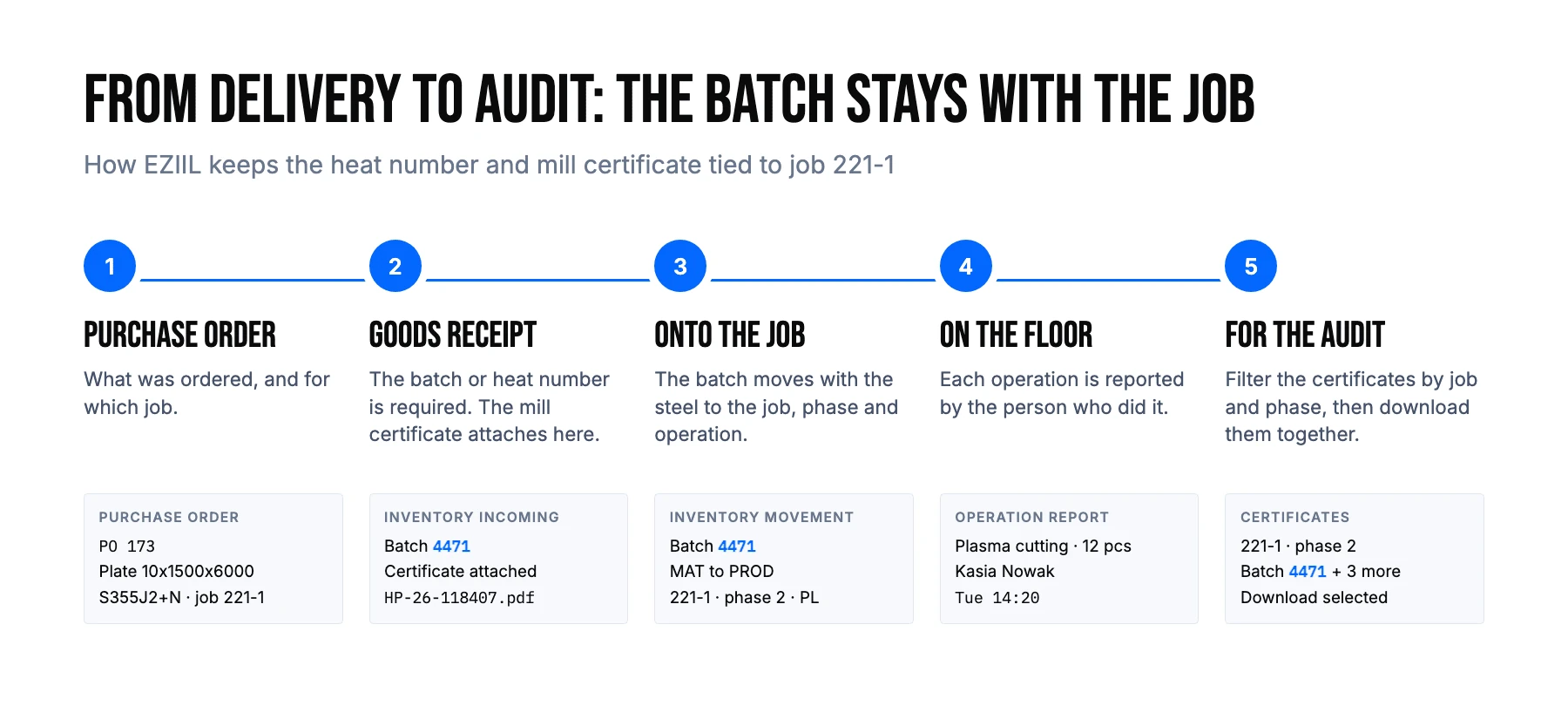
Here is the chain, step by step:
- Purchase order. What was ordered, and for which job.
- Goods receipt. For steel set to track batches, EZIIL asks for a batch or heat number before the steel can be received, and the mill certificate attaches to the receipt. If the cert is late, the number goes in now and the file can be added when it arrives.
- Onto the job. When steel moves from the material warehouse to production, the batch number moves with it, to the job, the phase and the operation it was booked to (for example plasma cutting on job 221).
- On the floor. Each operation is reported by the person who did it: who, when, how many, with a comment and photos where needed. Inspection can be set up as its own operation, reported by the inspector.
- For the audit. Filter the certificates by job and phase and download them together. Reported operations export to Excel.
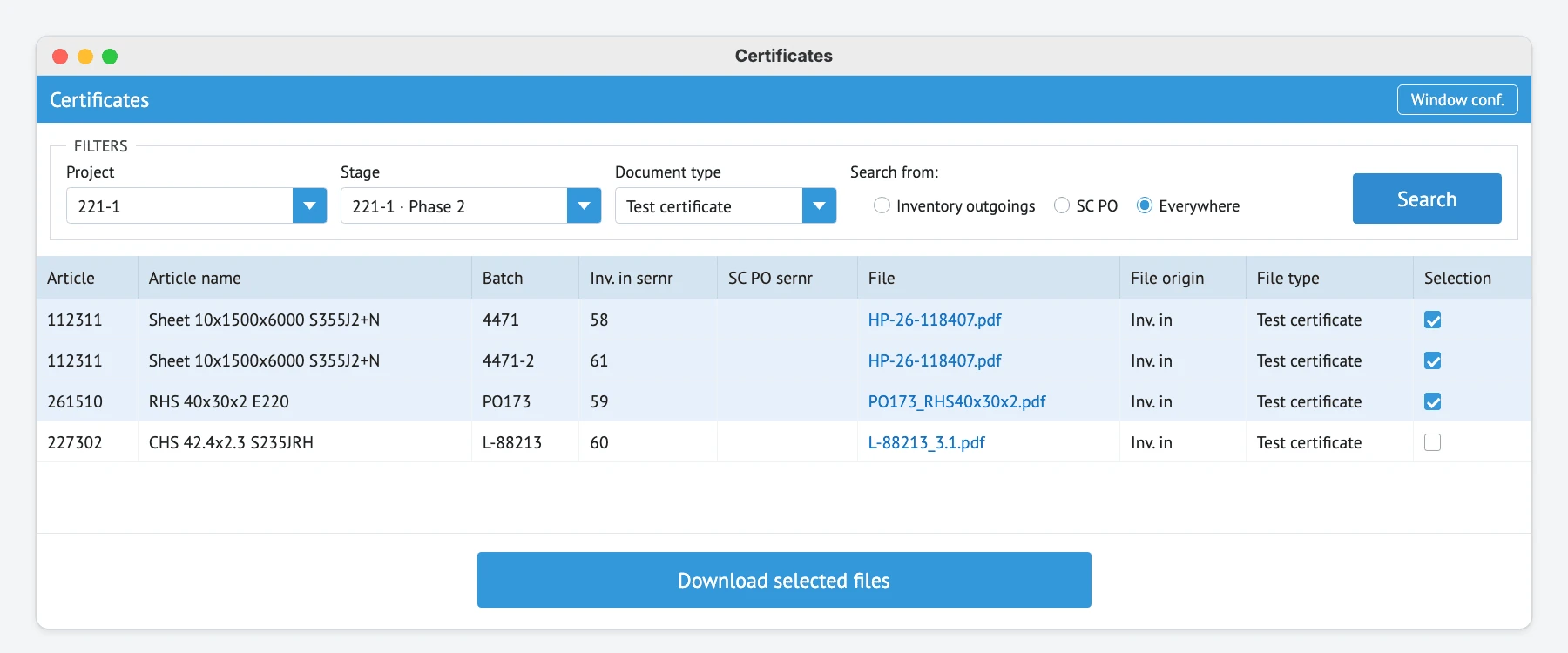
Both batch-number habits, the PO number or the supplier’s lot number, work in EZIIL. With a consistent supplier lot number, the certificates for a job gather in one place on their own. Offcuts that go back to stock keep their batch number.
Where the scope stops:
- EZIIL keeps the batch number your team marks on the steel. Checking the steel against its certificate stays with your goods-in inspection.
- EZIIL traces each batch to the job, phase and operation it was booked to, which in AISC’s terms is lot traceability. It does not record which batch went into each individual piece, so if your contract asks for piece-mark or piece traceability, plan for that in your marking and inspection records.
- Inspection is an operation with a comment and photos. Inspection checklists and approvals stay in your quality system.
- EZIIL supports your EN 1090 or AISC traceability. Your FPC, your procedures and your certifying body are what make you compliant.
- Offcut lengths are not tracked piece by piece. Keeping remnants on their own shelf, with their batch marked, is a habit for the shop.
Batch numbers and certificates come with the BOM, purchasing and warehouse modules; records of who did which operation come with production (and Starter). EZIIL Starter costs €120 / $140 a month for up to 15 users plus a one-off €300 / $350 onboarding fee (prices as of November 2026), and you add modules when a contract needs them. See pricing.
B&W Metall, a structural fabricator certified up to EXC3 and to ISO 3834-2, replaced its paper archive with EZIIL. As their project manager and planner Elari puts it: “If we ever need to look back and see who made a part, we see it in the reported operations.” Read how B&W Metall runs its projects. FLI Structures runs EZIIL on EXC4 telecom towers.
If you run a welding-led shop, start with our page on welding shop management software. To see the chain with your own jobs, take a free product tour or book a 30-minute demo with team EZIIL’s experts.
Frequently asked questions
What is the difference between material identification and traceability?
Identification means you can show that the specified grade and size of steel went into the structure. Traceability means you can link a specific piece in the structure to its specific mill test report for the life of the structure. Traceability takes much more work, and many jobs only need identification.
What does EXC2 require for material traceability?
EXC2, the default execution class under EN 1090-2, usually asks for partial or batch traceability: you can show which batches of steel went into the job. The project specification can ask for more, so check it together with clause 5.2 of EN 1090-2 and your FPC.
Is a 3.1 certificate the same as a mill test report?
In practice, yes. A 3.1 is the EN 10204 type of mill test report with test results for the actual product, signed by the mill’s inspection department. A 3.2 adds validation by an outside inspector, and a 2.2 only gives typical results.
What should I do if the mill certificate arrives after the steel?
Identify the steel the day it arrives anyway. Give the delivery a batch number, such as the purchase order number, mark it on the steel and file the certificate under that number when it comes. Receiving unmarked steel is how batches and certificates get mixed up.
How do I keep heat numbers on offcuts?
Mark the batch or heat number on the offcut before it goes back on the rack, and keep remnants on their own shelf. Without the mark, a drop from a certified job can end up in another job with no way to prove what it is.
Does ISO 9001 require material traceability?
ISO 9001:2015 (clause 8.5.2) requires traceability only where it is a requirement, for example from a customer, a contract or a product standard such as EN 1090. Where it applies, you must control the unique identification of your outputs and keep the records needed to trace them. See this summary of clause 8.5.2.
Do I need software for EN 1090 traceability?
No. Many shops meet EN 1090 with paper records and a folder per job. Software helps once steel is shared across many jobs, the work is EXC3 or EXC4, or several people book material in and out, because finding a job’s certificates becomes a filter instead of a search.
Does EZIIL keep material certificates for EN 1090?
Yes. For steel set to track batches, EZIIL asks for a batch or heat number at goods receipt, the certificate attaches to the receipt, and the batch follows the material to the job, phase and operation. You can filter a job’s certificates and download them together. EZIIL records what your team marks; it does not check the steel itself.