
Steel Projects PLM, the workshop production management software from the Ficep Group, is one of the most established names in steel fabrication, with best-in-class CNC machine integration and 2,500+ customers worldwide. But it is not the best fit for every shop, and small custom steel fabricators researching about Steel Projects usually find that out at the demo stage. If you’re still exploring, our guide compares 16 metal fabrication software tools on price, deployment and fit.
This comparison puts Steel Projects and EZIIL side by side: what each does well, where each falls short, and which type of shop each one actually serves.
Both are purpose-built for steel fabrication, and both are far better than spreadsheets, whiteboards, and someone’s memory. The difference is their specialized focus. Steel Projects PLM answers “how do we get drawings onto our CNC machines and through the workshop with as little waste as possible?” EZIIL answers “how do we run the whole shop, from project intake to procurement to delivery, and know whether every job is on time and making money?”
TL;DR:
Steel Projects is workshop production management software, built around best-in-class CNC machine integration: DSTV import, bar and plate nesting, automatic CNC programming, and live machine monitoring, backed by 30 years of development and 2,500+ customers worldwide.
If your shop runs heavy CNC lines and your biggest cost is machine time and material waste, Steel Projects PLM deserves a serious look.
EZIIL is whole-shop production management for small custom steel fabricators: projects, scheduling, procurement, subcontractors, real-time job costing, and OTD indicators, at a published flat price (€120 to €290 per month by team size, plus a one-off €300 onboarding fee) with go-live in under a week.
If you are a 15 to 150 person custom fabricator with mixed or manual equipment and your biggest problem is visibility, deadlines, and profit, EZIIL is the tighter and far more transparent fit.
Last updated: July 2026.
Steel Projects vs EZIIL: Quick comparison table
What is Steel Projects PLM?
Steel Projects PLM is production management software for steel fabricators from Steel Projects, a French software company founded in 1994 that became the software division of the Ficep Group, one of the world’s largest manufacturers of CNC machinery for structural steel. The company reports more than 2,500 customers in over 100 countries and a dedicated R&D team of about 20 steel-construction specialists, with two major releases per year.
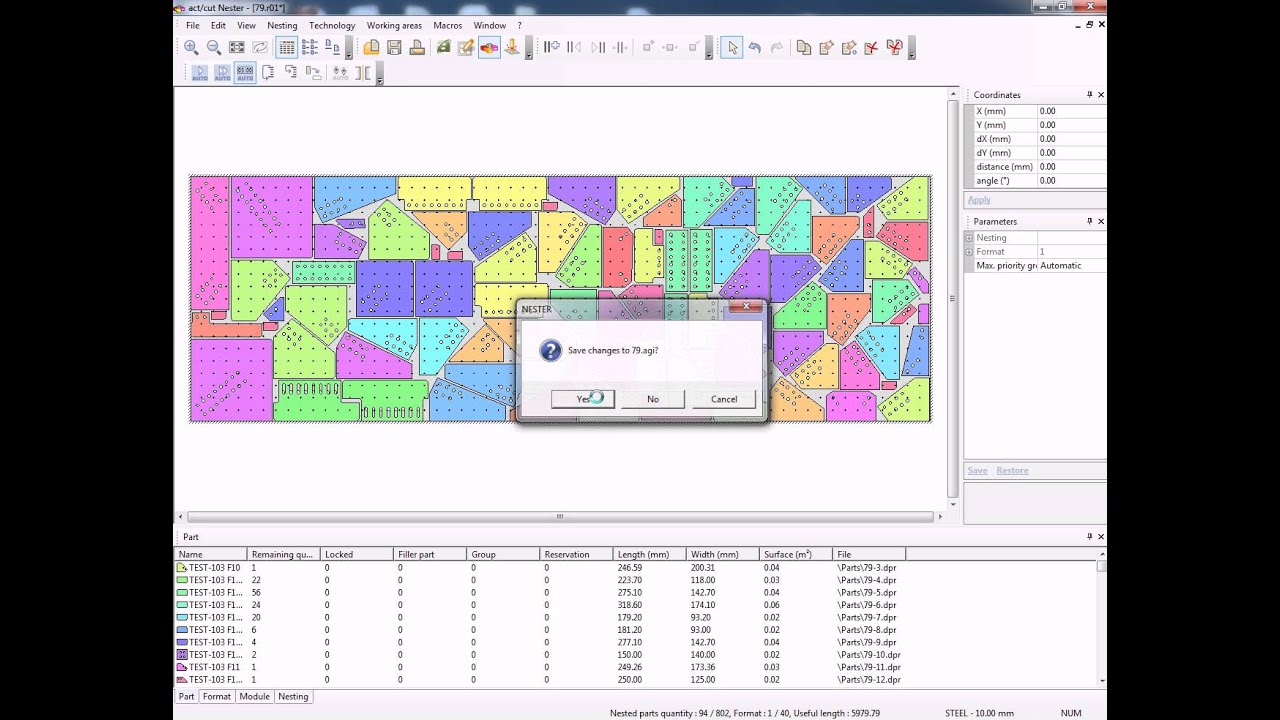
The product is modular, built around a suite of components: SP.Project (prepare, modify, and check projects, including an integrated drawing editor), SP.Production (prepare, optimize, and plan production), SP.Nesting (nest plate and profile parts into CAM files), SP.Inventory (stock and purchasing), SP.Interface (data exchange with detailing software, ERP, and MIS systems), SP.Workshop (launch, monitor, and analyze production), and SP.Shipping (organize and launch shipments).
Its defining strength is the link between the detailing office and the machines. Steel Projects PLM imports BOMs and NC data from common industry formats (DSTV among them), checks and validates parts, nests bars and plates to cut scrap, generates optimized CNC programs automatically, and routes work orders through both CNC machines and manual workstations. Its PNI data exchange format is supported by partners including Tekla PowerFab, StruMIS, SigmaNest, and Lantek. Recent releases add AI-assisted calculation of processing times and resource allocation. Barcode-based tracking covers traceability, nonconformance, and quality logging through to delivery planning.
Steel Projects PLM’s pricing is not published. You request a demo, the vendor scopes your workshop, machines, and interfaces, and you get a quote. The software is frequently sold through the Ficep machinery channel, often as part of a machine investment. Installation and training are delivered as vendor services, with ongoing support through their SMART maintenance and assistance program.
What Steel Projects PLM does well
- CNC machine integration is the best in this comparison, and arguably the market. Drawings in, optimized machine programs out. If you run Ficep beam lines, drills, or plasma tables, the software and the machines come from the same group and are engineered to work together. Non-Ficep machines are supported too.
- Nesting that pays for itself in material. Bar and plate nesting algorithms with remnant and stock management directly attack the single biggest cost in fabrication: steel. For a high-tonnage shop, percentage points of scrap are real money.
- Deep interoperability. DSTV import, BIM compatibility, and the PNI exchange format adopted by Tekla PowerFab, StruMIS, SigmaNest, and Lantek mean Steel Projects PLM slots into an existing detailing and MIS stack rather than fighting it.
- 30 years of domain focus. Founded in 1994, steel only, with an in-house R&D team and two major releases a year. This is not a generic MES with a steel brochure.
- Global reach and machinery-channel support. With Ficep’s worldwide sales and service network behind it, support exists in most markets where structural steel is fabricated. AISC and CISC memberships anchor its North American presence, with reference customers like Dave Steel, High Steel Structures, and Mueller Inc.
- Live workshop monitoring. Real-time tracking of CNC machines and manual stations, with configurable dashboards, custom reports, and KPI analysis of production performance.
Where Steel Projects PLM falls short for a small custom steel fabricator
The same research surfaces consistent limitations for the 15 to 150 person custom shop:
- It manages the workshop, not the whole business. Steel Projects PLM’s scope runs from detailing import to shipping. Project-level profitability for the owner, procurement tied to project budgets, and subcontractor coordination are not what the product is centered on. You will still need something else (often spreadsheets) to answer “is this job making money?” and “can we take on that new contract?”
- Its value concentrates where the machines are. The drawings-to-machine automation that justifies the product assumes meaningful CNC capacity. A custom shop running saws, manual drills, and welding bays with an occasional subcontracted cut gets a fraction of the value while carrying the full weight of the system.
- Pricing requires a sales cycle. No published prices means no quick budgeting, no easy comparison, and a procurement process that favors shops used to capital-equipment buying. Small shops comparing monthly software line items are in a different conversation entirely.
- Windows-installed workshop software. The core product installs on Windows in your workshop, with some features extended through Android apps. That typically means IT setup, servers or workstations to maintain, and scheduled upgrades rather than a browser login. (Deployment options evolve. Confirm current architecture with the vendor.)
- Mobile is partial. Some features are available on Android. There is no indication of an iOS app, so shops with iPhones in the pocket of every foreman should check this in the demo.
- No independent online reviews. At the time of writing, Steel Projects PLM has no reviews on G2 or Capterra. The 2,500+ customer base is real, but a buyer doing due diligence has to rely on vendor-provided case studies and references rather than verified third-party reviews.
- Machinery-channel gravity. Being backed by Ficep’s sales channel means the software conversation often arrives packaged with a machinery conversation. If you have no plans to buy or standardize on particular machines, evaluate carefully whether the roadmap and support priorities will center on shops like yours.
Who Steel Projects PLM is The Best Fit for
A structural steel fabricator whose competitiveness depends on machine throughput and material yield: automated beam lines, plate processors, high tonnage, in-house detailing or clean DSTV feeds from outside, quite possibly a Ficep machine on the floor or on order. For that shop, Steel Projects PLM is one of the most credible options in the world, and the machine integration alone can justify it.
What is EZIIL?
EZIIL is cloud production management software built specifically for small custom steel and metal fabricators, the 15 to 150 person shops doing project-based, one-off work: structural steel, staircases, architectural metalwork, industrial equipment. It was founded by people from the fabrication industry and is used by shops across the US, Canada, Australia, Europe and the UK.
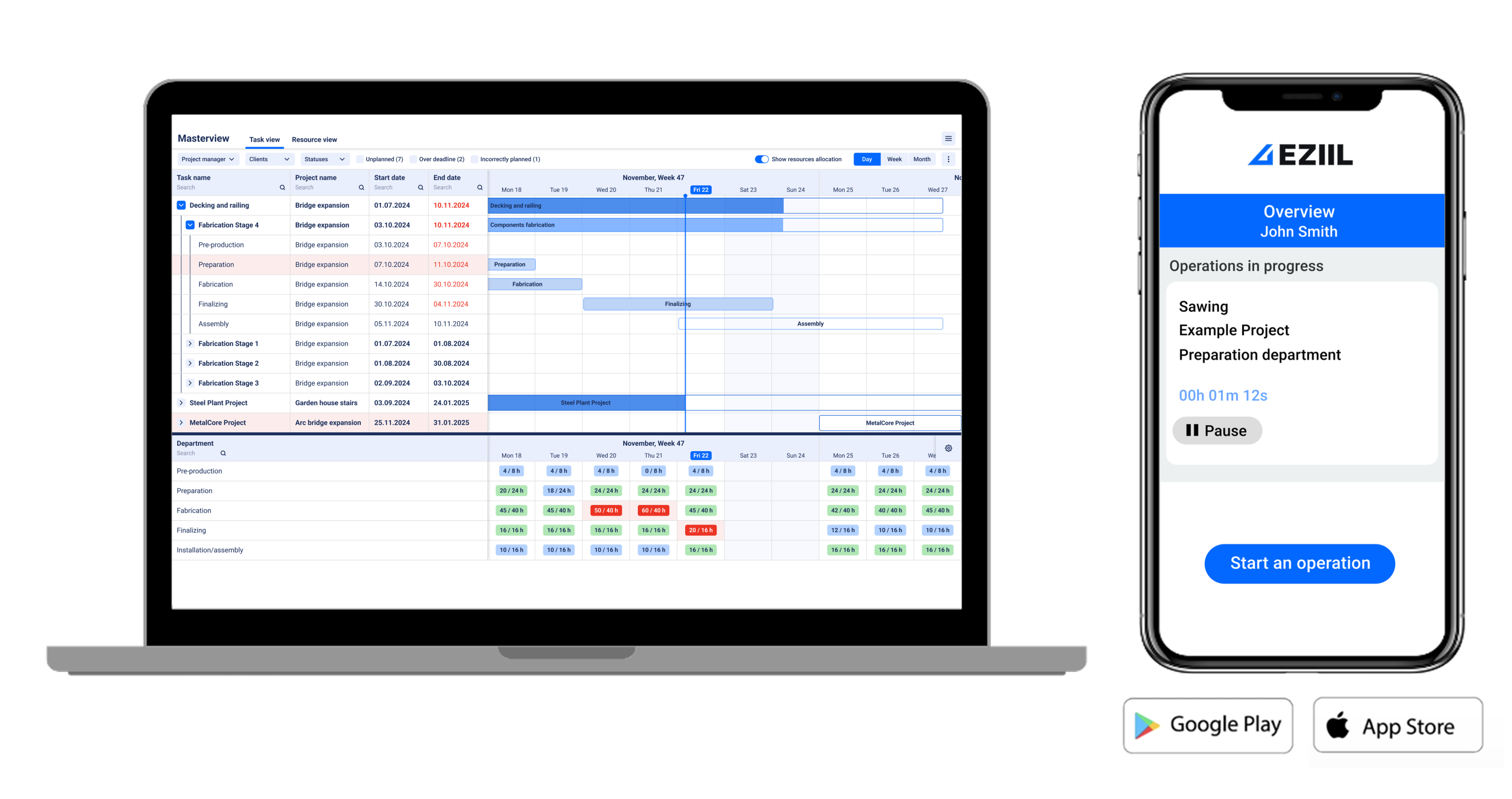
EZIIL’s core idea is different from Steel Projects PLM’s. Instead of starting at the machine, it starts with the whole shop. EZIIL Starter, the complete base product, gives you drag-and-drop capacity planning by department, a live dashboard that updates as hours are reported, plan vs actual hours and costs per project, OTD indicators that flag anything falling behind, drawings and documents tied to each job, and a mobile shop-floor app where workers start and stop a timer and see today’s tasks. Then you add advanced ERP modules only when you are ready: Bill of Materials (BOM), procurement, inventory, EN 1090-2 compliance, subcontractor management, machine planning, shipments, and more.
EZIIL’s pricing is flat by team size, published on the pricing page, and every tier gets the same full Starter feature set:
- €120 / $140 per month for 1 to 15 users
- €180 / $210 per month for 16 to 50 users
- €290 / $338 per month for 51 to 150 users
- One-off €300 / $350 onboarding fee (setup, training, and regular check-ins)
No per-user fees, no quote-based opacity. A 30-person shop can compute its year-one cost from the website in thirty seconds: €180 x 12 + €300 = €2,460.
Implementation is where EZIIL is most opinionated: go live in under a week, starting with one module, with personal onboarding from people who understand fabrication. Kane Metall built a production drawing management platform and job order system within a week. APS Group‘s planner Syed H. describes the rollout plainly: “It only took us a few weeks to roll out EZIIL internally, as the learning curve was minimal.“
What EZIIL does well
- The whole shop in one live view. Projects, schedules, drawings, procurement, subcontractors, and hours in one system that every department shares. Enefit Solutions deleted 12 separate daily-updated Excel sheets after rollout: “The whole team can now work in one system,” says Rait K., Chairman of the Board.
- Profit visibility the owner actually gets. Plan vs reality dashboards per project show whether a job is making money before you invoice, not after. APS Group: “This has given us tighter control of active jobs, better-informed estimating and concrete profit/loss insights per job.“
- On-time delivery you can defend. OTD indicators flag tasks and departments falling behind across every live job as hours are reported, so slippage surfaces while there is still time to act.
- No machinery vendor lock-in. EZIIL fits shops with mixed, manual, or subcontracted equipment. It does not need a particular machine brand on your floor to deliver its value, and it integrates with tools like ProNest for nesting.
- Real cost math a small shop can plan around. €2,460 in year one for a 30-person shop ($210 x 12 + $350 = $2,870 in USD), and €2,160 / $2,520 every year after.
- Shop floor adoption that actually happens. B&W Metall reached 100% shop-floor adoption, every worker reporting in EZIIL regardless of age or role, through a step-by-step rollout. The mobile app (iOS and Android) asks workers for two things: start/stop a timer and check today’s tasks.
- Proven, attributed outcomes. VMT raised engineers’ work efficiency by 40% and increased turnover by 30% without hiring after adopting EZIIL BOM, and lifted supply security from 45% to 98%. Nordic Shelter’s engineering lead reports a 24x return: “1 hour invested in Eziil BOM saves 8 hours in procurement and 16 hours in production.“
Where EZIIL falls short
- It does not program your machines. No DSTV-to-CNC pipeline, no nesting engine of its own, no direct machine control. If drawings-to-machine automation is the job to be done, Steel Projects PLM wins this category outright, and it is not close.
- No built-in estimating engine. EZIIL sharpens your future quotes with plan vs actual data, but it does not generate quotes. You keep your own pricing tool.
- Not a full ERP. EZIIL focuses on production management and integrates with accounting tools (Directo, among others) rather than replacing them.
- Not built for high-volume batch production. EZIIL is for one-off, project-based fabrication. A shop running repeatable batches through automated lines is outside its lane.
- Cloud only. EZIIL needs an internet connection. There is no offline mode.
Steel Projects PLM vs EZIIL: the verdict for small custom steel fabricators
The cleanest way to say it: Steel Projects PLM makes your machines smarter. EZIIL makes your whole shop visible. A large fabricator might eventually want both jobs done. A small custom shop has to pick the problem that hurts most, and for most 15 to 150 person shops without automated lines, that problem is visibility and profit, not CNC programming.
Here’s a side by side comparison of both products’ features and capabilities:
| Feature | EZIIL | Steel Projects PLM |
|---|---|---|
| Running the business | ||
| Job costing (plan vs actual hours and costs per project) | EZIIL✓Live profitability indicators per project, built for the owner. | Steel Projects PLM●Production analysis and time tracking, workshop-performance focused. |
| On-time delivery (OTD) indicators across all jobs | EZIIL✓Flags tasks and departments falling behind, shop-wide, in real time. | Steel Projects PLM●Live monitoring of machines and stations against the production plan. |
| Quoting and estimating | EZIIL✗Use your own pricing tool; plan vs actual data sharpens future quotes. | Steel Projects PLM✗Not a core module; scope starts at detailing import. |
| Reporting and KPI dashboards | EZIIL✓Live dashboard plus detailed reporting module; business and production views. | Steel Projects PLM✓Configurable dashboards, custom reports, and KPI analysis of production. |
| Planning and scheduling | ||
| Visual capacity planning by department | EZIIL✓Drag-and-drop planning with bottleneck flags. | Steel Projects PLM●Production planning through optimized routing of work orders. |
| BOM, drawing, and document management tied to jobs | EZIIL✓BOM module; drawings, files, and custom data on every project. | Steel Projects PLM✓Imports BOMs and NC data from detailing software; integrated drawing editor. |
| Subcontractor management | EZIIL✓Dedicated module, subcontracted steps planned inside the project. | Steel Projects PLM✗Not a published module; focus is in-house workshop execution. |
| Workshop and machines | ||
| DSTV / NC data import from detailing software | EZIIL✗Imports BOMs; no NC file pipeline. | Steel Projects PLM✓Core strength; PNI exchange with Tekla PowerFab, StruMIS, SigmaNest, Lantek. |
| Bar and plate nesting | EZIIL●Via integration with nesting software like ProNest. | Steel Projects PLM✓Built-in nesting algorithms with remnant and scrap optimization. |
| Automatic CNC programming and machine link | EZIIL✗Machine planning module schedules machines; does not program them. | Steel Projects PLM✓Best in class: automatic CNC data creation, direct link to Ficep and other machines. |
| Manual workstation management | EZIIL✓Built for mixed and manual shops; no machine dependency. | Steel Projects PLM✓Work orders routed to manual stations alongside CNC machines. |
| Shop floor time tracking on mobile | EZIIL✓iOS and Android apps: start/stop timer, today’s tasks, drawings on the phone. | Steel Projects PLM●Some features available on Android; barcode-based workshop tracking. |
| Materials and supply chain | ||
| Procurement tied to projects | EZIIL✓Procurement module linked to project BOMs and budgets. | Steel Projects PLM●Purchasing oriented to material supply for production. |
| Inventory and stock management | EZIIL✓Inventory module tied to projects. | Steel Projects PLM✓Stock and remnant management driven by nesting; strong on material yield. |
| Compliance and delivery | ||
| EN 1090-2 traceability | EZIIL✓Built-in EN 1090-2 compliance module. | Steel Projects PLM●Barcode traceability, nonconformance and quality logging; confirm EN 1090 workflow specifics in the demo. |
| Shipments and deliveries | EZIIL✓Shipments and deliveries module. | Steel Projects PLM✓SP.Shipping: organize, prepare, and launch shipments with delivery planning. |
| Platform | ||
| Cloud SaaS, no servers to maintain | EZIIL✓100% cloud, OS agnostic, automatic updates. | Steel Projects PLM✗Installed Windows workshop software; confirm current options with the vendor. |
| ERP and accounting integrations | EZIIL✓Directo, ProNest, and others; invoicing and accounting integration module. | Steel Projects PLM✓SP.Interface exchanges data with detailing software, ERP, and MIS systems. |
| Modular adoption (start small, add later) | EZIIL✓Start with one module, live in under a week, add modules when ready. | Steel Projects PLM✓Modular suite (SP.Project through SP.Shipping), vendor-scoped installation. |
| Published pricing | EZIIL✓€120/$140 to €290/$338 per month by team size, plus one-off €300/$350 onboarding. | Steel Projects PLM✗Quote-based through the demo process. |
✓ Included ● Partial or via integration ✗ Not offered. Steel Projects PLM details from public vendor documentation, verified July 2026; capabilities evolve, confirm specifics with Steel Projects. EZIIL details: eziil.com/features and eziil.com/pricing.
Choose Steel Projects PLM if you are a machine-driven structural steel fabricator where CNC throughput and material yield decide your margin, you have (or are buying) automated lines, your detailing pipeline produces clean DSTV or model data, and you have the budget process for quote-based, vendor-installed software. Within that profile it is a world-class tool with three decades behind it, and the Ficep connection is a feature, not a bug.
Choose EZIIL if you are a custom steel fabricator with 15-150 people doing one-off, project-based work on mixed or manual equipment, and your daily pain is visibility: which jobs are on track, what needs to be ordered, whether you can take on more work, and which projects actually made money. You get whole-shop management at a published flat price (€120 to €290 per month plus €300 once), EN 1090-2 traceability as a module, iOS and Android apps for the floor, and go-live in under a week.
Before you buy: Steel Projects offers a demo through its request form. EZIIL offers a free product tour, sign up and see the platform in a demo version, or book a demo and bring your messiest live project.
four questions To Help You Decide
1. Where does your money actually leak?
If the answer is machine idle time and material scrap, Steel Projects PLM attacks exactly that, and its nesting and CNC automation will likely return more than EZIIL could. If the answer is late jobs, quoting blind, procurement surprises, and not knowing which projects lost money until the accountant tells you, that is EZIIL’s home turf.
2. What does year one actually cost?
EZIIL, 30-person shop: €180 x 12 months + €300 onboarding = €2,460 in year one ($210 x 12 + $350 = $2,870), published and predictable.
Steel Projects PLM: you will need the sales process to find out. The number depends on modules, machine interfaces, installation, and training scope, and the conversation frequently runs alongside a machinery investment. That is normal for this class of software, but budget the sales cycle itself, and get the full cost of ownership (licenses, maintenance program, upgrades, IT) in writing before comparing.
3. Who in your shop will Use the software Most?
Steel Projects PLM’s daily users are production preparation staff, programmers, and workshop supervisors. EZIIL’s daily users are the owner checking profit and OTD, the production manager planning capacity, the project manager tracking jobs, and every worker on the floor logging time on a phone. Ask which group’s pain brought you to this comparison in the first place.
4. What happens if you change machines, or never buy one?
EZIIL is machine-agnostic by design; your software does not care whose logo is on the beam line, or whether you have one at all. Steel Projects PLM supports non-Ficep machines, but its deepest value and its distribution model are tied to the machinery world. If your five-year plan includes automated lines, that gravity works for you. If it does not, you would be paying for a bridge to machines you do not own.
FAQ
What is Steel Projects PLM used for? Steel Projects PLM is workshop production management software for steel fabricators, developed by Steel Projects, the software division of the Ficep Group. It imports BOMs and NC data from detailing software (including DSTV format), nests bars and plates, generates optimized CNC machine programs, routes work through CNC and manual stations, and monitors workshop production in real time through to shipping.
Is Steel Projects PLM only for Ficep machines? No. Steel Projects PLM supports machines beyond Ficep’s and exchanges data with partners like Tekla PowerFab, StruMIS, SigmaNest, and Lantek through its PNI format. That said, Steel Projects is part of the Ficep Group and the software is frequently sold through the Ficep machinery channel, so its deepest integration and its distribution model center on the machinery world.
How much does Steel Projects PLM cost compared to EZIIL? Steel Projects PLM does not publish pricing; quotes are scoped per workshop through its demo process, and cost depends on modules, machine interfaces, installation, and training. EZIIL publishes flat team-size pricing: €120 per month (1 to 15 users), €180 (16 to 50), or €290 (51 to 150), plus a one-off €300 onboarding fee. A 30-person shop pays roughly €2,460 on EZIIL in year one.
Does Steel Projects PLM do job costing and project profitability? Steel Projects PLM tracks production information and provides production analysis, custom reports, and KPI dashboards focused on workshop performance. Project-level profit visibility for the business owner is not its center of gravity. EZIIL tracks plan vs actual hours and costs per project with live profitability indicators, so the owner can see whether a job is making money before invoicing.
Is Steel Projects PLM cloud-based? Steel Projects PLM has traditionally been installed Windows workshop software, with some features available through Android apps (confirm current deployment options with the vendor). EZIIL is 100% cloud software, OS agnostic, with mobile apps on both iOS and Android.
Which is better for a small fabrication shop without CNC automation? A shop running manual and mixed equipment gets limited value from Steel Projects PLM’s core strength, which is drawings-to-machine automation and nesting. EZIIL is machine-agnostic and focuses on scheduling, job tracking, procurement, subcontractors, and profitability, which is where shops without automated lines usually feel the most pain.
Can I try Steel Projects PLM or EZIIL before buying? Steel Projects offers demos booked through its website. EZIIL offers a free product tour where you sign up and see inside the platform in a demo version, plus booked demos. EZIIL does not offer a self-serve free trial because steel fabrication setups are unique and the onboarding team helps with initial setup and data migration.
How we compared Steel Projects PLM and EZIIL: methodology
This comparison was researched and written by Team EZIIL in July 2026.
What we looked at. We compared the two products on the criteria small custom steel fabricators tell us decide their vendor shortlists: core focus and scope, total year-one and ongoing cost, pricing transparency, machine integration, job costing and OTD visibility, procurement and subcontractor handling, deployment and IT burden, mobile access, implementation time, and verifiable customer evidence. These criteria come from our customers and sales conversations with custom steel fabrication shops of 15-150 people.
How we researched Steel Projects PLM. All Steel Projects PLM claims are drawn from public sources: the Steel Projects website (steelprojects.com, confirmed July 2026), Ficep Group’s software pages and release announcements, Tekla and partner integration documentation, and public software directories. Steel Projects PLM had no verified review presence on G2 or Capterra at the time of writing, which we note in the comparison. Where deployment or packaging details are not published, we say so and recommend confirming with the vendor.
How we described EZIIL. EZIIL pricing, features, and implementation timelines come from our published pricing and documentation. Every customer outcome is attributed to a named customer (Enefit Solutions, VMT, B&W Metall, Kane Metall, Nordic Shelter, APS Group, FLI Structures) and quoted as originally given.
Updates. Pricing and features change. We review this comparison when either vendor makes a material change and re-verify at least quarterly. If you spot something outdated, email support@eziil.com and we will correct it.