
Last updated November 2026 · Prices checked November 2026
The best manufacturing software for a small business depends on how your work arrives. If every job is a one-off project with its own stages and deadline, EZIIL (our own product) is built for that. If you make the same products to stock, start with an MRP such as MRPeasy or Katana. If you run a job shop that quotes and routes work across machines, look at JobBOSS² or Fulcrum. And if you need accounting, sales and stock in one system, a full ERP such as Acumatica, Odoo or Cetec ERP fits better.
This guide is for owners and operations managers at manufacturers with 10 to 150 people who have outgrown spreadsheets and want to know what to buy next. We compared 11 tools on price, team size, setup time, shop floor reporting and accounting, using public pricing and independent sources. Prices were checked in November 2026.
Quick picks: the best manufacturing software by type of shop
EZIIL is the pick for project-based and custom work, MRPeasy is the best low-cost pick for small make-to-stock manufacturers, JobBOSS² and Fulcrum lead for job shops, and Acumatica, Odoo and Cetec ERP cover the full ERP end.
| Tool | Best for | Starting price (Nov 2026) | Team size it suits | Typical go-live |
|---|---|---|---|---|
| Project-based and custom work | ||||
| EZIIL | Best forProject-based custom manufacturers, built for metal and steel fabrication | Starting price (Nov 2026)$140 a month for 1 to 15 users, flat | Team size it suits10 to 150 | Typical go-liveStarter in the first week |
| Genius ERP | Best forEngineer-to-order manufacturers that design in CAD | Starting price (Nov 2026)Quote; est. $80 to $175 per user a month | Team size it suitsCustom and ETO manufacturers | Typical go-live3 to 6 months |
| Make-to-stock and simple assembly | ||||
| MRPeasy | Best forLow-cost MRP for repeat products | Starting price (Nov 2026)$49 per user a month | Team size it suits10 to 200 | Typical go-live1 to 3 months |
| Katana | Best forProduct brands that sell online | Starting price (Nov 2026)Free plan; paid plan by quote | Team size it suitsSmall product makers | Typical go-liveWeeks (per Katana) |
| Fishbowl Advanced | Best forShops that want to keep QuickBooks | Starting price (Nov 2026)From $675 a month, quoted | Team size it suits2 to 200+ users | Typical go-live6 to 8 week training program |
| Job shops and machine shops | ||||
| JobBOSS² | Best forEstablished US job shops | Starting price (Nov 2026)Quote; est. from $3,000 a year | Team size it suitsSmall and mid job shops | Typical go-live2 to 5 months |
| Fulcrum | Best forModern cloud tool for high-mix job shops | Starting price (Nov 2026)Quote; est. from $800 a month | Team size it suitsSmall and mid US job shops | Typical go-liveNot published |
| ProShop ERP | Best forMachine shops that need quality built in | Starting price (Nov 2026)Quote; est. $500 to $715 a month for 5 to 10 users | Team size it suitsCNC and precision shops | Typical go-live3 to 9 months |
| Full small-business ERPs | ||||
| Odoo | Best forLow-cost all-in-one suite | Starting price (Nov 2026)About $25 to $31 per user a month (ERP Research) | Team size it suits5 to 5,000 users | Typical go-live1 to 4 months |
| Acumatica Manufacturing Edition | Best forGrowing manufacturers that want unlimited users | Starting price (Nov 2026)Quote; est. $1,800 to $2,500 a month | Team size it suits10 to 200 | Typical go-live3 to 12 months |
| Cetec ERP | Best forFull ERP with a published price | Starting price (Nov 2026)$50 per user a month, 5-user minimum | Team size it suitsSmall and mid US manufacturers | Typical go-live30 to 60 days after prep |
Prices checked November 2026.
What is manufacturing software for a small business?
Manufacturing software for a small business is software that plans, tracks and costs your production. It comes in three main kinds: MRP (materials and stock), ERP (the whole business, including accounting) and production or shop floor management software (jobs, schedules and hours from the floor).
The names get mixed up a lot, and vendors don’t help. Many tools that call themselves ERP are really MRP with an accounting module, and some “MRP” tools now do scheduling and shop floor reporting too. Look at what each kind is built around.
| Kind | What it runs | What it usually leaves out | Typical small-business price |
|---|---|---|---|
| Production or shop floor management | What it runsJobs, stages, schedules, capacity, hours reported from the floor, on-time delivery | What it usually leaves outAccounting, often stock and purchasing unless added | Typical small-business priceFlat or per user, from about $140 a month |
| MRP (material requirements planning) | What it runsBills of materials, stock levels, reorder points, manufacturing orders | What it usually leaves outProject stages, one-off jobs, often full accounting | Typical small-business price$50 to $150 per user a month |
| ERP (enterprise resource planning) | What it runsAccounting, sales, purchasing, inventory and production in one system | What it usually leaves outLittle, but it takes the longest to set up | Typical small-business priceFrom about $250 a month (Cetec ERP) to $2,000+ (Acumatica), plus implementation |
If you want the longer version of the difference, read our guide to MRP vs ERP.
Which kind of manufacturing software does your shop need?
Pick by how work arrives. One-off projects with stages and deadlines need project-based production software. Repeat products built from stock need an MRP. Quoted jobs that run through machines need job shop software. A full ERP makes sense when you need one system for accounting, sales and stock across the business.
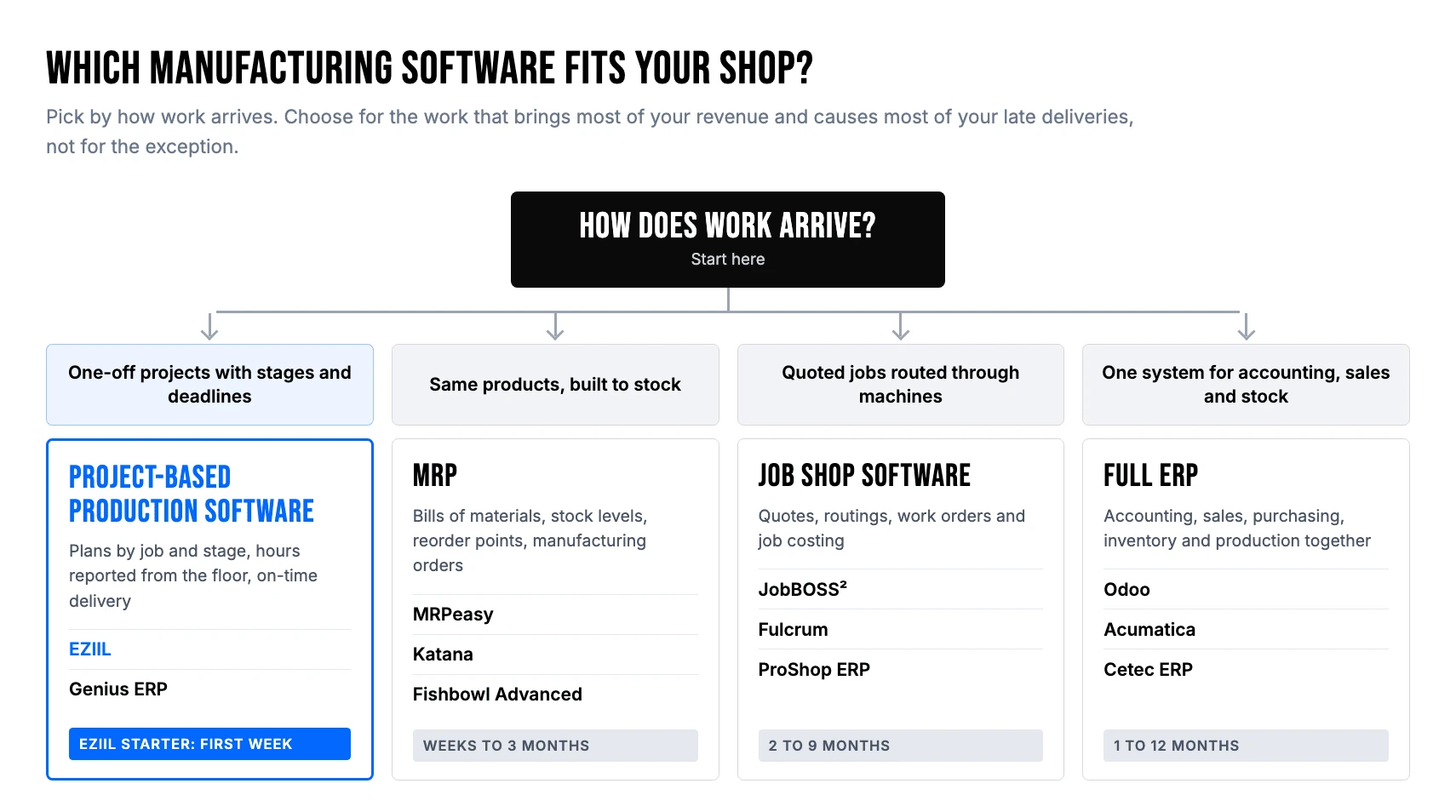
Most shops are a mix. A fabricator might run a small repeat product line next to custom projects, and a machine shop might carry some stock. Choose for the work that makes most of your revenue and causes most of your late deliveries, not for the exception.
You have probably outgrown spreadsheets if any of these sound familiar:
- The schedule lives in one person’s head or one weekly Excel Gantt, and nobody else can update it.
- Job status comes from walking the floor or asking on the phone.
- Hours come from weekly timesheets or a paper production log, so you find out a job lost money after it ships.
- Information sits in spreadsheets, email and memory, and it gets lost when someone is on holiday.
- You promise delivery dates without knowing what else is booked into the same weeks.
How we evaluated these tools
We compared each tool on the same six points, in the same order, so you can scan them side by side:
- Starting price and pricing model: per user, flat or quote only, and any implementation fee.
- Team size it suits: the company size the vendor or independent sources name.
- Deployment: cloud, on-premise or both.
- Typical go-live: how long implementations take, where a source states it.
- Shop floor reporting: whether workers can report work from a phone, tablet or terminal.
- Accounting: built in, integrated, or kept in a separate package.
We also looked at how much data each tool needs before day one and at which kind of shop it was built for.
This is desk research. We used public pricing pages, independent review and comparison sites (ERP Research, SoftwareConnect, Software Finder, SelectHub, Software Advice, Top10ERP) and vendor documentation, checked in November 2026. We did not run hands-on trials of other vendors’ software, and no vendor paid to be included. Prices change often, so confirm them with each vendor before you buy.
Best manufacturing software for project-based and custom manufacturers
When every job is different and runs in stages, each with its own deadline, you need software that plans by job and stage and shows live progress from the floor. Stock reorder points and product catalogs matter much less here. We start with this group because most generic roundups skip it: most manufacturing software is built around repeat products.
1. EZIIL: best for project-based custom manufacturers with 10 to 150 people
EZIIL is cloud production management software for project-based and custom manufacturers, priced flat by team size and built for metal and steel fabrication.
Best for: custom manufacturers, especially metal and steel fabricators, with 10 to 150 people, running many one-off projects at once and promising delivery dates they need to keep.
Not for: make-to-stock manufacturers, or businesses that want accounting, sales and stock in one system.
| Starting price | $140 a month (€120) for 1 to 15 users; $210 (€180) for 16 to 50; $338 (€290) for 51 to 150. One-off onboarding fee $350 (€300). Flat by team size, no per-user fees (EZIIL pricing) |
|---|---|
| Team size | 10 to 150 people |
| Deployment | Cloud; runs on Windows, Mac, Linux, iOS and Android, with apps on the App Store and Google Play |
| Go-live | Starter running in the first week, then modules one at a time |
| Shop floor | Workers start, pause and finish work on a phone, tablet or shared computer; hours are confirmed next morning and exported for payroll |
| Accounting | Keeps your accounting package. Xero, QuickBooks, Microsoft Dynamics and Merit integrations run at customers today, through the invoicing and accounting integrations module |
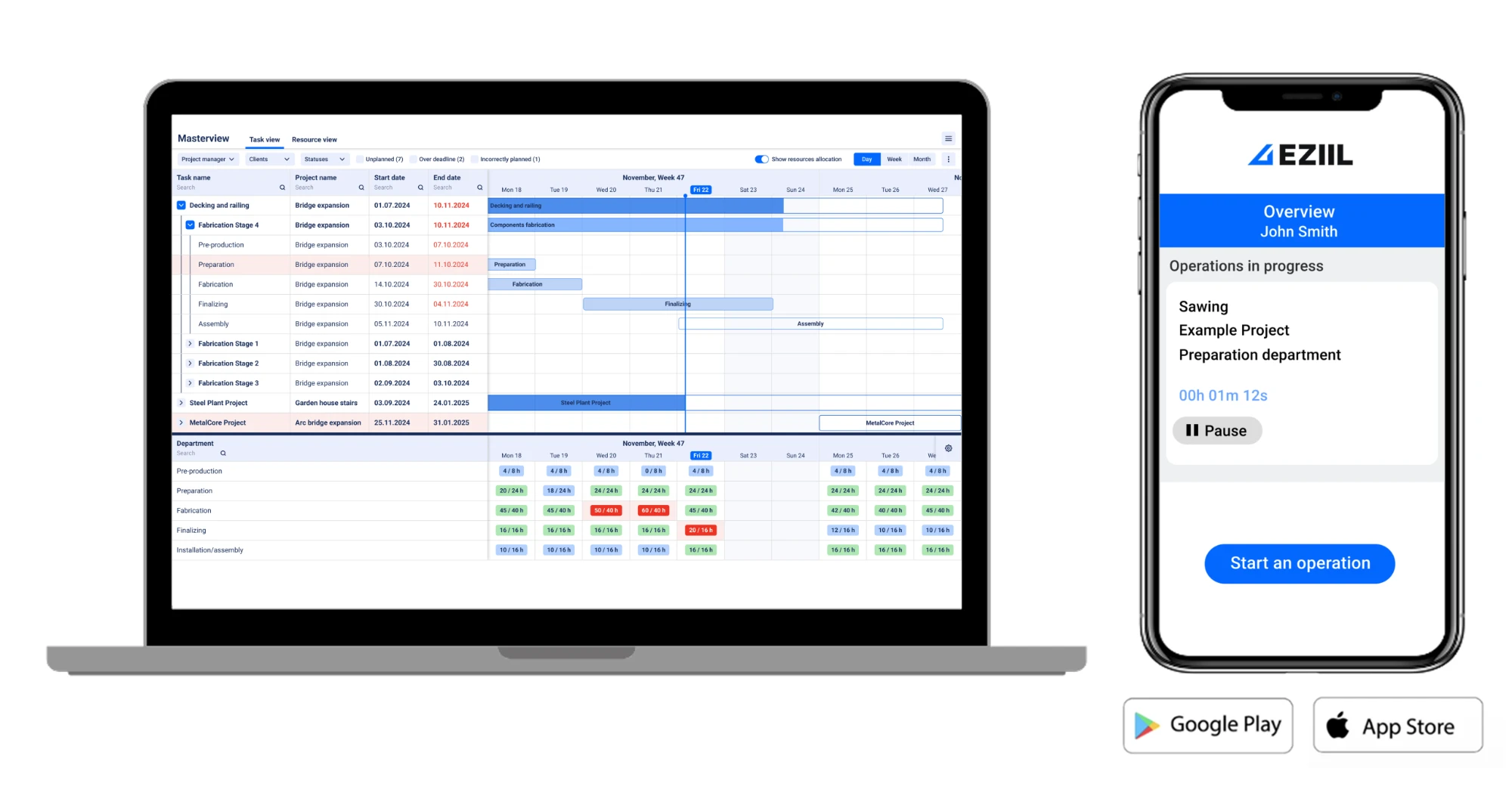
How it works. Each customer order is a project, split into stages. Every stage carries its own due date, status, sale price and document folder, so a project with three deliveries has three stages with three deadlines. Operations get budget hours, and EZIIL fits their dates around the work already booked, by department capacity, in a week or month Gantt view. You can look at the plan by project or by resource.
On the floor, workers pick the project and operation on their phone or a shared tablet and report when they start, pause and finish. Several people can report on the same job. The next morning, one person in the office reviews and confirms the hours, and confirmed hours drive progress against the budget and the payroll export. The start screen shows upcoming and overdue due dates, on-time delivery, project completion and revenue from project values, all from data you already enter.
Pricing for a 20-person team. Because the price is flat by team size, a 20-person shop where 15 people report from the floor pays the same $210 a month as one where only 5 people use the system. In a shop, floor workers who only report time are the users that per-user pricing charges you for most. Starter includes planning, the start screen dashboard and mobile reporting. Modules such as the bill of materials, procurement, inventory, subcontracting and EN 1090-2 compliance are added when you need them and priced on request.
What customers say. “Packing used to be a five-hour job. Today I can probably get the same five hours of work done in twenty minutes.” (Elari, Project Manager and Planner, B&W Metall, a 76-person structural steel fabricator). “The admin work has reduced dramatically, I now have the flexibility to focus on procurement at the best price, and on time delivery.” (Lynn Smith, Purchasing Manager, FLI Structures).
Where it falls short. EZIIL doesn’t model make-to-stock production as its own object, so a shop that mostly builds to stock is better off with an MRP from the make-to-stock group below. Quoting is limited, and most customers keep quoting in their estimating tool or spreadsheet. EZIIL keeps your accounting package rather than replacing it. There is no self-serve free trial; you can take a free product tour instead. And in the base product, workers see their reporting screen on the phone, not the whole plan.
More detail: fabrication shop management software and job tracking software.
2. Genius ERP: best for engineer-to-order manufacturers that design in CAD
Best for: engineer-to-order and custom machinery or fabrication shops in North America that build to customer specs and design in CAD.
Not for: make-to-stock shops, or small teams that want a light start.
| Starting price | Quote only. ERP Research estimates $80 to $175 per user a month |
|---|---|
| Implementation | $20,000 to $200,000, with support about 18% of the license (ERP Research) |
| Team size | Custom and ETO manufacturers; no published range |
| Deployment | Hosted cloud or on-premise |
| Go-live | 3 to 6 months |
| Shop floor | ShopFloor module: operators start and stop jobs by barcode, mobile or touchscreen |
| Accounting | Built in |

What stands out. Genius ERP connects CAD, the bill of materials, production and costing for engineer-to-order work, which few small-business ERPs do.
Where it falls short. It is a full ERP project, with implementation costs to match. ERP Research also notes it is a smaller vendor with limited presence outside North America.
More detail: Genius ERP vs EZIIL.
Best manufacturing software for make-to-stock and simple assembly
If you make the same products again and again and need stock levels, reorder points and manufacturing orders, start with an MRP. Most searches for “MRP software for small business” end up here. These tools are cheap, quick to try and built around inventory.
3. MRPeasy: best low-cost MRP for small product manufacturers
Best for: manufacturers with roughly 10 to 100 people that build repeat products in batches and want real MRP and costing at a low, published price.
Not for: shops where every job is a one-off project with its own stages.
| Starting price | $49 per user a month (Starter); Professional $69, Enterprise $99, Unlimited $149. After 10 users, extra users come in bundles of 10 for $79 a month (ERP Research) |
|---|---|
| Team size | About 10 to 200 employees |
| Deployment | Cloud |
| Go-live | 1 to 3 months (ERP Research) |
| Shop floor | Shop floor reporting screen plus iOS and Android apps; each worker who reports needs a user seat |
| Accounting | Built-in accounting module, plus QuickBooks Online and Xero integrations |
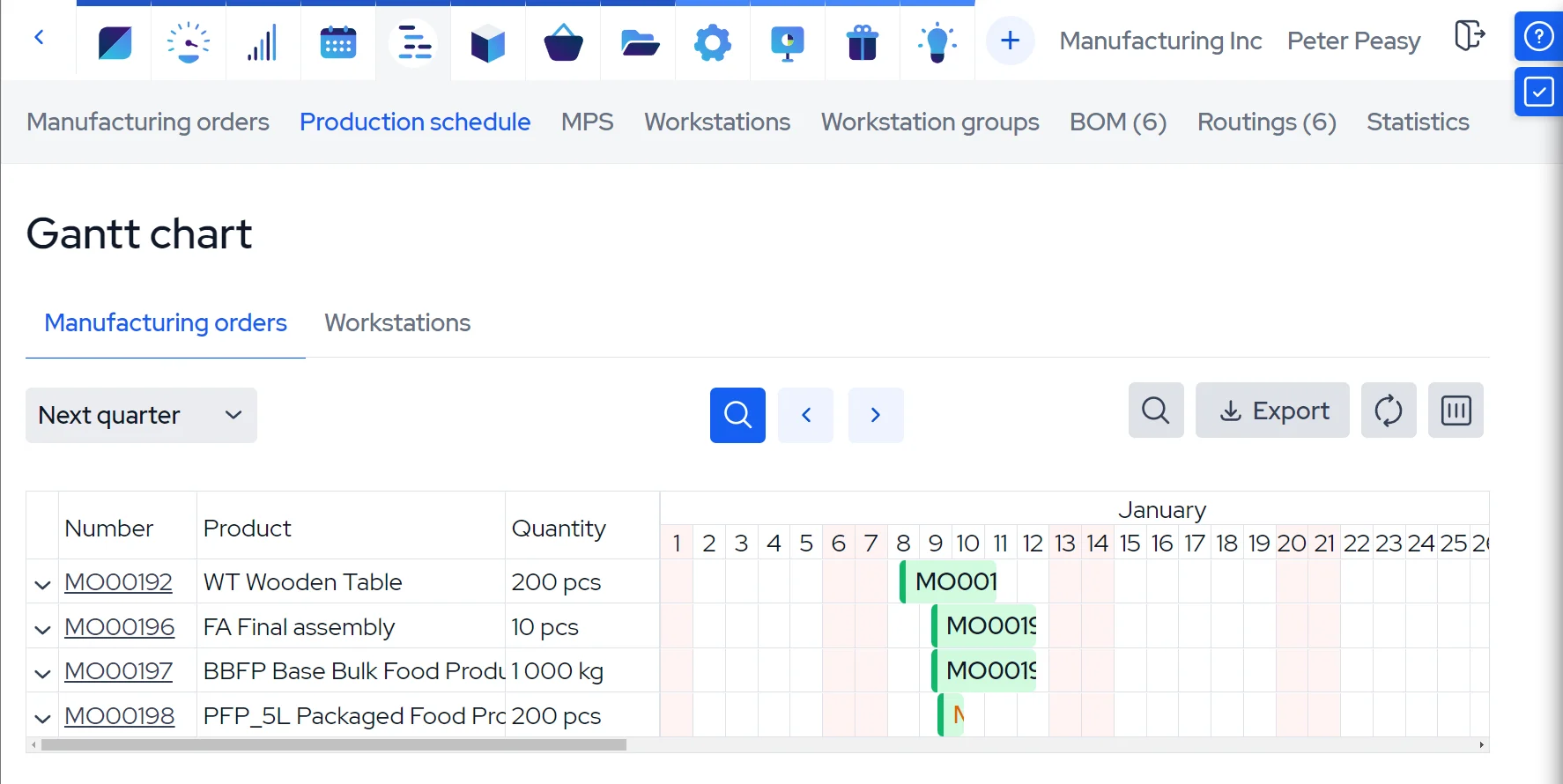
What stands out. MRPeasy publishes its prices, offers a free trial and doesn’t require a paid implementation package, per its pricing page in November 2026. For a small product manufacturer that wants stock, purchasing, manufacturing orders and costing in one cloud tool, it is the cheapest serious option on this list.
Where it falls short. It is built around products and manufacturing orders, not projects. If every job is different, you end up creating new products for each order. Onboarding is light unless you pay for support (optional plans run $199 to $499 a month, per MRPeasy’s pricing page).
More detail: MRPeasy alternatives for custom fabricators.
4. Katana: best for product brands that sell online
Best for: small make-to-stock brands (food, apparel, cosmetics, furniture) that sell through Shopify or similar channels.
Not for: custom or project work.
| Starting price | Free plan for up to 30 SKUs. The paid Advantage plan is priced by quote on an annual contract with unlimited users, per Katana’s pricing page in November 2026 |
|---|---|
| Team size | Small product makers in food, apparel, cosmetics and furniture (SelectHub) |
| Deployment | Cloud |
| Go-live | “Ready in weeks” for Advantage setups, per Katana |
| Shop floor | Shop Floor app for phone or tablet, included in the price |
| Accounting | QuickBooks Online and Xero integrations |
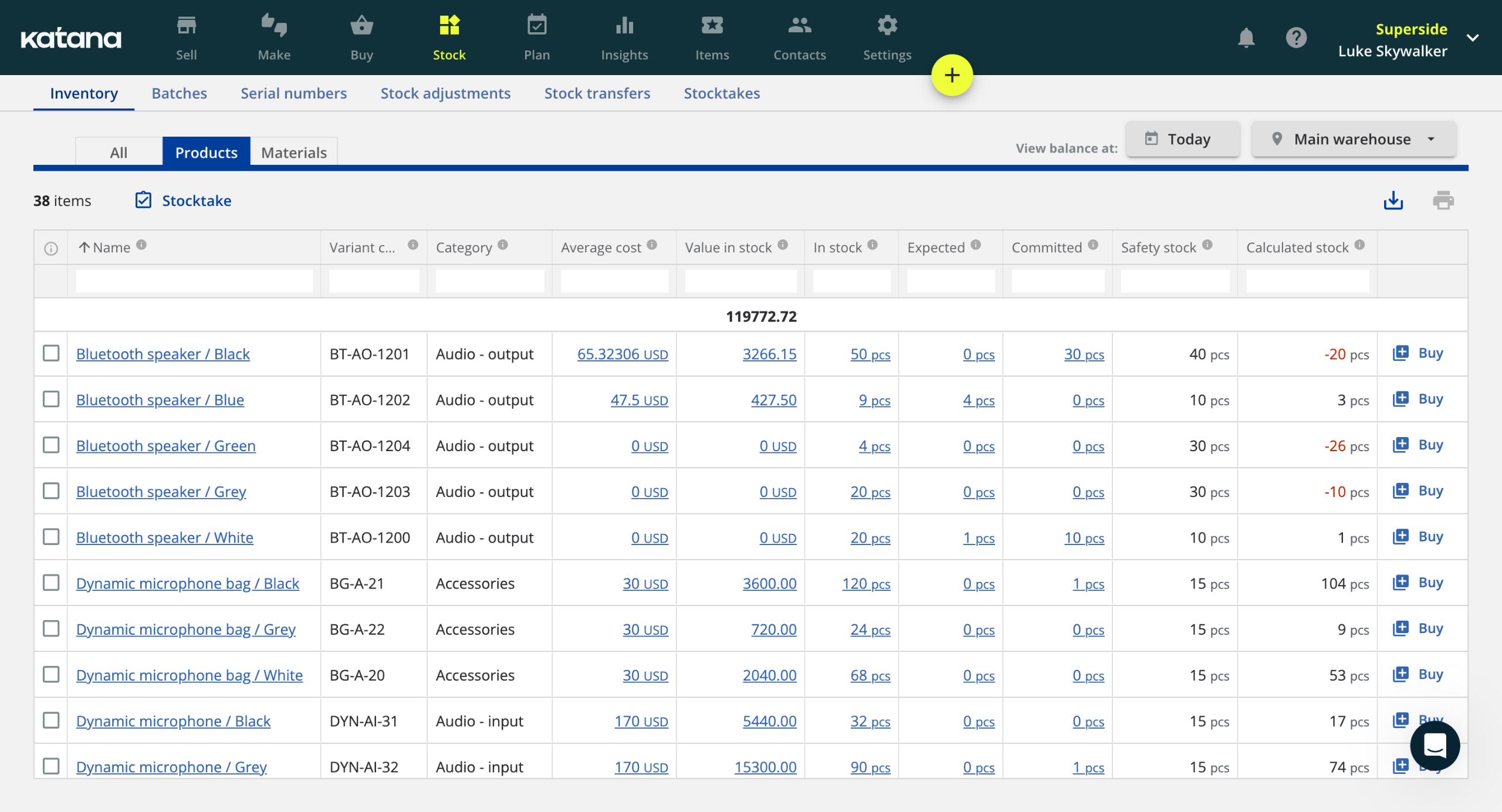
What stands out. Katana is easy to start with and connects well with e-commerce stores, so stock and sales orders stay in step.
Where it falls short. It is product and SKU driven, so one-off jobs don’t fit well. Paid pricing is now quote only. Some third-party sites still list a $299 a month plan that no longer appears on Katana’s own page, so ask for a written quote.
More detail: Katana alternative for custom fabricators.
5. Fishbowl Advanced: best if you want to keep QuickBooks
Best for: small manufacturers already on QuickBooks that build repeat products from inventory and want BOMs, MRP and work orders on top.
Not for: shops that want to avoid a formal implementation project.
| Starting price | Advanced Manufacturing from $675 a month, quoted by users and deployment (PricingSaaS) |
|---|---|
| Team size | 2 to 200+ users |
| Deployment | Cloud hosting included on Advanced plans, with other deployment options |
| Go-live | An implementation package is part of every purchase, including a 6 to 8 week training certification, per Fishbowl’s pricing page |
| Shop floor | Mobile barcode scanning; time by job comes from Fishbowl Time, a separate product |
| Accounting | No built-in general ledger; deep QuickBooks Online, Desktop and Enterprise integration |
What stands out. If QuickBooks runs your books and you don’t want to move them, Fishbowl adds manufacturing and inventory without replacing your accounting.
Where it falls short. It is inventory first. Job and labor costing sit in the Advanced plan, and the implementation package is mandatory but its price isn’t published. Third-party sources also disagree on whether the $675 starting price is per user or flat, so check that in your quote.
Best manufacturing software for job shops and machine shops
Job shops quote work, route it through machines and work centers, and live or die on the accuracy of the quote and the routing. The tools in this group are built around quotes, routings and work orders, and most are sold in the US.
6. JobBOSS²: best-known US job shop ERP
Best for: US job shops and machine shops that quote and track many small custom orders.
Not for: buyers who want a modern interface and a quick, light rollout.
| Starting price | Quote only. ERP Research estimates an entry platform fee of about $3,000 a year, with totals from $3,000 to $30,000 a year |
|---|---|
| Implementation | $5,000 to $40,000, quoted separately (ERP Research) |
| Team size | Small and mid-sized make-to-order job shops |
| Deployment | Cloud or on-premise |
| Go-live | 2 to 5 months |
| Shop floor | Shop floor data collection terminals and a mobile time app |
| Accounting | Built-in accounting, plus QuickBooks integration |
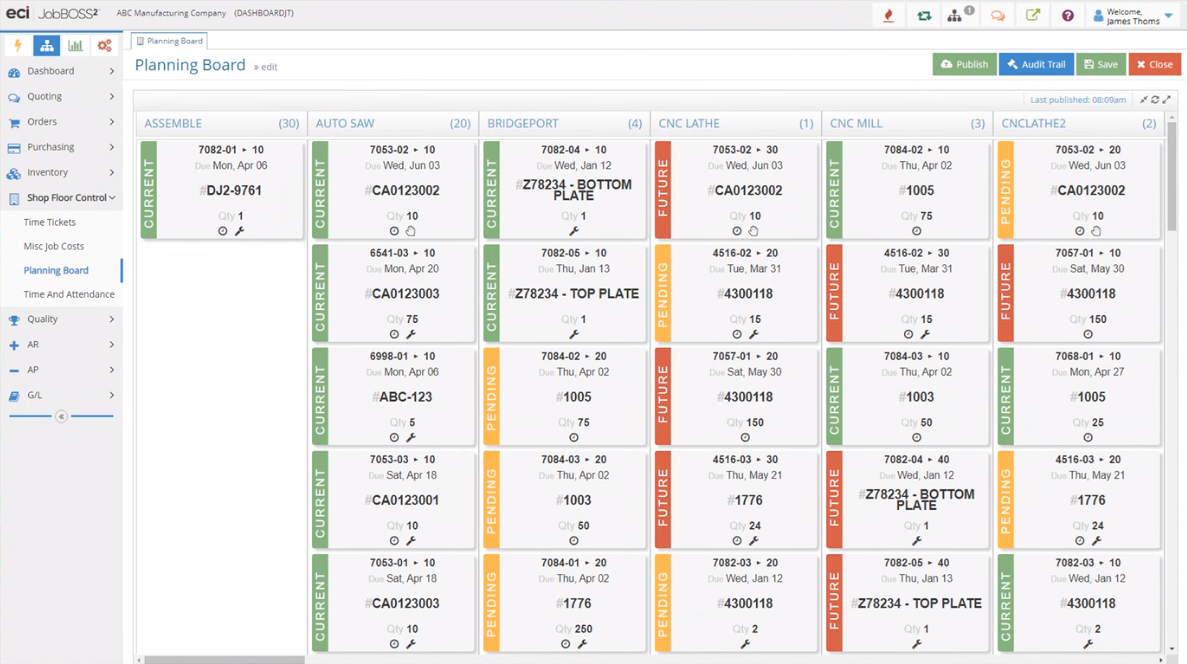
What stands out. JobBOSS² is the job shop ERP many US shop owners already know: quoting, routings, scheduling and job costing in one system.
Where it falls short. ERP Research notes that the interface and reporting “feel dated against cloud-native competitors”, and custom reports often need a consultant. Implementation is a real project.
More detail: JobBOSS² pricing, pros and cons.
7. Fulcrum: best modern cloud option for high-mix job shops
Best for: US CNC and sheet metal job shops that want live shop floor tracking and scheduling in one modern cloud tool.
Not for: shops outside the US or buyers who want a published price.
| Starting price | Quote only (Software Advice). SelectHub estimates from about $800 a month (SelectHub) |
|---|---|
| Pricing model | Historically revenue based, with unlimited users |
| Team size | Small to mid-sized US manufacturers and job shops (The CFO Club) |
| Deployment | Cloud |
| Go-live | Not published |
| Shop floor | Operators start labor and machine timers per operation from a browser on a tablet or terminal |
| Accounting | No built-in general ledger; QuickBooks integration |
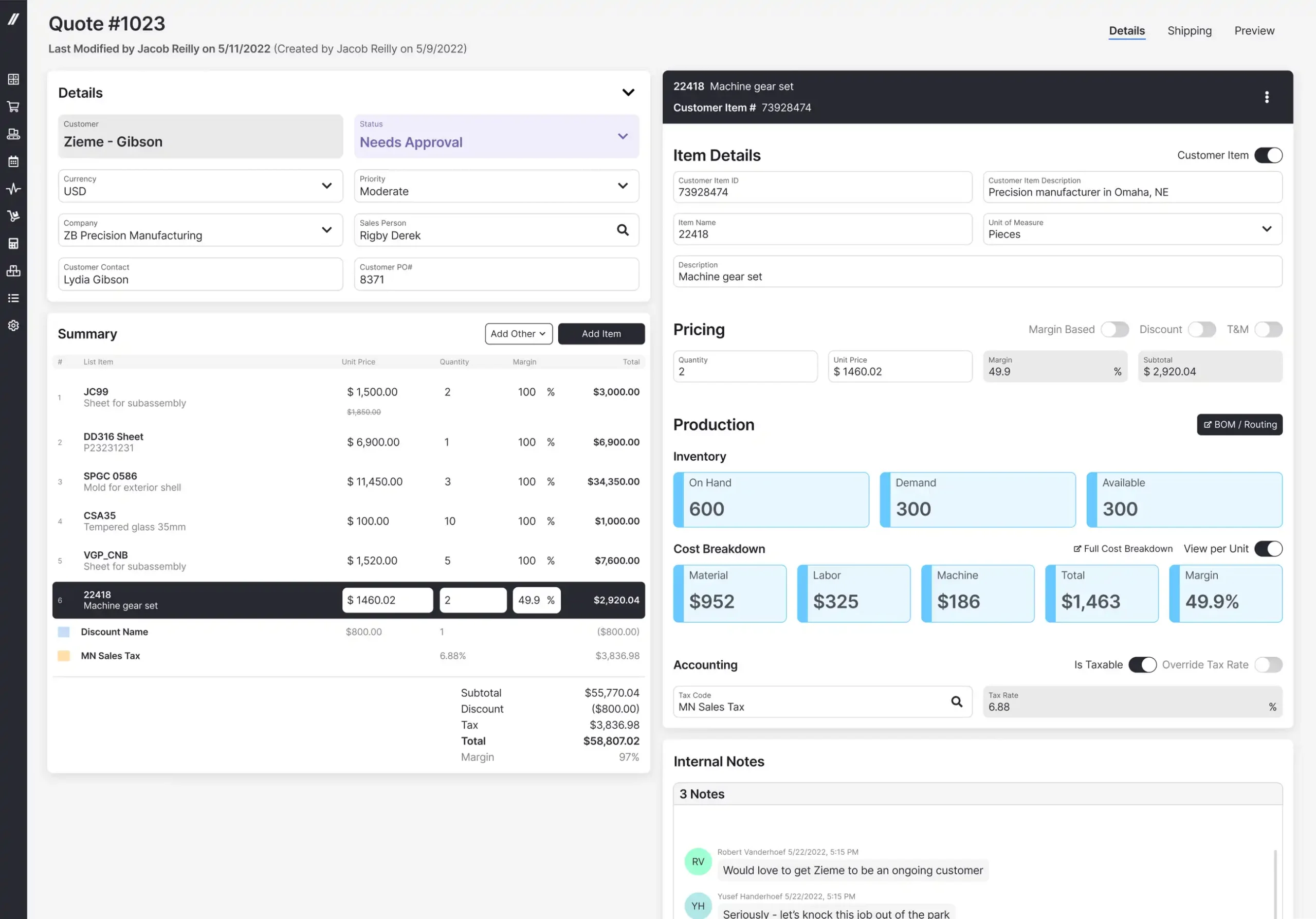
What stands out. Fulcrum feels like modern software: automated scheduling, live estimate against actual, and no per-user fees, so the whole floor can report.
Where it falls short. There is no public price, and pricing tied to revenue grows as your turnover grows. It is built for the US market.
More detail: Fulcrum vs EZIIL.
8. ProShop ERP: best for machine shops that need quality built in
Best for: CNC and precision machine shops (aerospace, defense, medical) that need ERP, quality management for AS9100 or ISO 9001 and shop floor tracking in one system.
Not for: small shops that want to start light.
| Starting price | Quote only. Software Finder estimates $500 to $715 a month for 5 to 10 users and $800 to $1,800 a month for 10 to 30 users, on a 12-month minimum (Software Finder) |
|---|---|
| Implementation | Software Finder’s general estimate: $20,000 to $150,000+ |
| Team size | CNC machine shops and precision manufacturers |
| Deployment | Web based, cloud or local install |
| Go-live | 3 to 9 months (estimate) |
| Shop floor | Operators clock on operations in the browser on shop floor stations or tablets |
| Accounting | Not confirmed in our research; ask the vendor |

What stands out. ProShop keeps quality records, documents and shop floor data in one system, which matters when audits decide whether you keep a customer.
Where it falls short. Setup is heavy: templates, routings and quality documents all have to be built before the system pays back, and the price isn’t published.
More detail: ProShop ERP alternative.
Best full ERP for small manufacturers
Choose a full ERP when you need one system for accounting, sales, purchasing, inventory and production, often across more than one site, and you have the budget and a partner for a rollout of several months. Searches for “manufacturing ERP for small business” usually want this group.
9. Odoo: best low-cost all-in-one suite, if you have a good partner
Best for: small firms that want one low-cost suite for sales, inventory, manufacturing and accounting and have a good implementation partner.
Not for: shops that want it working without outside help.
| Starting price | About $25 to $31 per user a month for Standard (all apps), per ERP Research, July 2026. Odoo prices by country, so check your local price list |
|---|---|
| Implementation | Through partners: ERP Research puts typical 10 to 30 user rollouts at $20,000 to $75,000 |
| Team size | From 1 to 5,000+ users; small and mid-sized firms are the core |
| Deployment | Cloud, Odoo.sh or on-premise; a free open-source Community edition can be self-hosted |
| Go-live | 1 to 4 months |
| Shop floor | Shop Floor tablet interface with operator PIN login, in the paid Enterprise edition only |
| Accounting | Built in |
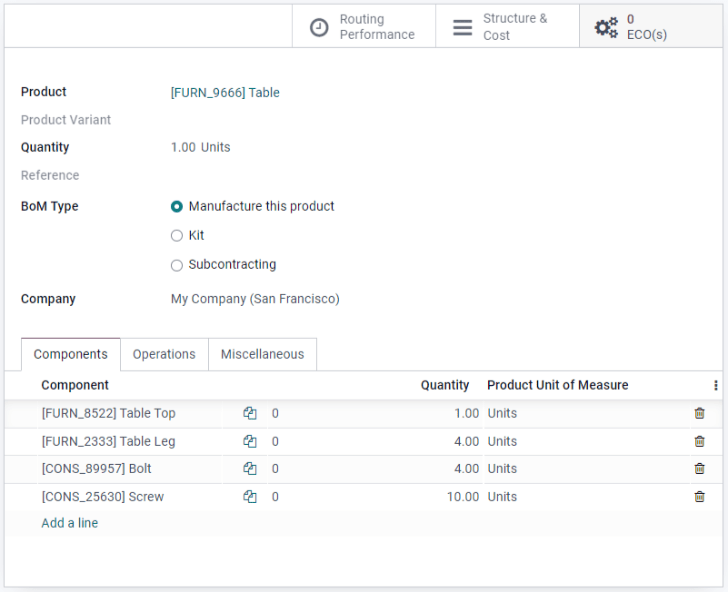
What stands out. For the license price, nothing else here covers as much: sales, inventory, manufacturing and accounting in one system.
Where it falls short. The real cost is the partner who sets it up. ERP Research notes that “complex manufacturing and quality may need customisation”, and the shop floor tablet screen isn’t in the free edition.
10. Acumatica Manufacturing Edition: best for growing manufacturers that want unlimited users
Best for: growing manufacturers at the larger end of the 10 to 150 range that want a full cloud ERP without per-user fees.
Not for: budgets under about $20,000 a year.
| Starting price | Quote only. ERP Research says plans typically start at $1,800 to $2,500 a month (ERP Research); SoftwareConnect puts small businesses at about $21,000 to $34,000 a year |
|---|---|
| Pricing model | Based on resources used, not users; unlimited users; sold through partners |
| Team size | 10 to 200 employees, per SoftwareConnect |
| Deployment | Cloud, on-premise or hybrid |
| Go-live | 3 to 12 months for manufacturers |
| Shop floor | Manufacturing Data Collection on phones, tablets or shared terminals with barcode scanners |
| Accounting | Built in; financials are its core |
What stands out. Acumatica gives you a full cloud ERP where adding floor users doesn’t add license cost.
Where it falls short. It has the highest entry cost on this list, the rollout is partner-led and takes months, and SoftwareConnect notes a steep learning curve and tedious setup.
11. Cetec ERP: best full ERP with a published per-user price
Best for: small US manufacturers (electronics, assembly, machine shops) that want a full ERP with a price they can see before the first call.
Not for: buyers who want a modern interface or support included.
| Starting price | $50 per user a month with a 5-user minimum; shop floor users $25 a month (Top10ERP) |
|---|---|
| Support | Self-supported at no charge, or $650 or $3,200 a month for paid plans, per Cetec’s pricing page |
| Team size | Small and mid-sized US manufacturers |
| Deployment | Cloud, with hosting included |
| Go-live | 30 to 60 days after 1 to 2 months of preparation |
| Shop floor | Start and stop work by barcode scan or manual entry |
| Accounting | Built-in general ledger, payables and receivables; QuickBooks Online integration for $300 a month |

What stands out. Cetec ERP is one of very few full ERPs that publishes its price, and its cheaper shop floor seats soften the cost of putting the whole floor on the system.
Where it falls short. The interface feels dated, and paid support and add-ons raise the real cost quickly.
More detail: Cetec ERP vs EZIIL.
Small business manufacturing software comparison table (2026)
All 11 tools on the same six points. Prices checked in November 2026.
Scroll sideways to see all columns. The tool column stays in place.
| Tool | Starting price | Pricing model | Deployment | Go-live | Shop floor reporting | Accounting |
|---|---|---|---|---|---|---|
| EZIIL | Starting price$140/mo (1 to 15 users) | Pricing modelFlat by team size | DeploymentCloud | Go-liveStarter in the first week | Shop floor reportingYes, phone, tablet or shared PC | AccountingKeeps yours; Xero, QuickBooks, Dynamics (module) |
| Genius ERP | Starting priceQuote (est. $80 to $175/user/mo) | Pricing modelPer user | DeploymentCloud or on-prem | Go-live3 to 6 months | Shop floor reportingYes, barcode, mobile, touchscreen | AccountingBuilt in |
| MRPeasy | Starting price$49/user/mo | Pricing modelPer user, then $79 per 10 extra users | DeploymentCloud | Go-live1 to 3 months | Shop floor reportingYes, app (seat per worker) | AccountingBuilt in + QuickBooks, Xero |
| Katana | Starting priceFree plan; paid by quote | Pricing modelAnnual contract, unlimited users | DeploymentCloud | Go-liveWeeks (vendor) | Shop floor reportingYes, Shop Floor app | AccountingQuickBooks, Xero |
| Fishbowl Advanced | Starting priceFrom $675/mo | Pricing modelQuote, by users and deployment | DeploymentCloud hosted | Go-live6 to 8 week training | Shop floor reportingBarcode; time via separate app | AccountingQuickBooks |
| JobBOSS² | Starting priceQuote (est. from $3,000/yr) | Pricing modelQuote | DeploymentCloud or on-prem | Go-live2 to 5 months | Shop floor reportingTerminals + mobile time app | AccountingBuilt in + QuickBooks |
| Fulcrum | Starting priceQuote (est. from $800/mo) | Pricing modelRevenue based, unlimited users | DeploymentCloud | Go-liveNot published | Shop floor reportingYes, timers per operation | AccountingQuickBooks |
| ProShop ERP | Starting priceQuote (est. $500 to $715/mo, 5 to 10 users) | Pricing modelPer user, 12-month minimum | DeploymentCloud or local | Go-live3 to 9 months | Shop floor reportingYes, browser on the floor | AccountingNot confirmed |
| Odoo | Starting priceAbout $25 to $31/user/mo (ERP Research) | Pricing modelPer user | DeploymentCloud or on-prem | Go-live1 to 4 months | Shop floor reportingYes, Enterprise only | AccountingBuilt in |
| Acumatica Mfg Edition | Starting priceQuote (est. $1,800 to $2,500/mo) | Pricing modelBy resources, unlimited users | DeploymentCloud, on-prem, hybrid | Go-live3 to 12 months | Shop floor reportingYes, data collection app | AccountingBuilt in |
| Cetec ERP | Starting price$50/user/mo, 5-user minimum | Pricing modelPer user; floor users $25 | DeploymentCloud | Go-live30 to 60 days after prep | Shop floor reportingYes, barcode or manual | AccountingBuilt in + QuickBooks Online |
Prices checked November 2026.
How much does manufacturing software cost a 20-person shop in year one?
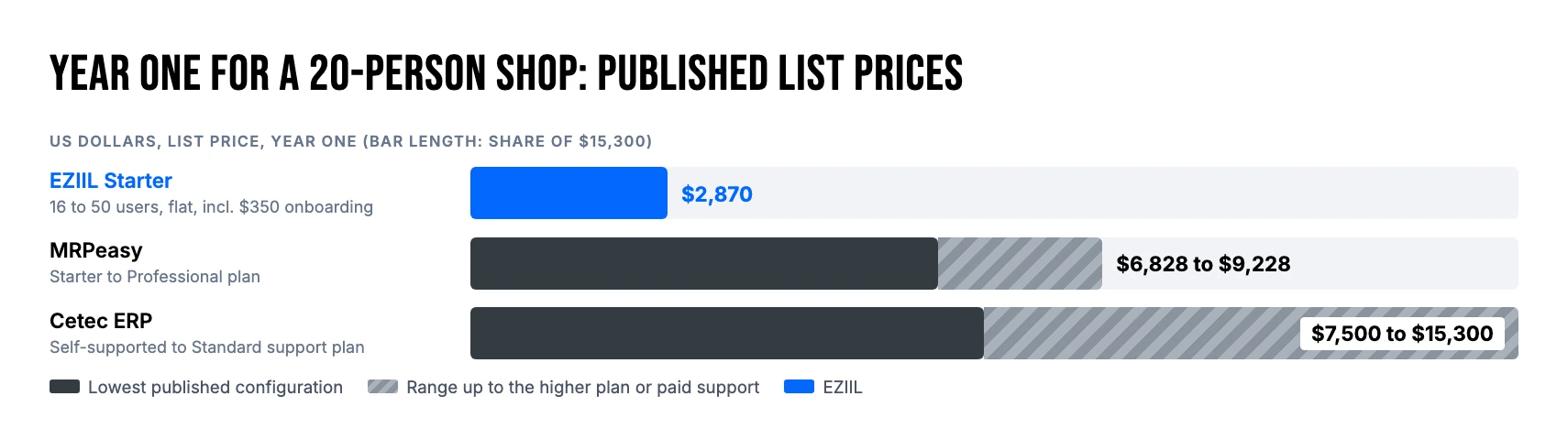
For a 20-person shop, published prices put year one at about $2,900 for flat-priced production software, about $6,800 to $9,200 for a per-user MRP and about $7,500 to $15,300 for a full ERP with a published price, before any implementation work. What decides the bill is usually not the headline price but who counts as a user and what implementation costs.
Our example shop has 20 people: 5 in the office and 15 on the floor who report their time. The first table uses only prices the vendor publishes.
| Tool | How we calculated it | Year-one list price |
|---|---|---|
| EZIIL Starter | How we calculated it$210 × 12 (16 to 50 users) + $350 onboarding. Add-on modules are priced on request and not included | Year-one list price$2,870 (€2,460) |
| MRPeasy Starter to Professional | How we calculated it(10 users × $49 or $69 + $79 for users 11 to 20) × 12; check which plan has the features you need | Year-one list price$6,828 to $9,228 |
| Cetec ERP | How we calculated it(5 × $50 + 15 × $25) × 12, self-supported; with the $650 Standard support plan | Year-one list price$7,500; $15,300 with support |
List prices, November 2026. 20 people: 5 office, 15 floor. Implementation excluded unless listed.
For the quote-only tools, these are the independent estimates we found. None of them are list prices:
- JobBOSS²: $3,000 to $30,000 a year, plus $5,000 to $40,000 implementation (ERP Research).
- Fulcrum: from about $800 a month (SelectHub).
- ProShop ERP: $800 to $1,800 a month for 10 to 30 users, plus $20,000 to $150,000+ implementation (Software Finder).
- Genius ERP: $80 to $175 per user a month, plus $20,000 to $200,000 implementation (ERP Research).
- Odoo: about $6,000 to $7,500 a year in licenses if all 20 people need a user seat, plus $20,000 to $75,000 for a typical partner rollout (ERP Research).
- Acumatica: about $21,000 to $34,000 a year for a small business (SoftwareConnect), plus partner implementation.
- Fishbowl Advanced: from $675 a month plus a mandatory implementation package with no published price.
- Katana: free for up to 30 SKUs; paid plans by quote.
Check two things in every quote. First, ask whether floor workers who only report time need a full user seat. In a 20-person shop that’s the difference between paying for 5 users and paying for 20. Second, ask what year one costs with implementation, training and support included, not just the monthly license. The license is often the smaller part.
Do small manufacturers need an ERP?
Most small manufacturers under about 50 people don’t need a full ERP to fix scheduling, job visibility and late deliveries. Production or MRP software plus the accounting package you already use usually covers it. An ERP makes sense when you need one system for accounting, sales, purchasing and stock, or you run several sites.
The cost of getting this wrong is high in both directions. A full ERP for a 20-person shop often means months of setup and five-figure implementation fees before the floor reports a single hour. Small-shop rollouts most often fail because there’s too much to enter before anything works, or because the one person running the setup leaves. On the other hand, a shop that does need integrated accounting and stock will outgrow a production tool and end up entering everything twice.
A middle path many shops take: keep the accounting package, add production software for planning and the floor, and connect the two. You can move to an ERP later if the business needs it, with clean job data already in hand.
For the longer answer, read does a small shop really need an ERP? and our guide to ERP implementation cost and timelines in a small fab shop.
How to choose manufacturing software: 6 questions to ask in the demo
Most buying decisions get made in the demo. These six questions come up again and again in our calls with small manufacturers, and the answers usually show whether a tool will get used after go-live.
- How much do we have to enter before day one, and who loads our data? If the answer is “all your products, routings and stock”, ask how long that took for a shop your size, and who does it.
- Who counts as a user? Ask whether workers who only report time on the floor cost the same as office users.
- What do workers see on the floor? Ask to see the phone or tablet screen a welder or machinist would use, not just the office view.
- Does it work with our accounting package, or replace it? Know whether you’re buying a production tool or moving your books.
- Can we start with one part and add the rest later? A phased start, planning and floor reporting first, is how most successful small-shop rollouts begin.
- What does year one cost in total? License, implementation, training, support and any per-module fees, in writing.
If you’re comparing tools for a specific job, our other guides go deeper: production scheduling software, BOM software, job costing software and, for metal shops, metal fabrication software.
Tools we considered but left out
- NetSuite, Microsoft Dynamics 365 Business Central, SAP Business One and Epicor Kinetic: strong ERPs, but partner-led and usually priced and sized for companies above this guide’s range.
- Sage 100 with Production Management: a fit if you already run Sage, but it is mainly on-premise and sources disagree on how much of the manufacturing side is built in.
- DBA Manufacturing and SimpleManufacturing: low one-time prices, but we couldn’t find independent sources to confirm their deployment options and shop floor features.
Where EZIIL is not the right choice
We’d rather you pick the right tool than book a demo that doesn’t fit. EZIIL is the wrong choice if:
- You mostly build to stock. Repeat products, reorder points and finished-goods stock are what MRPeasy, Katana and Fishbowl are built for.
- You want accounting, sales and stock in one system. Look at Odoo, Acumatica or Cetec ERP instead.
- Quoting is your biggest problem. EZIIL’s quoting is limited, so a dedicated estimating tool will serve you better.
- You need a self-serve trial before talking to anyone. EZIIL offers a free product tour and a guided setup, not an open trial.
To sum it up
The right manufacturing software for a small business follows how your work arrives: project-based production software for one-off jobs, an MRP for stock, job shop software for quoted machine work, and a full ERP when you need one system for everything. Before you compare headline prices, count who will actually use the system and what year one costs in total.
If your shop runs custom projects with stages and deadlines, take a free product tour of EZIIL to see the planning and floor reporting with sample data, or book a 30-minute demo with the EZIIL team.
Frequently asked questions
What is the best manufacturing software for a small business?
It depends on how your work arrives. EZIIL is built for project-based custom manufacturers, especially metal fabricators. MRPeasy is a strong low-cost pick for small make-to-stock manufacturers, JobBOSS² and Fulcrum lead for job shops, and Acumatica, Odoo and Cetec ERP suit shops that want a full ERP.
What is the best MRP software for a small business?
MRPeasy is the most common pick, at $49 to $149 per user a month with built-in accounting and a shop floor app. Katana suits small brands that sell online, with a free plan for up to 30 SKUs, and Fishbowl Advanced suits shops that want to keep QuickBooks.
What is the cheapest ERP for a small manufacturer?
Among full ERPs with published prices, Cetec ERP starts at $50 per user a month with a 5-user minimum, and Odoo’s Standard plan is about $25 to $31 per user a month, per ERP Research (Odoo prices vary by country). Implementation, support and partner fees often cost more than the license in year one.
What is the difference between ERP and MRP for a small manufacturer?
MRP plans materials and production: bills of materials, stock levels, reorder points and manufacturing orders. ERP covers the whole business, including accounting, sales and purchasing, with production as one part. Many small manufacturers start with MRP or production software and keep their existing accounting package.
Do small manufacturers need an ERP?
Most manufacturers under about 50 people don’t need a full ERP to fix scheduling and job visibility. Production or MRP software plus an existing accounting package usually covers it. An ERP makes sense when you need one system for accounting, sales and stock, or you run several sites.
How long does it take to implement manufacturing software in a small shop?
It ranges from days to a year. EZIIL Starter runs in the first week, with modules added one at a time. MRPeasy typically takes 1 to 3 months, job shop ERPs such as JobBOSS² 2 to 5 months, and full ERPs such as Acumatica 3 to 12 months, per ERP Research.
Can I keep QuickBooks or Xero with manufacturing software?
Yes, with most tools on this list. MRPeasy and Katana integrate with QuickBooks Online and Xero, Fishbowl and Fulcrum integrate with QuickBooks, and EZIIL connects to Xero, QuickBooks and Microsoft Dynamics through its accounting integrations module. Full ERPs such as Odoo and Acumatica replace your accounting instead.
Is cloud or on-premise manufacturing software better for a small business?
Cloud is usually the better fit for a small business: no servers to run, updates included and access from the floor on phones and tablets. On-premise still makes sense if you have in-house IT or customer rules about where data is stored. Several tools here, such as JobBOSS², Odoo and Acumatica, offer both.
How much does manufacturing software cost per month?
For a 20-person shop, published prices run from $210 a month for EZIIL Starter (flat, 16 to 50 users) and about $570 to $770 a month for MRPeasy, to $625 a month or more for Cetec ERP. Quote-only ERPs often start around $1,800 a month, plus implementation.
What manufacturing software works for custom, one-off jobs?
Project-based production software works best for one-off jobs, because it plans each job in stages with its own deadlines instead of building from a product catalog. EZIIL is built for project-based custom manufacturers, especially metal fabricators, and Genius ERP covers engineer-to-order work at ERP scale.